IT Staff Augmentation vs Outsourcing for Enterprises
Compare IT staff augmentation vs outsourcing for enterprise companies. Learn the differences in cost, scalability, security, control, and ROI.
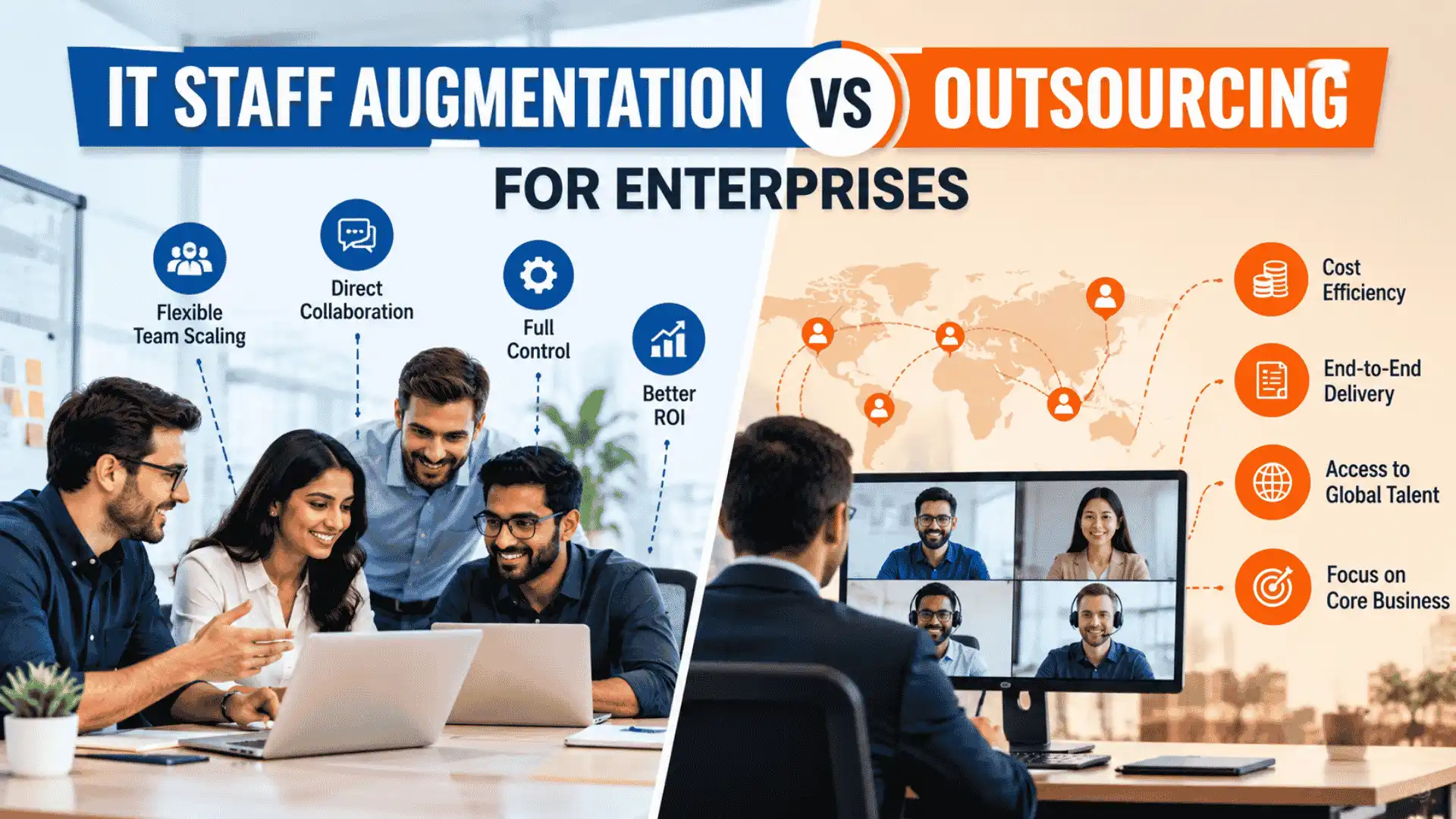
Choosing between IT staff augmentation and outsourcing is one of the biggest decisions enterprise companies make when expanding their software development capabilities. Both models provide access to experienced developers, architects, QA engineers, DevOps specialists, and AI professionals without hiring full-time employees. However, they differ significantly in terms of project ownership, flexibility, cost, scalability, and business control.
The wrong decision can increase project costs, delay product releases, and create communication challenges. The right engagement model helps enterprises accelerate development, maintain quality, and respond quickly to changing business priorities.
In this guide, we'll compare IT staff augmentation and outsourcing from an enterprise perspective, explain their advantages and limitations, and help you determine which model best aligns with your business goals.
What Is IT Staff Augmentation?
IT staff augmentation is a hiring model where external developers become an extension of your internal engineering team. Instead of outsourcing an entire project, companies hire experienced professionals through a staffing partner while retaining full control over project management, technical decisions, workflows, and delivery.
The staffing provider is responsible for recruiting, payroll, compliance, and talent replacement, while your internal team manages the day-to-day work.
Think of staff augmentation as expanding your existing engineering team without increasing permanent headcount.
Key Characteristics
- Developers work under your management.
- Your company owns the roadmap and priorities.
- Engineers use your tools and development process.
- Team size can increase or decrease as business needs change.
- Intellectual property remains within your organization.
Common Enterprise Use Cases
- Digital transformation projects
- Enterprise application modernization
- Cloud migration
- AI and machine learning development
- ERP implementation
- Product engineering
- DevOps transformation
- Cybersecurity initiatives
What Is IT Outsourcing?
IT outsourcing is a business model where an external company takes responsibility for delivering an entire project, application, or technology service.
Instead of managing individual developers, enterprises define project requirements, timelines, and expected outcomes. The outsourcing partner builds and manages the delivery team, supervises development, conducts quality assurance, and delivers the completed solution.
This model works best when project requirements are clearly defined and internal management resources are limited.
Key Characteristics
- Vendor manages the project.
- Vendor provides developers, QA, and project managers.
- Internal involvement is lower.
- Contracts often follow fixed-price or milestone-based pricing.
- Suitable for well-defined projects.
Common Enterprise Use Cases
- Mobile application development
- Website redesign
- Legacy application migration
- ERP implementation
- Infrastructure management
- Software maintenance
- Help desk operations
IT Staff Augmentation vs Outsourcing: The Core Difference
Many decision-makers compare pricing first.
That's a mistake.
The real difference is who owns delivery.
With staff augmentation, your engineering managers direct the work, assign priorities, review code, and control product decisions.
With outsourcing, the vendor manages the team and becomes responsible for delivering the agreed scope.
Everything else, including flexibility, communication, hiring speed, and project ownership, follows from this difference.
IT Staff Augmentation vs Outsourcing: Side-by-Side Comparison
| Feature | IT Staff Augmentation | IT Outsourcing |
|---|---|---|
| Team Management | Your company | Vendor |
| Project Ownership | Internal | External |
| Daily Communication | Direct with developers | Through project manager |
| Hiring Speed | Very Fast | Moderate |
| Team Flexibility | High | Limited by contract |
| Change Requests | Easy | Usually requires approval |
| Knowledge Retention | Internal | Vendor |
| Project Control | Full | Limited |
| Cost Model | Monthly / Hourly | Fixed Price / Milestones |
| Best For | Long-term products | Fixed-scope projects |
Enterprise Decision Matrix
Not every enterprise should choose the same engagement model.
The best option depends on your internal capabilities.
| If Your Business Needs... | Recommended Model |
|---|---|
| Build a SaaS platform | Staff Augmentation |
| Launch an MVP | Outsourcing |
| Extend an existing product team | Staff Augmentation |
| Modernize legacy software | Outsourcing |
| Add AI engineers quickly | Staff Augmentation |
| Reduce internal management | Outsourcing |
| Scale developers every quarter | Staff Augmentation |
| Complete a one-time migration | Outsourcing |
| Build long-term intellectual property | Staff Augmentation |
| Maintain multiple enterprise applications | Staff Augmentation |
Why Enterprises Are Choosing Staff Augmentation More Frequently
Enterprise software rarely follows a fixed roadmap.
Business priorities change.
Customer requirements evolve.
New compliance regulations appear.
Product teams adjust sprint priorities every week.
Because of this, many enterprise organizations prefer staff augmentation over outsourcing for ongoing product development. It allows them to add specialized talent without giving up technical leadership or product ownership. When requirements evolve frequently, augmentation also avoids the delays and contract changes that are common in project-based outsourcing.
Benefits of IT Staff Augmentation
1. Faster Hiring
Recruiting senior software engineers can take weeks or even months.
Staff augmentation partners maintain pre-vetted talent pools, allowing enterprises to onboard developers much faster than traditional hiring.
This speed is especially valuable during product launches, cloud migrations, and digital transformation initiatives.
2. Complete Project Control
Unlike outsourcing, augmented developers work under your engineering leadership.
Your team decides:
- Sprint planning
- Development priorities
- Architecture
- Technology stack
- Coding standards
- Release schedules
This control helps maintain product consistency and reduces communication gaps.
3. Easy Team Scalability
Enterprise workloads constantly change.
One quarter may require five developers.
The next may require twenty.
Staff augmentation allows organizations to scale engineering teams up or down without long recruitment cycles or permanent hiring commitments.
4. Better Knowledge Retention
When developers work inside your repositories, documentation systems, and engineering processes, business knowledge stays within your organization.
This reduces dependency on external vendors and simplifies future product development.
5. Improved Collaboration
Augmented developers participate in:
- Daily stand-ups
- Sprint planning
- Code reviews
- Architecture discussions
- Product meetings
They become part of your engineering culture instead of operating as a separate delivery team.
Benefits of IT Outsourcing
Outsourcing remains an excellent option in many situations.
Reduced Management Responsibility
The vendor manages developers, project timelines, quality assurance, and delivery.
Internal teams spend less time supervising day-to-day activities.
Access to Complete Delivery Teams
Instead of hiring developers individually, enterprises receive a complete delivery organization that may include:
- Project Manager
- Solution Architect
- UI/UX Designer
- Software Engineers
- QA Engineers
- DevOps Engineers
Predictable Budget
Fixed-price outsourcing contracts provide greater budget predictability when project scope is stable.
Faster Delivery for Well-Defined Projects
If requirements are unlikely to change, experienced outsourcing vendors can often deliver projects efficiently because they already have established development processes.
Which Model Offers Better Control?
This is one of the most important questions for enterprise leaders.
| Area | Staff Augmentation | Outsourcing |
|---|---|---|
| Product Roadmap | ✅ Full Control | Limited |
| Technology Stack | ✅ Internal Decision | Vendor Recommendation |
| Development Process | ✅ Internal | Vendor Process |
| Code Reviews | ✅ Internal | Vendor |
| Daily Priorities | ✅ Internal | Vendor |
| Sprint Planning | ✅ Internal | Vendor |
If maintaining product ownership is critical, staff augmentation generally provides the highest level of control.
Cost Comparison: Which Model Delivers Better ROI?
When evaluating IT Staff Augmentation and IT Outsourcing, many enterprise companies compare hourly rates first. While pricing is important, it represents only a small portion of the overall investment. The real value comes from delivery speed, engineering productivity, team flexibility, communication efficiency, and long-term business outcomes.
A software project that costs less today may become significantly more expensive if it experiences delays, change requests, or repeated onboarding. That's why successful enterprises evaluate the Total Cost of Ownership (TCO) instead of focusing only on developer rates.
The cheapest engagement model isn't always the most cost-effective. Long-term value matters more than short-term savings.
Learn more about our IT Staff Augmentation Services and how they help enterprises optimize development costs.
Direct Cost Comparison
| Cost Factor | IT Staff Augmentation | IT Outsourcing |
|---|---|---|
| Recruitment Cost | Low | Included in Vendor Pricing |
| Hiring Time | Fast | Moderate |
| Billing Model | Monthly | Fixed Project / Monthly |
| Team Scalability | Excellent | Contract Dependent |
| Change Request Cost | Low | Often Additional |
| Knowledge Retention | High | Medium |
| Long-Term ROI | Excellent | Moderate |
While outsourcing may appear attractive for short-term projects, Staff Augmentation generally delivers stronger long-term ROI for enterprise organizations building digital products over multiple years.
Looking Beyond Hourly Rates
Hourly pricing rarely reflects the complete cost of software development.
Enterprise projects involve architects, software engineers, DevOps specialists, QA engineers, security teams, product managers, and business stakeholders working together throughout the software lifecycle.
When communication slows down or project priorities change, the hidden operational costs can quickly exceed any initial savings.
Instead of asking:
"Which option has the lower hourly rate?"
Ask:
"Which engagement model helps us build better software faster while reducing long-term operational costs?"
Companies that evaluate software partnerships based on business outcomes rather than hourly pricing usually achieve stronger return on investment.
Hidden Costs Enterprises Often Ignore
Every proposal contains visible costs, but enterprise leaders should also evaluate hidden operational expenses that can significantly affect project profitability.
These costs often appear after development begins and are rarely included in vendor quotations.
Understanding these expenses helps organizations choose the engagement model that offers the best long-term value.
Hidden Costs of IT Staff Augmentation
Although IT Staff Augmentation provides excellent flexibility and project control, enterprises remain responsible for managing their engineering teams.
Typical hidden costs include:
- Developer onboarding
- Sprint planning
- Engineering management
- Technical leadership
- Team coordination
- Documentation
- Knowledge sharing
These responsibilities require internal effort, but they also provide greater control over software quality, delivery timelines, and product direction.
Benefits That Offset These Costs
- Faster feature releases
- Better collaboration
- Higher engineering consistency
- Improved knowledge retention
- Easier long-term maintenance
Organizations building long-term products often recover these management costs through improved productivity and reduced vendor dependency.
Hidden Costs of IT Outsourcing
Outsourcing reduces day-to-day management responsibilities, but it introduces different operational expenses that enterprises should evaluate carefully.
Common hidden costs include:
- Change request fees
- Contract renegotiation
- Vendor communication delays
- Knowledge transfer
- Resource replacement
- Vendor transition
- Limited flexibility during changing priorities
These expenses can increase significantly when project requirements evolve after development has started.
Enterprise Tip
Before signing an outsourcing agreement, ask how the vendor handles:
- Scope changes
- Additional developers
- Timeline extensions
- Knowledge transfer
- Developer replacement
Understanding these policies early helps avoid unexpected project costs.
| Hidden Cost | Staff Augmentation | Outsourcing |
|---|---|---|
| Internal Management | High | Low |
| Change Requests | Low | High |
| Knowledge Retention | High | Medium |
| Vendor Dependency | Low | High |
| Project Flexibility | Excellent | Moderate |
Which Model Scales Faster?
Modern software development rarely follows a fixed roadmap.
New customer requirements, AI initiatives, compliance updates, acquisitions, and product enhancements require engineering teams to scale quickly without disrupting delivery.
This is where IT Staff Augmentation provides a significant competitive advantage.
Enterprise organizations that scale engineering teams faster often deliver products to market sooner than their competitors.
Staff Augmentation Scalability
With Staff Augmentation, companies can expand engineering teams based on business demand.
Benefits include:
- Add developers within days
- Hire niche technology experts
- Expand Agile Scrum teams
- Scale globally
- Support seasonal workloads
- Reduce teams after project completion
- Increase engineering capacity without permanent hiring
This flexibility allows enterprises to respond quickly to changing business priorities.
Best Use Cases
- AI product development
- SaaS platforms
- Cloud migration
- Enterprise modernization
- Digital transformation
- Product engineering
Outsourcing Scalability
Outsourcing also supports growth, but additional resources usually require vendor approval and contract updates.
Scaling often involves:
- Budget approvals
- Revised Statements of Work (SOW)
- Contract amendments
- Updated delivery timelines
- Vendor resource availability
For organizations with stable project requirements, this process works well.
However, rapidly changing enterprise environments generally benefit from the flexibility offered by Staff Augmentation.
Scalability Comparison
| Scalability Factor | Staff Augmentation | Outsourcing |
|---|---|---|
| Add Developers Quickly | ✅ Excellent | Depends on Vendor |
| Reduce Team Size | ✅ Easy | Contract Dependent |
| Agile Sprint Support | ✅ Excellent | Moderate |
| Respond to Changing Priorities | ✅ Excellent | Limited |
| Long-Term Product Growth | ✅ Ideal | Moderate |
| Enterprise Flexibility | ✅ High | Medium |
Which Model Provides Better Security?
For enterprise organizations, security is often more important than development cost.
Whether you're building financial platforms, healthcare software, AI applications, or enterprise SaaS products, protecting intellectual property and customer data should remain a top priority.
The engagement model you choose directly affects security, compliance, and operational risk.
Security Benefits of IT Staff Augmentation
With Staff Augmentation, developers operate inside your existing security environment.
This allows enterprises to maintain complete control over:
- Source code repositories
- Cloud infrastructure
- Development environments
- Access permissions
- Internal documentation
- Security monitoring
Most organizations implement:
- Company-managed devices
- VPN access
- Multi-Factor Authentication (MFA)
- Single Sign-On (SSO)
- Role-Based Access Control
- Endpoint protection
Keeping developers inside your existing security framework reduces operational risk and improves governance.
Security Benefits of IT Outsourcing
Professional outsourcing providers also maintain strong cybersecurity standards.
Before selecting a technology partner, verify that they support:
- ISO 27001
- SOC 2
- GDPR
- Secure Software Development Lifecycle (SSDLC)
- Data Encryption
- Secure Access Controls
- Disaster Recovery Planning
Request compliance documentation before signing any agreement.
Compliance Considerations for Enterprise Companies
Many enterprise organizations operate in industries with strict regulatory requirements.
Before choosing an engagement model, evaluate whether it supports your compliance obligations.
Industries requiring strong governance include:
- Healthcare
- Banking
- Insurance
- Government
- Financial Services
- Retail
- Telecommunications
- Manufacturing
Common Compliance Standards
| Compliance Standard | Purpose |
|---|---|
| GDPR | Customer Privacy Protection |
| HIPAA | Healthcare Information Security |
| PCI DSS | Payment Security |
| ISO 27001 | Information Security Management |
| SOC 2 | Operational Security Controls |
| NDA | Intellectual Property Protection |
For organizations operating in highly regulated industries, IT Staff Augmentation often simplifies compliance because developers follow existing internal governance policies, security controls, and audit procedures instead of introducing external delivery environments.
Expert Recommendations for Enterprise Companies
Selecting the right engagement model is not about choosing the latest trend. It is about aligning your hiring strategy with your business objectives, engineering maturity, and product roadmap.
Based on common enterprise development scenarios, here are our recommendations.
Choose IT Staff Augmentation If:
- You already have an internal engineering team.
- Your product roadmap changes frequently.
- You need developers quickly.
- You want complete control over architecture and development.
- Security, compliance, and intellectual property are business priorities.
- Your project follows Agile or Scrum.
- You plan to build and maintain software over several years.
Choose IT Outsourcing If:
- Your project has a clearly defined scope.
- You lack internal technical leadership.
- You want a vendor to manage the complete delivery process.
- Development is temporary.
- Your goal is to launch a standalone application or MVP.
In our experience, enterprises achieve the best results when staff augmentation supports core product development while outsourcing is reserved for non-core applications, maintenance, or one-time implementation projects.
Can Enterprises Combine Both Models?
Absolutely.
Many Fortune 500 companies use a hybrid engagement model instead of relying exclusively on one approach.
For example:
| Project | Recommended Model |
|---|---|
| Core Product Development | Staff Augmentation |
| ERP Migration | Outsourcing |
| Website Redesign | Outsourcing |
| AI Product Development | Staff Augmentation |
| Cloud Modernization | Staff Augmentation |
| Software Maintenance | Outsourcing |
| Customer Support Platform | Outsourcing |
| Internal Innovation Team | Staff Augmentation |
This hybrid strategy allows organizations to balance flexibility, cost efficiency, and operational control.
How TeamBees Helps Enterprise Companies Scale Faster
At TeamBees, we help enterprises extend their engineering capabilities with experienced developers who integrate seamlessly into existing teams.
Our IT staff augmentation services are designed for organizations that need to scale quickly without compromising quality, security, or delivery timelines.
What You Can Expect
- Pre-vetted software engineers
- Fast onboarding process
- Flexible engagement models
- Dedicated account management
- Transparent communication
- Enterprise-grade security practices
- Long-term scalability
- Direct collaboration with your development team
Whether you need a single specialist or an entire cross-functional team, we help you accelerate development while maintaining complete project control.
Why Enterprise Companies Prefer Staff Augmentation in 2026
Enterprise software development has changed significantly over the past few years.
Organizations are now building AI-powered applications, migrating to the cloud, modernizing legacy systems, and delivering new features continuously.
These initiatives require engineering teams that can scale quickly without slowing product delivery.
Staff augmentation supports this approach by allowing businesses to:
- Respond faster to market demands.
- Access specialized technical expertise.
- Reduce recruitment delays.
- Maintain engineering consistency.
- Improve sprint velocity.
- Deliver software faster.
As AI, cloud computing, cybersecurity, and digital transformation continue to evolve, flexible hiring models will become even more important for enterprise growth.
Frequently Asked Questions
What is the difference between IT staff augmentation and outsourcing?
IT staff augmentation provides external developers who work under your management, while outsourcing transfers project responsibility to an external vendor that manages the delivery process.
Which model is better for enterprise software development?
For ongoing enterprise software development, staff augmentation is often the preferred option because it offers greater flexibility, stronger collaboration, and complete control over product decisions.
Is staff augmentation more expensive than outsourcing?
Not necessarily.
Although monthly developer rates may appear similar, staff augmentation often delivers better long-term value by reducing hiring delays, improving knowledge retention, and allowing enterprises to scale resources based on demand.
Which model offers better security?
Staff augmentation generally provides greater security because developers operate within your company's infrastructure, repositories, and security policies.
However, reputable outsourcing providers also maintain strong compliance frameworks such as ISO 27001, SOC 2, and GDPR.
Which engagement model is best for Agile development?
Staff augmentation aligns naturally with Agile methodologies because developers become part of your Scrum team and participate in sprint planning, daily stand-ups, retrospectives, and continuous delivery.
Can I switch from outsourcing to staff augmentation later?
Yes.
Many organizations begin with outsourcing and transition to staff augmentation as their internal engineering capabilities grow and long-term product ownership becomes more important.
Is staff augmentation suitable for AI and machine learning projects?
Yes.
AI projects often involve continuous experimentation, model improvements, and changing business requirements. Staff augmentation provides the flexibility needed to adapt quickly while keeping AI expertise within the organization.
How quickly can TeamBees provide developers?
The hiring timeline depends on your technical requirements, experience level, and team size. In many cases, qualified candidates can be shortlisted within a few business days, helping enterprises reduce recruitment delays.
Final Verdict
Both IT staff augmentation and outsourcing are proven engagement models, but they solve different business challenges.
If your enterprise values flexibility, direct communication, rapid scaling, and long-term ownership of software products, IT staff augmentation is usually the better choice.
If your project has a fixed scope, limited internal technical resources, and well-defined deliverables, outsourcing may provide a more efficient path to completion.
Rather than asking which model is universally better, enterprise leaders should evaluate:
- Business objectives
- Internal engineering maturity
- Project complexity
- Security requirements
- Compliance obligations
- Long-term product strategy
Choosing the right engagement model today can significantly improve development speed, software quality, and overall return on investment tomorrow.
Ready to Scale Your Engineering Team?
If you're looking to hire experienced software developers without the delays of traditional recruitment, TeamBees can help.
Our IT Staff Augmentation services enable enterprise companies to quickly expand development teams with highly skilled professionals across software engineering, cloud, DevOps, AI, QA, and emerging technologies.
Whether you're building a new digital product, modernizing enterprise applications, or accelerating software delivery, our flexible staffing solutions help you scale with confidence.
Related Services
- Dedicated Development Team
- AI Agents Services
- Cloud Consulting Services
- QA & Software Testing Services
Suggested Related Articles
- How Much Does IT Staff Augmentation Cost?
- Staff Augmentation vs Managed Services
- Staff Augmentation vs Dedicated Development Team
- Benefits of IT Staff Augmentation for Enterprise Companies
- How to Choose the Right IT Staff Augmentation Partner
- Offshore vs Nearshore vs Onshore Staff Augmentation
Author's Note: The best engagement model depends on your organization's goals, team structure, and product strategy. Evaluating these factors before making a hiring decision will help maximize both delivery speed and long-term business value.