What CEOs, CTOs & CXOs Really Think about Staff Augmentation
Learn how CEOs, CTOs, CIOs, CFOs, and CHROs evaluate staff augmentation partners. Discover what executives look for, common mistakes to avoid, and how AI is shaping the future of engineering teams.
What CEOs, CTOs & CXOs Really Think about Staff Augmentation
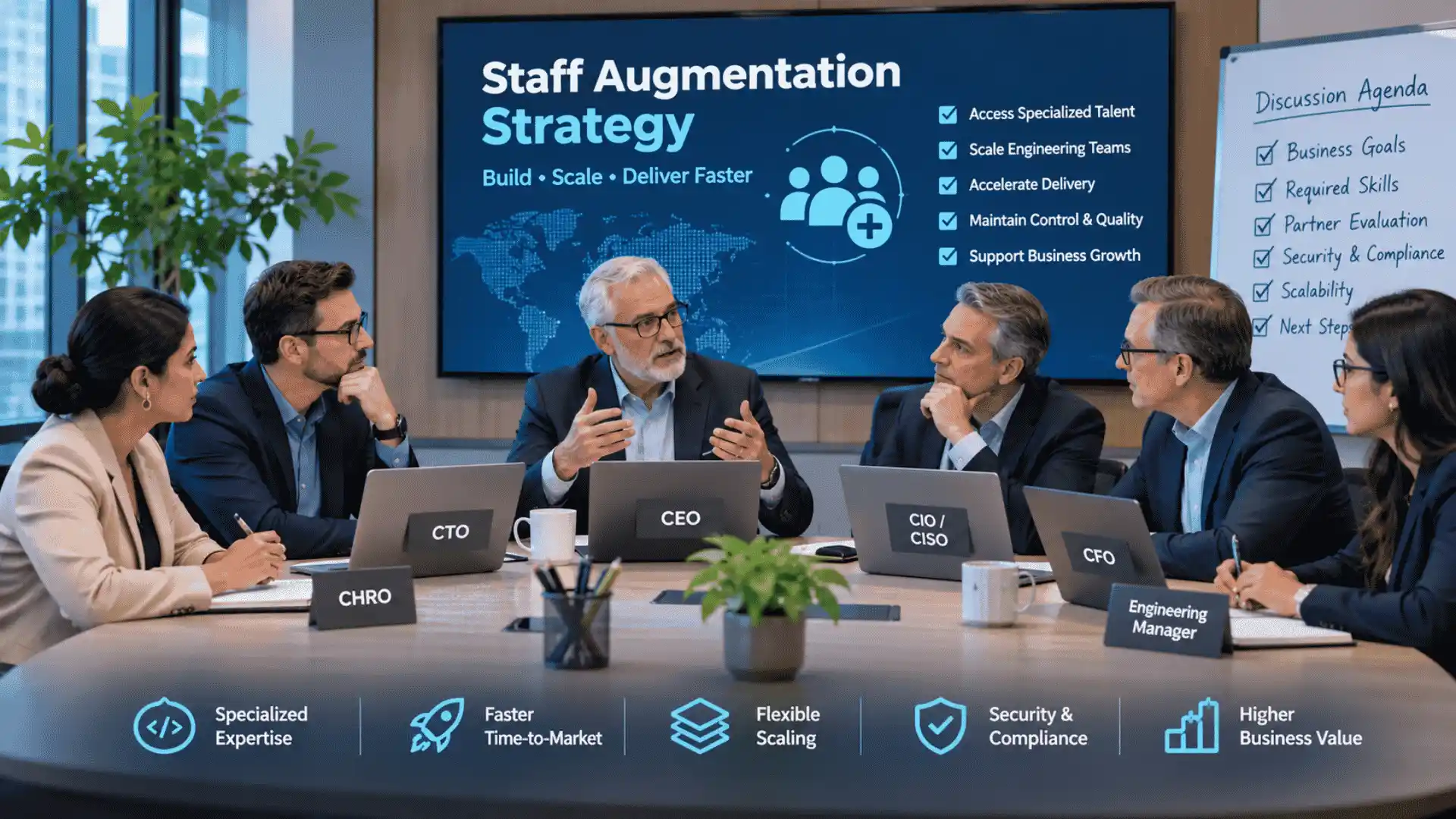
Most CEOs, CTOs, and CXOs do not see Staff Augmentation Services as a way to hire cheaper developers. They view it as a strategic solution to scale engineering teams faster, access specialized skills, reduce hiring delays, and deliver business outcomes without increasing permanent headcount. For executive leaders, the decision is driven by speed, capability, quality, and business risk, not hourly rates.
Modern organizations operate in a business environment where technology evolves rapidly, customer expectations change continuously, and AI is transforming how companies build products. Traditional hiring alone is often too slow to meet these demands. As a result, many organizations combine internal employees, external specialists, and AI-enabled workflows to stay competitive.
This shift has moved staff augmentation from being an HR decision to becoming a boardroom strategy.
Why Has Staff Augmentation Become a Strategic Business Decision?
A few years ago, staff augmentation was mainly used to fill temporary resource gaps or support large development projects.
Today, executive leaders use it for a very different reason.
Instead of asking,
"Can we hire another developer?"
they ask,
"What is the fastest and safest way to deliver this product?"
That single question changes everything.
According to LinkedIn's Future of Talent research, organizations are moving beyond traditional hiring models. Instead of filling every position with permanent employees, companies are building flexible workforces by combining internal talent, external experts, and AI to achieve business objectives.
This is why staff augmentation is becoming a strategic investment rather than simply a recruitment solution.
Companies typically use staff augmentation to accelerate initiatives such as:
- Digital transformation
- AI implementation
- Cloud migration
- Cybersecurity projects
- Legacy application modernization
- Enterprise software development
- Product expansion
- Platform engineering
The discussion is no longer about adding developers.
It is about increasing execution capacity.
What Do CEOs Really Care About?
CEOs rarely evaluate programming languages or technical frameworks.
Instead, they evaluate business outcomes.
Their responsibility is to grow revenue, improve profitability, reduce operational risk, and create long-term competitive advantages.
Because of this, CEOs ask very different questions than engineering managers.
Typical CEO questions include:
- Can this partner help us launch faster?
- How quickly can the team start?
- Will this reduce hiring delays?
- Can they scale if demand increases?
- What happens if a developer leaves?
- Can they support us over the next two to three years?
- Will this partnership reduce business risk?
Notice something important.
None of these questions focus on coding.
They focus entirely on business continuity and execution.
According to Gartner, workforce strategy continues to remain one of the highest priorities for CEOs as organizations respond to economic uncertainty, digital transformation, and AI adoption.
For CEOs, staff augmentation only creates value when it contributes directly to measurable business goals.
| Business Goal | Executive Expectation |
|---|---|
| Faster product delivery | Shorter release cycles |
| Revenue growth | Faster time to market |
| Lower hiring risk | Flexible team scaling |
| Innovation | Access to specialized expertise |
| Competitive advantage | Faster execution than competitors |
The best staff augmentation partners therefore sell business outcomes, not developer resumes.
Why Speed Matters More than Cost
Many service providers compete by offering the lowest hourly rate.
Executive leaders usually do not make decisions this way.
A delayed product launch can cost significantly more than paying experienced engineers.
For example, a SaaS company that spends four months hiring internally may lose valuable market opportunities while competitors continue releasing new features.
An experienced staff augmentation partner that can onboard engineers within days helps reduce that delay and keeps product Dedicated Development Team moving.
For executive teams, the comparison is rarely:
Internal hiring vs. external hiring
Instead, the comparison is:
Execution speed vs. business delay
Recent LinkedIn labor market research also highlights that hiring remains slower than pre-pandemic levels in many regions while demand for AI and specialized technical skills continues to increase.
This makes immediate access to experienced engineers even more valuable.
Key Takeaways From a CEO's Perspective
A CEO approves staff augmentation when it helps the organization:
- Launch products faster
- Enter new markets more quickly
- Reduce hiring bottlenecks
- Access specialized technical expertise
- Stay flexible during market uncertainty
- Scale engineering teams without significantly increasing permanent headcount
For CEOs, success is measured by business outcomes rather than the number of developers added to a project.
What do CTOs Really Expect From a Staff Augmentation Partner?
While CEOs focus on business outcomes, CTOs focus on execution.
A Chief Technology Officer is responsible for delivering secure, scalable, and reliable software. Before approving a staff augmentation partner, they evaluate whether external engineers can contribute immediately without slowing down the existing team.
For most CTOs, technical capability matters far more than the number of developers available.
They ask a simple question:
"Can this team solve our engineering challenges without creating new ones?"
The answer determines whether a partnership moves forward.
Can Augmented Engineers Integrate With Our Existing Team?
One of the biggest concerns for CTOs is integration.
Even highly skilled developers can become a liability if they cannot adapt to existing engineering processes.
A strong staff augmentation partner should be able to work within the company's current ecosystem instead of forcing new workflows.
CTOs typically evaluate whether engineers can quickly adapt to:
- Existing codebases
- Git workflows
- CI/CD pipelines
- Agile or Scrum processes
- Coding standards
- Internal documentation
- Project management tools
- Communication channels
The goal is simple.
External engineers should feel like an extension of the internal engineering team, not a separate organization.
How Quickly Can Developers Become Productive?
Hiring talented engineers is only the first step.
Productivity matters more.
Every week spent understanding architecture, business logic, and deployment processes delays product delivery.
This is why experienced CTOs evaluate onboarding time before evaluating hourly pricing.
Typical questions include:
- How long does onboarding usually take?
- What documentation do you provide?
- Can engineers understand an existing codebase quickly?
- Do developers require constant supervision?
- How do you reduce the learning curve?
The faster engineers become productive, the faster the organization sees business value.
Can They Produce Production-Ready Code?
Writing code is not enough.
Professional software must be maintainable, secure, scalable, and easy for future teams to understand.
CTOs therefore focus heavily on engineering quality.
They evaluate whether developers follow established software engineering practices such as:
- Clean architecture
- SOLID principles
- Design patterns
- Secure coding standards
- Automated testing
- Code reviews
- Version control best practices
- Documentation
Production-ready code reduces technical debt and makes future development faster.
Do They Understand Our Technology Stack?
Many companies require specialized expertise.
For example:
- React
- Angular
- Vue.js
- Node.js
- Java
- .NET
- Python
- Go
- AWS
- Azure
- Google Cloud
- Kubernetes
- Docker
- PostgreSQL
- MongoDB
A CTO wants engineers who can contribute immediately without spending months learning core technologies.
Specialized knowledge becomes even more important during cloud migration, AI implementation, cybersecurity upgrades, and enterprise modernization projects.
Read more - Cloud Engineering Services
How Do They Handle Code Quality?
Code quality directly affects software maintenance costs.
Poor code creates bugs, security vulnerabilities, and technical debt.
Strong staff augmentation providers usually have documented engineering standards covering:
- Peer code reviews
- Pull request approvals
- Static code analysis
- Unit testing
- Integration testing
- Continuous integration
- Performance optimization
These practices help maintain consistency even when multiple distributed teams contribute to the same project.
Can They Work With Modern DevOps Practices?
Modern software development depends on automation.
A CTO expects engineers to understand DevOps workflows instead of simply writing application code.
Common expectations include experience with:
- GitHub Actions
- Azure DevOps
- GitLab CI/CD
- Jenkins
- Docker
- Kubernetes
- Infrastructure as Code
- Monitoring and observability
Developers who understand deployment pipelines reduce release delays and improve software reliability.
Read more - DevOps Services
How Important is Security?
Security is no longer handled only by security teams.
Engineering teams are expected to build secure software from the beginning.
Before selecting a staff augmentation partner, CTOs often ask:
- How do you protect source code?
- What access controls do you follow?
- How do you manage credentials?
- Do developers follow secure coding practices?
- How are security vulnerabilities reported?
- What happens when an engineer leaves the project?
Organizations handling financial, healthcare, government, or enterprise applications usually place even greater emphasis on security and compliance.
Can They Scale With Business Growth?
Technology priorities change quickly.
A company that needs three developers today may require thirty engineers within a year.
Because of this, CTOs evaluate scalability before signing long-term agreements.
Typical questions include:
- Can additional engineers join within weeks?
- Can specialized experts be added later?
- How quickly can teams expand?
- Can resources be replaced without disrupting delivery?
- Is knowledge transferred properly during transitions?
Flexible scaling reduces hiring delays while allowing organizations to respond to changing business priorities.
What Technical Questions do CTOs Ask Before Choosing a Partner?
| Question | Why It Matters |
|---|---|
| How quickly can engineers start? | Reduces delivery delays |
| Can we interview developers? | Ensures technical fit |
| How do you maintain code quality? | Prevents technical debt |
| What testing practices do you follow? | Improves software reliability |
| How do you protect intellectual property? | Reduces legal and security risks |
| What happens if an engineer leaves? | Ensures project continuity |
| How do you manage knowledge transfer? | Maintains long-term stability |
| Can teams scale during product growth? | Supports business expansion |
These questions help CTOs identify partners capable of supporting long-term engineering success rather than simply supplying temporary developers.
Key Takeaways From a CTO's Perspective
For CTOs, staff augmentation is not about increasing headcount.
It is about increasing engineering capability.
A successful partner should be able to:
- Integrate seamlessly with existing teams
- Deliver production-ready code
- Follow established engineering standards
- Work within existing DevOps processes
- Maintain strong security practices
- Scale alongside business growth
- Reduce delivery risk without increasing technical debt
When these expectations are met, staff augmentation becomes a strategic engineering advantage rather than a temporary staffing solution.
How Do CIOs, CISOs and CFOs Evaluate a Staff Augmentation Partner?
While CTOs focus on engineering excellence, CIOs, CISOs, and CFOs evaluate staff augmentation from different perspectives.
A Chief Information Officer (CIO) looks at long-term technology strategy.
A Chief Information Security Officer (CISO) focuses on protecting business assets and reducing cyber risks.
A Chief Financial Officer (CFO) wants to know whether the investment delivers measurable business value.
Together, these executives often influence the final decision before a staff augmentation agreement is signed.
What Does a CIO Want From a Staff Augmentation Partner?
The CIO is responsible for ensuring that technology supports business goals.
Unlike project managers who focus on immediate delivery, CIOs evaluate whether a partner can support the organization's technology roadmap over several years.
Typical CIO questions include:
- Can this partner support enterprise-scale projects?
- Do they have experience with our industry?
- Can they work with legacy and modern systems?
- Will they follow our governance standards?
- Can they support future digital transformation initiatives?
- Do they understand cloud, AI, and enterprise architecture?
The CIO wants confidence that external engineers will strengthen-not complicate-the organization's technology ecosystem.
Can They Meet Enterprise Security Standards?
Security has become one of the biggest factors in selecting a technology partner.
Every external developer receives some level of access to business systems, repositories, infrastructure, or customer data.
That access introduces risk if proper controls are not in place.
Before approving a staff augmentation provider, security leaders commonly evaluate:
- Secure access management
- Multi-factor authentication
- VPN policies
- Device security
- Source code protection
- Identity management
- Data encryption
- Security monitoring
Organizations operating in regulated industries often require partners to follow internationally recognized security frameworks.
Common compliance requirements include:
- ISO 27001
- SOC 2
- GDPR
- HIPAA (Healthcare)
- PCI DSS (Payment Security)
The exact requirements vary depending on industry and country.
How is Intellectual Property Protected?
One concern shared by nearly every executive is intellectual property.
Software source code, product ideas, customer data, and internal documentation represent valuable business assets.
Executives therefore want clear answers to questions such as:
- Who owns the source code?
- Are Non-Disclosure Agreements (NDAs) signed?
- How is confidential information protected?
- What happens when the engagement ends?
- Are engineers removed from repositories immediately after offboarding?
A trustworthy staff augmentation partner should have documented policies covering intellectual property ownership and secure offboarding procedures.
How do CFOs Measure Return on Investment?
Many people assume CFOs only care about reducing costs.
In reality, CFOs care more about business value than the lowest hourly rate.
A cheaper team that delays product delivery can become far more expensive than an experienced team that delivers on time.
Instead of asking,
"Which provider is the cheapest?"
CFOs typically ask,
"Which provider creates the highest return on investment?"
Key evaluation factors include:
- Time to productivity
- Cost of delayed hiring
- Project completion speed
- Revenue impact
- Resource flexibility
- Long-term operating costs
The focus shifts from labor cost to business outcomes.
Hidden Costs That Executives Consider
The quoted hourly rate is only one part of the total investment.
Experienced executives also evaluate hidden costs that can affect overall project success.
Examples include:
- Recruitment expenses
- Employee benefits
- Training costs
- Employee turnover
- Delayed product launches
- Knowledge transfer
- Infrastructure costs
- Project management overhead
When these factors are included, staff augmentation can become a more flexible option for organizations with changing project demands.
How do Executives Measure Risk?
Every technology decision introduces risk.
Executive teams evaluate whether a staff augmentation provider reduces risk or creates additional uncertainty.
Common risk categories include:
| Risk Area | Executive Concern |
|---|---|
| Security | Can company data remain protected? |
| Compliance | Does the partner meet regulatory requirements? |
| Business Continuity | What happens if key engineers leave? |
| Delivery | Can project deadlines be achieved? |
| Technical Quality | Will poor code increase future maintenance costs? |
| Vendor Dependency | Can we scale or transition without disruption? |
A mature staff augmentation provider should have documented processes for each of these areas.
What Documentation Should a Professional Partner Provide?
Experienced executive teams expect transparency.
Before signing a contract, they often request documentation that demonstrates operational maturity.
This may include:
- Security policies
- NDA templates
- Master Service Agreement (MSA)
- Service Level Agreement (SLA)
- Data processing agreements
- Compliance certifications
- Employee background verification policies
- Business continuity plans
Providing clear documentation builds confidence and speeds up the procurement process.
What Makes Executives Trust a Staff Augmentation Partner?
Trust is built through consistency, transparency, and proven delivery.
Executives are more likely to choose partners who can demonstrate:
- Successful enterprise projects
- Long-term client relationships
- Experienced technical leadership
- Transparent communication
- Well-defined delivery processes
- Strong security practices
- Clear reporting
- Reliable governance
The decision is rarely based on marketing claims.
It is based on evidence.
Executive Evaluation Checklist
Before approving a staff augmentation partner, executive teams often verify the following:
- Proven technical expertise
- Enterprise security standards
- Compliance certifications where required
- Strong intellectual property protection
- Clear onboarding and offboarding process
- Transparent pricing
- Ability to scale teams
- Business continuity planning
- Reliable communication
- Long-term partnership capability
Organizations that can confidently answer these questions are far more likely to earn executive trust.
Key Takeaways From a CIO, CISO and CFO Perspective
For executive leadership, staff augmentation is about balancing growth with governance.
The right partner should help the organization:
- Protect sensitive business information
- Meet compliance obligations
- Scale technology teams safely
- Deliver measurable business value
- Reduce operational and delivery risks
- Support long-term digital transformation
When these objectives are achieved, staff augmentation becomes more than a staffing model-it becomes a strategic business partnership.
Read more - Digital Transformation
How Do CHROs and Engineering Managers View Staff Augmentation?
While CEOs focus on business growth and CTOs focus on technical execution, CHROs and Engineering Managers evaluate people, collaboration, and long-term productivity.
A successful staff augmentation partnership is not just about adding developers. It is about adding professionals who can integrate into the company's culture, communicate effectively, and contribute from day one.
For these leaders, the biggest question is:
"Will these engineers become productive members of our team without disrupting our existing workforce?"
If the answer is yes, staff augmentation becomes a strategic advantage instead of a temporary staffing solution.
Why Is Talent Shortage Driving Staff Augmentation?
Finding experienced software engineers has become increasingly difficult.
Organizations compete for professionals with expertise in areas such as:
- Artificial Intelligence
- Cloud Computing
- Cybersecurity
- DevOps
- Data Engineering
- Mobile Development
- Enterprise Architecture
Hiring these specialists through traditional recruitment often takes months.
During that time, product roadmaps slow down, customer expectations continue to rise, and competitors keep shipping new features.
Staff augmentation allows companies to access experienced professionals without waiting through lengthy hiring cycles.
According to LinkedIn's Future of Talent research, organizations are increasingly building flexible workforces by combining internal employees, external specialists, and AI-enabled work rather than relying solely on permanent hiring.
Can External Engineers Fit Into Our Company Culture?
Technical skills alone do not guarantee project success.
Engineering Managers know that communication, collaboration, and accountability often determine whether projects succeed or fail.
Before approving augmented engineers, hiring leaders typically evaluate:
- Communication skills
- Problem-solving ability
- Team collaboration
- Ownership mindset
- Learning attitude
- Time management
- Professionalism
- Adaptability
The goal is to ensure external engineers work as an extension of the internal team rather than as separate contractors.
The faster they become part of the engineering culture, the faster they contribute meaningful business value.
How Important Is Onboarding?
Even experienced engineers require onboarding.
Without proper onboarding, productivity drops and internal teams spend unnecessary time answering basic questions.
Professional staff augmentation partners usually support structured onboarding that includes:
- Project documentation
- Architecture overview
- Development environment setup
- Repository access
- Coding standards
- Sprint planning
- Team introductions
- Security guidelines
A structured onboarding process reduces confusion and helps engineers contribute within days instead of weeks.
Can They Communicate Effectively?
Communication problems are one of the most common reasons technology projects fail.
Engineering Managers therefore evaluate communication as carefully as technical expertise.
Important questions include:
- Can engineers communicate clearly in meetings?
- Will they provide regular project updates?
- Can they explain technical problems to non-technical stakeholders?
- Do they participate actively during sprint planning?
- Are they comfortable working with distributed teams?
Strong communication improves collaboration, reduces misunderstandings, and helps projects stay on schedule.
How Do Engineering Managers Measure Performance?
Successful engineering teams measure outcomes rather than hours worked.
Engineering Managers typically evaluate augmented engineers using performance indicators such as:
| Performance Area | What Managers Measure |
|---|---|
| Sprint Delivery | Stories completed on time |
| Code Quality | Review feedback and defect rates |
| Collaboration | Team participation and communication |
| Productivity | Feature delivery and task completion |
| Reliability | Meeting commitments consistently |
| Continuous Improvement | Ability to learn and adapt |
These metrics help organizations evaluate whether external engineers are delivering measurable value.
How Is Knowledge Shared Across Teams?
One major concern with temporary resources is knowledge loss.
If documentation is poor or information remains with a single developer, future maintenance becomes difficult.
Experienced staff augmentation providers encourage practices such as:
- Technical documentation
- Code comments where appropriate
- Knowledge-sharing sessions
- Pair programming
- Architecture documentation
- Recorded demonstrations
- Internal wikis
These practices reduce dependency on individuals and improve long-term project stability.
What Makes Collaboration Successful?
Engineering Managers want external developers who become trusted team members.
Successful collaboration usually includes:
- Daily stand-ups
- Sprint planning
- Retrospectives
- Shared project goals
- Transparent communication
- Regular feedback
- Clearly defined responsibilities
When collaboration becomes seamless, the distinction between internal and augmented engineers gradually disappears.
That is often considered the strongest indicator of a successful partnership.
Common People Challenges Companies Face
Not every staff augmentation engagement succeeds.
Some common challenges include:
- Poor onboarding
- Communication gaps
- Unclear project requirements
- Lack of documentation
- Different time zones
- Cultural misunderstandings
- Undefined responsibilities
- Inconsistent project management
Most of these issues can be avoided through proper planning, structured onboarding, and regular communication.
What Do CHROs Look For Before Approving a Partner?
Human Resources leaders focus on reducing workforce risks while supporting business growth.
Typical evaluation criteria include:
- Recruitment quality
- Employee verification
- Professional experience
- Communication ability
- Cultural compatibility
- Replacement policies
- Employee retention
- Learning and development
- Diversity and inclusion practices
- Long-term partnership capability
These factors help organizations build stable engineering teams without increasing permanent hiring commitments.
Key Takeaways From a CHRO and Engineering Manager's Perspective
For HR and engineering leaders, successful staff augmentation is about people, not just skills.
An ideal partner should:
- Provide experienced professionals
- Support structured onboarding
- Communicate effectively
- Integrate into existing teams
- Share knowledge openly
- Deliver consistent performance
- Adapt to company culture
- Reduce hiring delays without reducing quality
When these expectations are met, staff augmentation strengthens both engineering performance and organizational culture.
What Questions Should Every Executive Ask Before Signing a Staff Augmentation Contract?
Choosing a staff augmentation partner is a long-term business decision, not simply a hiring exercise.
Before signing any agreement, executive teams evaluate whether the provider can deliver consistent results, protect business interests, and scale alongside future growth.
The best organizations follow a structured evaluation process instead of relying solely on pricing or sales presentations.
Below are the most common questions CEOs, CTOs, CIOs, CFOs, and CHROs ask before selecting a staff augmentation partner.
Can the Partner Deliver the Skills We Actually Need?
Every project requires different technical expertise.
Instead of asking how many developers are available, executives ask whether the provider has experience with their specific technology stack and industry.
Typical questions include:
- Have you completed projects similar to ours?
- Which technologies do your engineers specialize in?
- Can we interview the assigned developers?
- How do you assess technical skills?
- Can you provide specialists instead of generalists?
Choosing engineers with relevant experience reduces onboarding time and project risk.
How Fast Can the Team Start?
Speed is often one of the biggest reasons companies choose staff augmentation.
Executives want to understand how quickly engineers can begin contributing.
Questions commonly asked include:
- What is your average onboarding time?
- How quickly can developers join our team?
- Can additional engineers be added later?
- What happens if project priorities change?
A provider with a flexible talent pool can respond faster to changing business needs.
How Do You Maintain Code Quality?
Software quality directly affects maintenance costs, customer satisfaction, and future scalability.
Engineering leaders often ask:
- Do you perform peer code reviews?
- What testing standards do you follow?
- Do developers write unit tests?
- How do you prevent technical debt?
- What coding standards are followed?
Reliable engineering processes produce consistent software quality across projects.
How Will You Protect Our Intellectual Property?
Every organization wants assurance that its ideas, software, and customer information remain secure.
Important questions include:
- Who owns the source code?
- Will an NDA be signed?
- How is confidential information protected?
- What security policies do you follow?
- How is access revoked after project completion?
Clear contractual terms help protect both parties throughout the engagement.
What Happens If a Developer Leaves?
Unexpected resource changes should never stop project delivery.
Executives therefore ask:
- Do you provide replacement engineers?
- How quickly can replacements be assigned?
- How is project knowledge transferred?
- Will onboarding start again from the beginning?
- How do you ensure continuity?
A mature staff augmentation provider has documented transition processes that minimize disruption.
How Do You Communicate During the Project?
Transparent communication builds trust and improves delivery.
Typical questions include:
- Who will be our primary point of contact?
- How often will project updates be shared?
- Which collaboration tools do you use?
- How are project risks reported?
- What happens if deadlines change?
Regular communication prevents misunderstandings and enables faster decision-making.
How Do You Handle Security and Compliance?
Security is one of the first areas enterprise organizations evaluate.
Questions often include:
- Do you follow secure development practices?
- Are engineers background verified?
- Do you comply with industry regulations?
- How is customer data protected?
- What security certifications do you maintain?
The exact compliance requirements depend on industry and geography.
Can Your Team Scale With Our Business?
Business priorities change quickly.
Executives want partners who can grow alongside the organization.
Typical questions include:
- Can the team expand within weeks?
- Can we reduce resources after project completion?
- Do you support long-term engagements?
- Can specialized experts join later?
- How do you manage large distributed teams?
Scalability allows organizations to respond quickly without restarting the hiring process.
How Do You Measure Success?
Professional providers should define success before development begins.
Important questions include:
- Which KPIs will be tracked?
- How is productivity measured?
- How will project progress be reported?
- What happens if milestones are missed?
- How do you measure engineering performance?
Clearly defined metrics improve accountability throughout the engagement.
Executive Vendor Evaluation Checklist
Before signing a contract, executive teams typically evaluate the following areas.
| Evaluation Area | Key Question |
|---|---|
| Technical Expertise | Do they have relevant experience? |
| Industry Knowledge | Have they solved similar business problems? |
| Security | Can they protect our systems and data? |
| Compliance | Do they meet regulatory requirements? |
| Communication | Will reporting remain transparent? |
| Scalability | Can they grow with our business? |
| Code Quality | Do they follow engineering best practices? |
| Business Continuity | Can projects continue if resources change? |
| Documentation | Are processes clearly documented? |
| Cultural Fit | Will engineers collaborate effectively with our team? |
Organizations that evaluate providers across all of these areas are more likely to build successful long-term partnerships.
Red Flags Every Executive Should Watch For
Not every staff augmentation provider follows mature engineering and business practices.
Warning signs include:
- Unclear pricing structure
- No documented onboarding process
- No code review practices
- Poor communication during sales discussions
- No replacement policy
- Limited technical documentation
- Weak security controls
- Unrealistic delivery promises
- No client references or case studies
- Inability to explain development methodology
Recognizing these warning signs early can prevent costly project delays and operational risks.
Executive Decision Checklist
Before signing a staff augmentation agreement, ask yourself:
- Does this partner understand our business goals?
- Can they deliver engineers with the right skills?
- Do they follow secure engineering practices?
- Will they integrate into our existing team?
- Can they scale as our business grows?
- Are communication and reporting clearly defined?
- Do they protect our intellectual property?
- Can they demonstrate successful client engagements?
If the answer to these questions is yes, the partnership is far more likely to deliver long-term business value.
What Common Mistakes Do Companies Make With Staff Augmentation?
Staff augmentation has helped organizations accelerate software development, access specialized talent, and scale engineering teams more efficiently.
However, not every engagement delivers the expected results.
In many cases, projects fail because of poor planning rather than poor developers.
Organizations that treat staff augmentation as a simple hiring transaction often face communication issues, delayed releases, security concerns, and rising project costs.
Understanding these common mistakes can help executives avoid unnecessary risks and build stronger technology partnerships.
Choosing the Cheapest Provider Instead of the Best Partner
Price is important, but it should never be the only decision factor.
A lower hourly rate may appear attractive during procurement, but poor engineering practices can significantly increase long-term costs.
Common consequences include:
- Technical debt
- Missed deadlines
- Frequent bugs
- Poor documentation
- Higher maintenance costs
- Increased rework
Executives should evaluate overall business value rather than selecting a provider based solely on pricing.
Treating Staff Augmentation Like Traditional Outsourcing
One of the biggest misconceptions is assuming augmented engineers work independently without becoming part of the internal team.
Successful staff augmentation works differently.
External engineers collaborate with internal teams, participate in sprint planning, attend daily meetings, and follow existing engineering standards.
Organizations that isolate external developers often experience:
- Communication gaps
- Duplicate work
- Slow decision-making
- Reduced productivity
The most successful companies treat augmented engineers as part of one engineering team.
Poor Onboarding Delays Productivity
Even experienced engineers need time to understand:
- Business objectives
- Product architecture
- Development workflows
- Coding standards
- Security policies
- Internal tools
Without structured onboarding, developers spend valuable time searching for information instead of building software.
A simple onboarding checklist can reduce delays and improve productivity from the first week.
Unclear Project Requirements
Many software projects begin before requirements are fully documented.
This creates confusion for both internal and external teams.
Common problems include:
- Changing priorities
- Undefined features
- Missing acceptance criteria
- Inconsistent documentation
- Scope creep
Clear project documentation allows engineering teams to make better technical decisions and reduces unnecessary rework.
Ignoring Communication Planning
Communication should never be left to chance.
Organizations that lack regular updates often discover project risks too late.
Best practices include:
- Daily stand-up meetings
- Weekly progress reviews
- Sprint retrospectives
- Shared project dashboards
- Clear escalation processes
- Documented action items
Transparent communication builds trust and keeps projects aligned with business goals.
Focusing Only on Technical Skills
Technical expertise is essential, but soft skills are equally important.
Developers who cannot communicate effectively or collaborate with existing teams often slow down delivery.
Engineering leaders should evaluate:
- Communication skills
- Problem-solving ability
- Collaboration
- Accountability
- Adaptability
- Learning mindset
Successful engineering teams combine technical excellence with strong teamwork.
Neglecting Documentation
Documentation is one of the most overlooked aspects of software development.
Without proper documentation, organizations become dependent on individual developers.
This creates significant risks when engineers leave the project.
Important documentation includes:
- System architecture
- API documentation
- Deployment guides
- Coding standards
- Infrastructure configuration
- Technical decisions
Well-documented projects are easier to maintain, scale, and transfer between teams.
Ignoring Security Until Later
Security should be integrated into development from the beginning.
Waiting until deployment often results in expensive fixes and project delays.
Organizations should establish security requirements before development starts.
Examples include:
- Access management
- Secure repositories
- Multi-factor authentication
- Secure coding practices
- Vulnerability testing
- Regular security reviews
Building security into the development lifecycle reduces long-term business risk.
Not Defining Success Metrics
Some organizations begin projects without defining how success will be measured.
Without clear metrics, it becomes difficult to evaluate progress or identify improvement opportunities.
Useful project KPIs may include:
- Sprint velocity
- Feature completion rate
- Production defects
- Deployment frequency
- Lead time for changes
- Customer satisfaction
- System availability
Tracking measurable outcomes improves accountability and project visibility.
Expecting Immediate Results
Even experienced engineers require time to understand:
- Business processes
- Product architecture
- Team workflows
- Customer requirements
Organizations expecting immediate productivity without onboarding often become disappointed.
A realistic onboarding period combined with structured knowledge sharing produces better long-term results.
Choosing a Partner That Cannot Scale
Business priorities change quickly.
A provider that can support five engineers today may struggle to support twenty engineers six months later.
Before selecting a partner, executives should evaluate:
- Talent availability
- Recruitment capacity
- Specialized expertise
- Global delivery capability
- Replacement process
- Long-term scalability
Scalable partners reduce future hiring risks and support business growth.
Common Staff Augmentation Mistakes at a Glance
| Mistake | Business Impact | Recommended Solution |
|---|---|---|
| Choosing based only on price | Poor quality and rework | Evaluate overall business value |
| Weak onboarding | Slow productivity | Create a structured onboarding plan |
| Poor communication | Project delays | Schedule regular progress reviews |
| Undefined requirements | Scope creep | Document requirements clearly |
| Weak documentation | Knowledge loss | Maintain technical documentation |
| Ignoring security | Increased business risk | Integrate security from day one |
| No success metrics | Difficult performance evaluation | Define measurable KPIs |
| Limited scalability | Hiring delays during growth | Choose a scalable partner |
Lessons Learned From Successful Organizations
Organizations that achieve the best outcomes with staff augmentation usually follow a few consistent practices.
They:
- Define project goals before hiring.
- Select partners based on expertise, not just price.
- Integrate external engineers into existing teams.
- Invest in onboarding and documentation.
- Maintain transparent communication.
- Measure delivery using clear KPIs.
- Build security into every stage of development.
- Treat staff augmentation as a long-term partnership rather than a temporary staffing solution.
These practices improve collaboration, reduce delivery risk, and create stronger engineering teams.
Key Takeaways
Most staff augmentation challenges are preventable.
Projects succeed when organizations focus on planning, communication, security, documentation, and collaboration instead of simply adding more developers.
Companies that view staff augmentation as a strategic partnership rather than a short-term staffing solution are more likely to achieve faster delivery, higher software quality, and long-term business value.
How Is AI Changing Staff Augmentation?
Artificial Intelligence is transforming how software is built, tested, deployed, and maintained. As AI adoption accelerates, organizations are no longer looking only for developers. They want engineering teams that know how to use AI responsibly to improve productivity, quality, and delivery speed.
For executives, this changes the purpose of staff augmentation.
The question is no longer:
"Can this partner provide developers?"
It has become:
"Can this partner help us build software faster using AI without compromising quality, security, or governance?"
Organizations that combine experienced engineers with AI-assisted development are often better positioned to deliver products more efficiently while maintaining engineering standards.
Why Are Companies Hiring AI-Ready Engineers?
Modern software development increasingly includes AI-assisted tools for coding, testing, documentation, debugging, and code reviews.
As a result, businesses now prefer engineers who understand both software engineering fundamentals and AI-powered development workflows.
Companies are actively seeking expertise in areas such as:
- Generative AI
- Large Language Models (LLMs)
- AI Agents
- Prompt Engineering
- Retrieval-Augmented Generation (RAG)
- AI Automation
- Machine Learning Integration
- Intelligent Workflows
These skills are becoming valuable across industries, from healthcare and finance to manufacturing and retail.
Read more - AI Development Services
AI Does Not Replace Developers. It Changes Their Role.
One of the biggest misconceptions is that AI will replace software engineers.
In practice, AI is changing how engineers work rather than eliminating the need for them.
AI can assist with repetitive tasks such as:
- Generating boilerplate code
- Writing documentation
- Creating unit tests
- Finding potential bugs
- Explaining unfamiliar code
- Suggesting code improvements
However, AI still depends on experienced engineers to:
- Design system architecture
- Make technical decisions
- Review generated code
- Ensure security
- Optimize performance
- Understand business requirements
- Maintain software quality
Human expertise remains essential for delivering reliable software.
Read more - Software Development Services
What Do CTOs Expect From AI-Enabled Engineering Teams?
Technology leaders increasingly expect engineering partners to use AI responsibly.
They want teams that improve productivity without sacrificing quality.
Typical questions include:
- Which AI tools do your engineers use?
- How do you review AI-generated code?
- How do you prevent security risks?
- What governance policies do you follow?
- Can AI improve delivery speed without reducing quality?
Responsible AI adoption combines automation with human oversight.
AI should support engineers, not replace engineering discipline.
Which AI Skills Are Becoming Valuable?
Organizations are expanding beyond traditional software development.
Many projects now require expertise in AI implementation and automation.
Examples include:
- Building AI-powered applications
- Integrating LLM APIs
- Developing AI chatbots
- Workflow automation
- Intelligent document processing
- AI-powered customer support
- Knowledge management systems
- Enterprise search solutions
Engineering partners that understand these technologies can help organizations accelerate digital transformation initiatives.
Read more - Enterprise Software Development
AI Is Changing Team Structures
Traditional software teams were often built around frontend, backend, QA, and DevOps roles.
Modern engineering teams increasingly include AI specialists.
A typical AI-enabled delivery team may include:
- Software Engineers
- AI Engineers
- Prompt Engineers
- Data Engineers
- Cloud Engineers
- DevOps Engineers
- Security Specialists
- Product Managers
These multidisciplinary teams help organizations deliver intelligent applications more efficiently.
Responsible AI Requires Governance
As AI adoption increases, governance becomes equally important.
Organizations need clear policies covering:
- Data privacy
- Intellectual property
- AI-generated code reviews
- Human oversight
- Security validation
- Compliance requirements
- Model selection
- Responsible AI usage
Executive leaders increasingly expect staff augmentation partners to demonstrate how they use AI safely and transparently.
How AI Improves Software Development
When implemented responsibly, AI can support software development in several areas.
| Development Activity | How AI Can Help |
|---|---|
| Code Generation | Creates initial code suggestions |
| Testing | Assists with unit test creation |
| Documentation | Generates technical documentation drafts |
| Debugging | Identifies possible issues faster |
| Code Reviews | Suggests improvements and detects common mistakes |
| Knowledge Sharing | Explains unfamiliar codebases and documentation |
AI should always be used alongside experienced engineers who review and validate the output before deployment.
What Should Executives Ask About AI Capabilities?
Before selecting a modern staff augmentation partner, executive teams should ask:
- Do your engineers use AI-assisted development tools?
- How do you validate AI-generated code?
- What security controls exist for AI usage?
- How do you protect confidential company data?
- Which AI technologies has your team implemented?
- Can you build AI-powered products?
- Do you provide AI consulting alongside engineering services?
- How do you ensure compliance with organizational policies?
These questions help determine whether a provider is prepared for modern software development.
Will AI Replace Staff Augmentation?
The evidence suggests otherwise.
Instead of replacing staff augmentation, AI is changing the type of talent organizations require.
Companies increasingly need engineers who can:
- Work effectively with AI tools
- Build AI-powered applications
- Integrate intelligent automation
- Maintain software quality
- Ensure secure AI adoption
- Deliver business outcomes faster
This evolution creates new opportunities for staff augmentation providers that invest in AI expertise while maintaining strong engineering fundamentals.
Key Takeaways
Artificial Intelligence is reshaping software development, but it has not removed the need for experienced engineers.
Instead, organizations are looking for staff augmentation partners who combine engineering excellence with practical AI expertise.
The most successful providers will help businesses:
- Accelerate software delivery
- Build AI-powered products
- Improve developer productivity
- Maintain security and governance
- Scale engineering capabilities for the future
As AI continues to evolve, staff augmentation will become less about supplying developers and more about delivering specialized engineering capability supported by intelligent tools.
Conclusion
Staff augmentation is no longer just a way to fill temporary vacancies or reduce hiring costs. It has become a strategic approach that helps organizations build stronger engineering teams, accelerate product development, and respond quickly to changing business needs.
Throughout this guide, we've explored how different executive leaders evaluate staff augmentation.
- CEOs focus on business growth, speed, and return on investment.
- CTOs prioritize engineering quality, scalability, and technical excellence.
- CIOs and CISOs evaluate governance, security, and compliance.
- CFOs measure financial impact and long-term value.
- CHROs and Engineering Managers emphasize collaboration, culture, and productivity.
Although each executive has different priorities, they all share one common objective:
Choosing a partner who can help the business deliver better outcomes with lower risk.
The most successful staff augmentation partnerships are built on transparency, technical expertise, strong communication, and shared business goals.
Organizations that invest time in selecting the right partner are more likely to:
- Deliver products faster
- Access specialized technical expertise
- Improve software quality
- Scale engineering teams efficiently
- Reduce hiring delays
- Strengthen security and governance
- Support long-term digital transformation
As Artificial Intelligence, cloud computing, cybersecurity, and modern software engineering continue to evolve, businesses will increasingly rely on flexible talent models that combine internal teams with external specialists.
Staff augmentation is becoming an important part of that strategy.
The organizations that treat augmented engineers as trusted members of their engineering teams, rather than temporary contractors, are often better positioned to innovate, adapt, and grow.
Final Executive Checklist
Before selecting a staff augmentation partner, make sure you can confidently answer the following questions.
Business
- Do they understand our business objectives?
- Can they support long-term growth?
- Will they help us deliver products faster?
Technical
- Do they have expertise in our technology stack?
- Can they integrate into our existing engineering team?
- Do they follow modern software development practices?
Security
- Are intellectual property and customer data protected?
- Do they follow secure development standards?
- Can they meet our compliance requirements?
Delivery
- Do they provide transparent communication?
- Can they scale resources when needed?
- Do they have a structured onboarding process?
Partnership
- Can they become a long-term technology partner?
- Do they have proven client success?
- Can they support future AI and digital transformation initiatives?
Read more - Client Success Stories
If the answer to these questions is yes, your organization is in a much stronger position to build a successful and lasting staff augmentation partnership.
Why This Matters for the Future
The future of software development is not about replacing people with technology.
It is about combining experienced engineers, modern development practices, and AI-powered tools to build better products faster.
Organizations that embrace this approach will be better equipped to respond to market changes, attract specialized talent, and deliver long-term business value.
Staff augmentation is no longer simply a staffing model.
It is a strategic business capability that enables organizations to innovate, scale, and compete in an increasingly digital world.
Conclusion
Staff augmentation is no longer just a way to fill temporary vacancies or reduce hiring costs. It has become a strategic approach that helps organizations build stronger engineering teams, accelerate product development, and respond quickly to changing business needs.
Throughout this guide, we've explored how different executive leaders evaluate staff augmentation.
- CEOs focus on business growth, speed, and return on investment.
- CTOs prioritize engineering quality, scalability, and technical excellence.
- CIOs and CISOs evaluate governance, security, and compliance.
- CFOs measure financial impact and long-term value.
- CHROs and Engineering Managers emphasize collaboration, culture, and productivity.
Although each executive has different priorities, they all share one common objective:
Choosing a partner who can help the business deliver better outcomes with lower risk.
The most successful staff augmentation partnerships are built on transparency, technical expertise, strong communication, and shared business goals.
Organizations that invest time in selecting the right partner are more likely to:
- Deliver products faster
- Access specialized technical expertise
- Improve software quality
- Scale engineering teams efficiently
- Reduce hiring delays
- Strengthen security and governance
- Support long-term digital transformation
As Artificial Intelligence, cloud computing, cybersecurity, and modern software engineering continue to evolve, businesses will increasingly rely on flexible talent models that combine internal teams with external specialists.
Staff augmentation is becoming an important part of that strategy.
The organizations that treat augmented engineers as trusted members of their engineering teams, rather than temporary contractors, are often better positioned to innovate, adapt, and grow.
Final Executive Checklist
Before selecting a staff augmentation partner, make sure you can confidently answer the following questions.
Business
- Do they understand our business objectives?
- Can they support long-term growth?
- Will they help us deliver products faster?
Technical
- Do they have expertise in our technology stack?
- Can they integrate into our existing engineering team?
- Do they follow modern software development practices?
Security
- Are intellectual property and customer data protected?
- Do they follow secure development standards?
- Can they meet our compliance requirements?
Delivery
- Do they provide transparent communication?
- Can they scale resources when needed?
- Do they have a structured onboarding process?
Partnership
- Can they become a long-term technology partner?
- Do they have proven client success?
- Can they support future AI and digital transformation initiatives?
If the answer to these questions is yes, your organization is in a much stronger position to build a successful and lasting staff augmentation partnership.
Why This Matters for the Future
The future of software development is not about replacing people with technology.
It is about combining experienced engineers, modern development practices, and AI-powered tools to build better products faster.
Organizations that embrace this approach will be better equipped to respond to market changes, attract specialized talent, and deliver long-term business value.
Staff augmentation is no longer simply a staffing model.
It is a strategic business capability that enables organizations to innovate, scale, and compete in an increasingly digital world.
Frequently Asked Questions (FAQs)
1. What is staff augmentation?
Staff augmentation is a hiring model where organizations temporarily add external professionals to their existing teams to fill skill gaps, accelerate projects, or scale engineering capacity. Unlike traditional outsourcing, augmented staff work as an extension of your internal team.
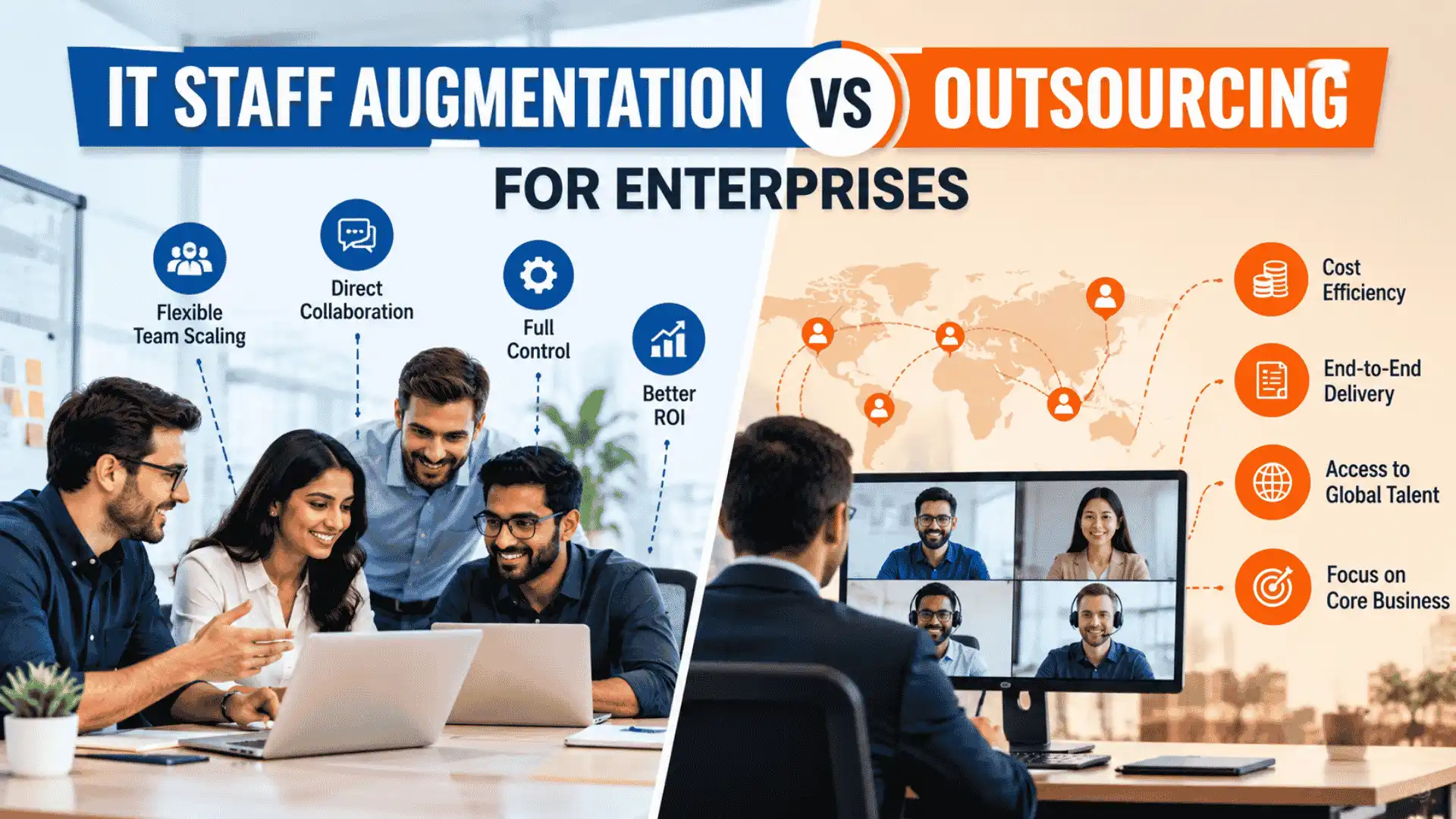
2. How is staff augmentation different from outsourcing?
The biggest difference is control.
With staff augmentation, your company manages the developers, project priorities, and daily work.
With outsourcing, an external company usually manages the entire project and delivery process.
| Staff Augmentation | Outsourcing |
|---|---|
| Client manages developers | Vendor manages the project |
| Developers join your team | Separate external team |
| High flexibility | Fixed project scope |
| Ideal for long-term collaboration | Ideal for complete project delivery |
3. When should a company choose staff augmentation?
Staff augmentation is a good option when organizations need to:
- Fill technical skill gaps
- Scale engineering teams quickly
- Accelerate product development
- Support digital transformation
- Build AI or cloud solutions
- Reduce hiring delays
- Access specialized expertise
4. Is staff augmentation suitable for startups?
Yes.
Many startups use staff augmentation to launch products faster without committing to large permanent engineering teams. It allows founders to access experienced developers while maintaining flexibility as business requirements evolve.
5. How long does staff augmentation usually last?
The duration depends on business requirements.
Common engagements include:
- Short-term projects (1-3 months)
- Product development (3-12 months)
- Long-term engineering partnerships (12+ months)
Many organizations continue working with trusted partners across multiple projects.
6. How quickly can augmented developers start?
The onboarding timeline varies depending on the required skills and resource availability.
Experienced providers can often onboard engineers much faster than traditional recruitment, especially for common technology stacks.
7. Is staff augmentation more cost-effective than hiring full-time employees?
It depends on the project, hiring market, and business goals.
Organizations often choose staff augmentation because it reduces recruitment time, increases flexibility, and provides access to specialized expertise without expanding permanent headcount.
The total business value should always be evaluated instead of hourly rates alone.
8. How do companies protect intellectual property?
Professional staff augmentation providers typically use:
- Non-Disclosure Agreements (NDAs)
- Secure access controls
- Role-based permissions
- Confidentiality policies
- Secure development practices
- Controlled offboarding procedures
Specific security requirements may vary depending on industry regulations and client policies.
9. Can augmented engineers work with our existing development team?
Yes.
A successful staff augmentation model integrates external engineers into existing workflows, including Agile ceremonies, sprint planning, code reviews, DevOps pipelines, and collaboration tools.
The goal is to create one engineering team rather than two separate groups.
10. What should executives evaluate before choosing a staff augmentation partner?
Key evaluation factors include:
- Technical expertise
- Industry experience
- Security practices
- Communication
- Scalability
- Engineering processes
- AI capabilities
- Client references
- Cultural fit
- Long-term partnership potential
Use these sources to support facts and improve credibility.
- Gartner — https://www.gartner.com
- McKinsey & Company — https://www.mckinsey.com
- Microsoft WorkLab — https://www.microsoft.com/worklab
- LinkedIn Talent Solutions — https://business.linkedin.com
- Project Management Institute (PMI) — https://www.pmi.org
- Scrum Guides — https://scrumguides.org
- NIST Cybersecurity Framework — https://www.nist.gov/cyberframework
- OWASP Foundation — https://owasp.org
- DORA Research Program — https://dora.dev
- Google Cloud Architecture Center — https://cloud.google.com/architecture
- Microsoft Well-Architected Framework — https://learn.microsoft.com/azure/well-architected
- GitHub Octoverse — https://octoverse.github.com