
Why Most AI Projects Fail Before Production
Many AI projects fail before production because of poor planning, weak data, and unclear goals. Learn the biggest mistakes and proven strategies for successful enterprise AI implementation.
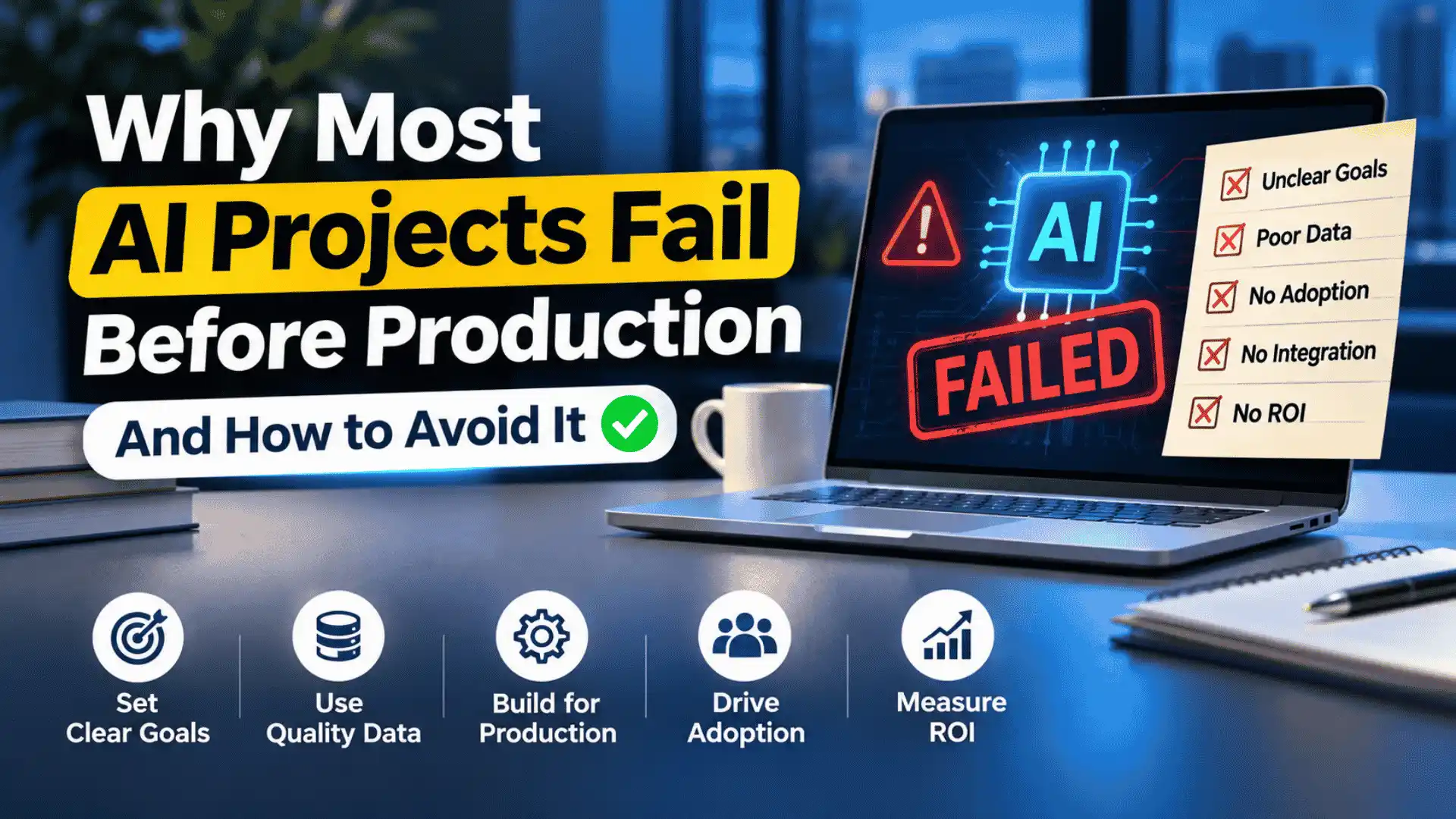
AI is Everywhere, So Why Are So Many Projects Failing?
Artificial Intelligence has become a boardroom priority. CEOs are investing millions into AI to automate operations, improve customer experience, and increase productivity.
However, many AI initiatives never make it to production.
According to the RAND Corporation, many organizations struggle with AI implementation because they focus on technology instead of solving real business problems. The report also notes that by some estimates, more than 80% of AI projects fail, and leadership decisions are among the biggest reasons behind these failures.
The problem isn't AI.
The problem is how businesses approach AI.
This article explains why enterprise AI projects fail before production and what business leaders can do differently.
AI Adoption is Growing Faster Than AI Readiness
Organizations are under pressure to adopt AI quickly.
Yet readiness remains low.
The RAND report highlights:
| Statistic | Insight |
|---|---|
| 84% | Business leaders believe AI will significantly impact their business |
| 97% | Say AI adoption has become more urgent |
| Only 14% | Feel their organization is fully prepared to integrate AI successfully |
These numbers show that while AI investment is increasing, organizational readiness is lagging behind.
1. Businesses Start With AI Instead of the Business Problem
This is the biggest mistake.
Many leadership teams ask:
"How can we use AI?"
Instead, they should ask:
- Which business process is slowing us down?
- Where are we losing money?
- Which manual task consumes the most employee time?
- Which customer problem needs solving?
Successful AI projects begin with a business objective, not with a model or technology.
RAND researchers found leadership frequently asks technical teams to solve the wrong problem, causing months of work to produce little business value.
2. Poor Data Quality Breaks AI Projects
AI learns from data.
If the data is incomplete or inconsistent, AI produces unreliable results.
Common problems include:
- Duplicate records
- Missing customer information
- Different data formats
- Outdated databases
- Information spread across multiple systems
One engineer interviewed by RAND summarized the challenge well:
"80 percent of AI is the dirty work of data engineering."
Without quality data, even the best AI models fail.
3. Companies Build Demos Instead of Production Systems
Many organizations celebrate after creating a proof of concept.
Unfortunately, a successful demo doesn't mean the project is ready for production.
Production AI requires:
- Security
- Monitoring
- Governance
- Scalability
- User authentication
- API integration
- Performance optimization
IBM explains that many AI pilots perform well in controlled environments but fail once they must operate across real enterprise systems with fragmented data and governance requirements.
4. Leadership Expectations Are Unrealistic
Executives often expect AI to deliver results within weeks.
In reality, successful AI implementation requires:
- Data preparation
- Business process redesign
- Testing
- Employee training
- Continuous improvements
RAND researchers found rapidly changing priorities often cause leadership to abandon projects before they can demonstrate measurable value.
5. Employees Don't Adopt the AI Solution
A technically successful AI solution can still fail.
Why?
Because employees don't use it.
The Stanford Digital Economy Lab found that organizations overcome adoption challenges by:
- Providing executive sponsorship
- Training employees
- Positioning AI as a productivity tool rather than a replacement
- Building internal AI champions
Technology alone never changes organizations.
People do.
6. AI isn't Connected to Existing Business Systems
Many AI tools operate separately from business operations.
Without integration into systems like:
- CRM
- ERP
- HR platforms
- Customer support software
- Internal databases
employees continue using manual processes.
IBM notes that enterprise AI often stalls because outputs cannot flow directly into existing business workflows.
7. Companies Chase New Technology Instead of Business Value
Every month brings a new AI model.
Many businesses constantly switch technologies without finishing implementation.
This leads to:
- Higher costs
- Delayed deployment
- Project abandonment
Successful organizations focus on solving one important business problem before exploring new technologies.
8. Success isn't Measured
Many AI projects launch without defining success.
Instead, establish measurable KPIs before development begins.
| KPI | Example |
|---|---|
| Cost Reduction | Lower operational expenses |
| Productivity | Faster task completion |
| Customer Satisfaction | Higher CSAT score |
| Revenue | Increased sales |
| Processing Time | Faster workflows |
If success cannot be measured, improvement becomes impossible.
9. AI is Treated as an IT Project
One of the biggest lessons from successful enterprise deployments is this:
AI is not just an IT initiative.
It is a business transformation initiative.
The Stanford Enterprise AI Playbook found that 61% of organizations experienced at least one failed AI project before achieving success. Many early failures occurred because companies treated AI as a technology implementation instead of redesigning business processes.
10. Businesses Try to Scale Too Early
Companies often attempt enterprise-wide AI implementation immediately.
A better approach is:
- Choose one business process.
- Build a production-ready solution.
- Measure ROI.
- Improve continuously.
- Expand gradually.
Small wins create executive confidence.
Large failures destroy momentum.
How Successful Companies Deploy AI
Organizations with successful AI implementations usually follow this roadmap.
- Identify one business problem.
- Define measurable KPIs.
- Prepare clean data.
- Select the right AI solution.
- Build production-ready infrastructure.
- Integrate business systems.
- Train employees.
- Measure ROI.
- Scale gradually.
Key Takeaways
- AI projects fail more because of business strategy than technology.
- Start with measurable business outcomes.
- Clean data is essential.
- Leadership sponsorship matters.
- Employee adoption determines success.
- Production systems require integration and governance.
- Scale only after proving ROI.
Frequently Asked Questions
Why do AI projects fail?
Most AI projects fail because organizations start with technology instead of solving a business problem. Poor data quality, lack of executive sponsorship, weak integration, and low employee adoption are also common causes.
How can businesses improve AI adoption?
Businesses should define clear objectives, improve data quality, involve leadership early, train employees, measure KPIs, and integrate AI into existing workflows.
Should every business build custom AI?
No. Many organizations achieve better ROI using AI bees agents, workflow automation, or existing enterprise AI platforms instead of building everything from scratch.
How long does enterprise AI implementation take?
The timeline depends on project complexity, integrations, data readiness, and organizational maturity. Starting with one high-value use case usually delivers faster results.
Final Thoughts
The organizations winning with AI are not necessarily using the newest models.
They are solving the right business problems.
Enterprise AI succeeds when leadership aligns technology with measurable outcomes, prepares quality data, supports employees through change, and scales only after proving value.
Businesses that treat AI as a long-term transformation strategy rather than a short-term technology experiment are far more likely to achieve lasting success.