Healthcare organizations are modernizing their systems to improve patient care, reduce operational costs, and streamline everyday processes. However, digital transformation is not always easy. Legacy systems, security concerns, compliance requirements, and complex integrations often slow progress. Understanding these challenges helps healthcare providers plan successful digital transformation projects.
What is healthcare digital transformation?
Healthcare digital transformation is the use of modern technology to improve how hospitals, clinics, laboratories, and healthcare providers deliver services.
This may include:
- Electronic Health Records (EHR)
- Hospital Management Systems
- Patient Portals
- Telemedicine Platforms
- Mobile Healthcare Apps
- Cloud Infrastructure
- Workflow Automation
- Data Analytics
The goal is to improve patient experience while making healthcare operations more efficient.
Healthcare organizations looking to modernize their technology can benefit from Healthcare Software Development Services that are built around their business needs.
Why is digital transformation difficult in healthcare?
Healthcare organizations manage sensitive patient data while operating critical systems that must remain available around the clock.
Unlike many industries, healthcare technology must support:
- Patient safety
- Regulatory compliance
- Data privacy
- Multiple clinical workflows
- High system availability
- Integration between many applications
Even a small technology change can affect doctors, nurses, administrators, and patients.
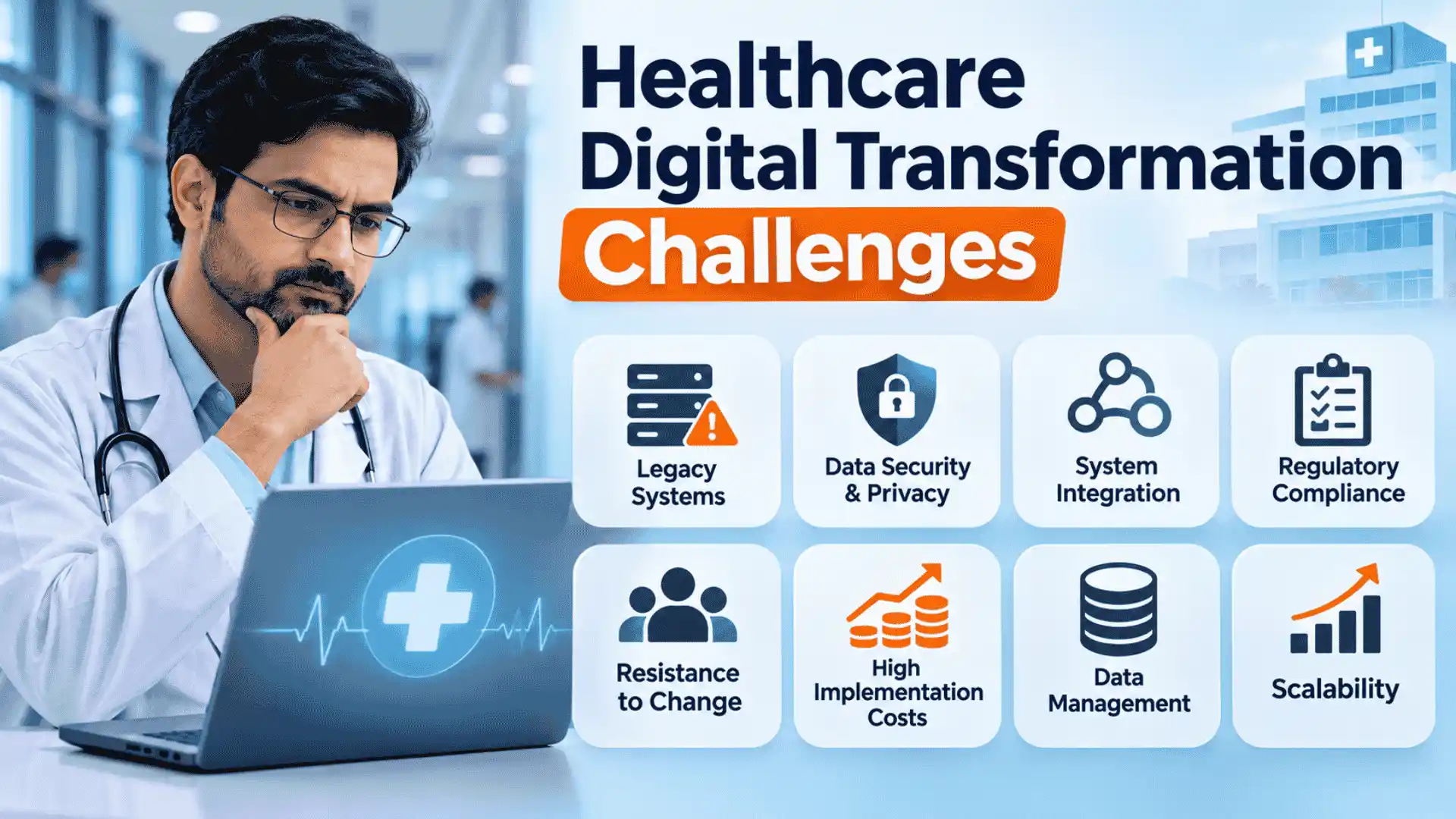
1. Legacy healthcare systems
Many hospitals still rely on aging software that was developed years ago.
Common problems include:
- Slow performance
- Outdated technology
- Limited scalability
- Difficult integrations
- High maintenance costs
Replacing these systems without interrupting patient care is one of the biggest digital transformation challenges.
2. Data security and patient privacy
Healthcare organizations store large amounts of confidential patient information.
Protecting this data requires:
- Secure authentication
- Role-based access
- Data encryption
- Security monitoring
- Regular software updates
Building secure healthcare applications should always be a priority during digital transformation.
3. Integrating multiple healthcare systems
Healthcare providers often use separate systems for:
- Electronic Health Records
- Billing
- Pharmacy
- Laboratory Management
- Appointment Scheduling
- Insurance Claims
Connecting these systems allows information to move securely across departments and improves operational efficiency.
Experienced Software Development Teams can help integrate legacy and modern healthcare applications.
4. Meeting compliance requirements
Healthcare organizations must follow strict regulations for handling patient information.
Digital platforms should support:
- Secure data storage
- Audit logs
- Access controls
- Compliance reporting
- Record management
Planning compliance early helps reduce project risks and avoids costly changes later.
5. Resistance to change
Technology alone does not guarantee success. Employees also need to adopt new ways of working.
Healthcare organizations often face challenges such as:
- Limited user training
- Resistance to new workflows
- Poor communication during implementation
- Low user adoption
Providing proper training and ongoing support helps healthcare teams use new systems more effectively.
6. High implementation costs
Digital transformation requires investment in technology, infrastructure, security, and skilled professionals.
Common costs include:
- Software development
- Cloud migration
- System integration
- Data migration
- Infrastructure upgrades
- Employee training
A phased implementation approach helps organizations manage budgets while reducing project risks.
7. Managing large volumes of healthcare data
Hospitals generate massive amounts of patient and operational data every day.
Without proper data management, organizations may face:
- Duplicate records
- Data inconsistencies
- Slow reporting
- Poor decision-making
Modern healthcare platforms should support secure, centralized, and accurate data management.
8. Scaling healthcare systems
As healthcare organizations expand, their technology should grow with them.
Modern software should support:
- Multiple hospitals and clinics
- More patients
- Higher user traffic
- New healthcare services
- Future integrations
Scalable platforms reduce maintenance costs and support long-term business growth.
How can healthcare organizations overcome these challenges?
Successful digital transformation starts with a clear strategy instead of adopting technology without a plan.
Healthcare providers should:
- Modernize legacy systems in phases.
- Prioritize data security from the beginning.
- Integrate existing healthcare applications.
- Choose scalable cloud infrastructure.
- Train healthcare professionals before launch.
- Monitor performance after implementation.
Working with experienced Dedicated Development Teams helps organizations reduce project risks and speed up delivery.
How TeamBees helps healthcare organizations
TeamBees builds secure and scalable healthcare software for hospitals, clinics, healthcare providers, and life sciences organizations.
Our expertise includes:
- Custom Software Development
- Cloud Migration
- System Integration
- QA Automation
- DevOps
- Data Engineering
- AI Solutions
- Staff Augmentation
Learn more about our Healthcare Software Development Services and Dedicated Development Teams for enterprise healthcare projects.
Related articles
- AI vs Hiring: Which is More Cost Effective?
- Why Most AI Agent Projects Fail: The Engineering Challenges Businesses Overlook
- How to Reduce Software Development Costs Without Hiring More Developers
Frequently Asked Questions
What is healthcare digital transformation?
Healthcare digital transformation is the process of improving healthcare services using modern technology such as hospital management systems, patient portals, cloud platforms, mobile applications, and integrated healthcare software.
Why do healthcare digital transformation projects fail?
Many projects struggle because of:
- Legacy systems
- Poor planning
- Limited user adoption
- Weak system integration
- Data security concerns
- Budget overruns
- Lack of skilled development teams
A clear implementation strategy helps reduce these risks.
How long does healthcare digital transformation take?
The timeline depends on the size and complexity of the organization.
A small modernization project may take a few months, while enterprise-wide transformation across multiple hospitals or healthcare facilities can take a year or longer.
Many organizations deliver projects in phases to reduce disruption.
What technologies are commonly used?
Healthcare organizations commonly invest in:
- Cloud platforms
- Electronic Health Records (EHR)
- Hospital Management Systems
- Patient Portals
- Mobile Apps
- API Integrations
- Data Platforms
- AI-powered Healthcare Solutions
Choosing the right technology depends on business goals rather than following market trends.
How can healthcare organizations reduce project risks?
Successful organizations usually:
- Define business objectives first.
- Modernize systems gradually.
- Protect patient data from day one.
- Integrate existing applications.
- Train healthcare staff before launch.
- Work with experienced technology partners.
Common mistakes to avoid
Healthcare organizations often delay projects because they make avoidable mistakes.
Some of the most common include:
- Replacing every system at once
- Ignoring staff training
- Underestimating data migration
- Choosing technology before defining business goals
- Delaying security planning
- Skipping user testing
- Not planning for future growth
Avoiding these mistakes increases the chances of a successful implementation.
Why choose TeamBees for healthcare software development?
Healthcare organizations need technology partners who understand enterprise software, secure integrations, and long-term scalability.
TeamBees supports healthcare providers with:
- Healthcare Software Development
- Staff Augmentation
- Dedicated Development Teams
- Cloud Engineering Services
- DevOps Engineers
- QA Automation Engineers
- Data Engineers
Our teams help healthcare organizations modernize applications, improve operational efficiency, and build software that supports future growth.
Final thoughts
Healthcare digital transformation is not just about replacing old software. It is about building secure, scalable, and connected systems that improve patient care and simplify daily operations.
Organizations that modernize in phases, invest in secure technology, and work with experienced software development teams are better prepared for future growth while reducing implementation risks.
Digital transformation is a long-term journey, but with the right strategy and technology partner, healthcare providers can deliver better experiences for both patients and healthcare professionals.