Enterprise AI Development Cost: What Should You Budget?
Planning an enterprise AI project? Learn what drives AI development costs, hidden expenses to avoid, budgeting best practices, and how to maximize ROI through AI automation, AI integration, and custom AI solutions.
Enterprise AI is no longer a future investment. It has become a business priority for organizations looking to improve productivity, automate operations, reduce costs, and deliver better customer experiences.
The challenge isn't deciding whether to invest in AI.
The real challenge is understanding how much an enterprise AI project actually costs and how to budget correctly.
Many organizations underestimate implementation costs by focusing only on software licenses. Successful AI initiatives require planning, data preparation, integration, governance, infrastructure, and ongoing optimization.
According to McKinsey's The State of AI 2025, 78% of organizations now use AI in at least one business function, while companies continue increasing AI investments because measurable business value is growing.
This guide explains the real cost of enterprise AI development, the factors that influence pricing, hidden expenses, and how business leaders can maximize ROI.
Why Enterprise AI Costs Vary So Much
There is no fixed price for enterprise AI.
The total investment depends on several business and technical factors.
These include:
- Business objectives
- Number of AI use cases
- Existing infrastructure
- Data quality
- Security requirements
- Compliance regulations
- System integrations
- Model complexity
- User adoption
For example:
An AI chatbot answering FAQs costs significantly less than an enterprise AI platform connected to ERP, CRM, HRMS, finance systems, and internal knowledge bases.
What Does Enterprise AI Development Include?
Many executives think AI development means building a chatbot.
In reality, enterprise AI projects involve multiple components working together.
| Component | Purpose |
|---|---|
| AI Strategy | Define business goals and ROI |
| Data Engineering | Prepare enterprise data |
| AI Model Development | Train or customize models |
| API Integration | Connect existing systems |
| Security & Governance | Protect sensitive information |
| Testing | Validate AI accuracy |
| Deployment | Launch into production |
| Continuous Improvement | Optimize over time |
Ignoring any of these areas often leads to delayed projects and poor adoption.
Average Enterprise AI Development Costs
The budget depends on the project's complexity.
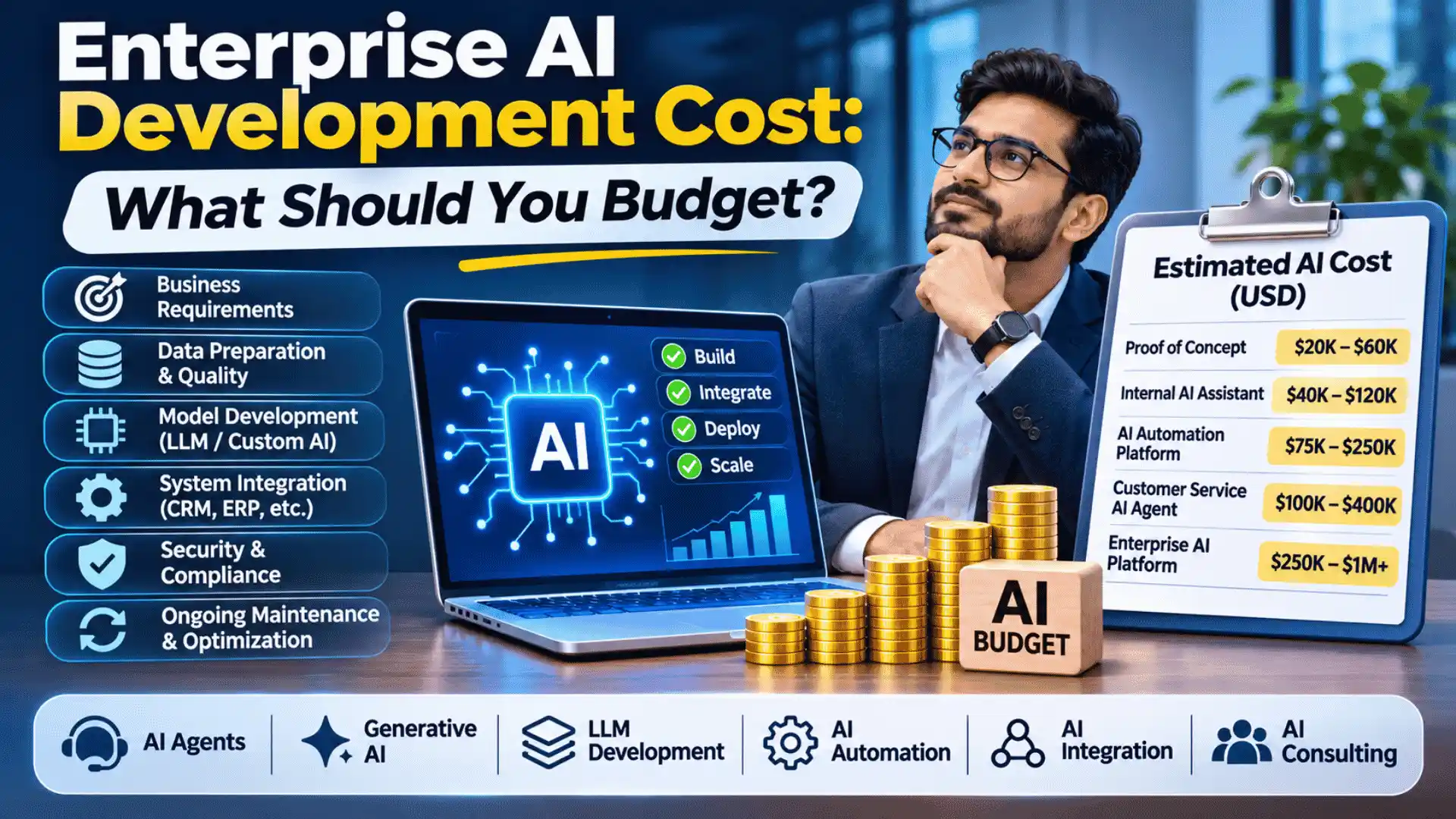
| Project Type | Estimated Cost (USD) |
|---|---|
| AI Proof of Concept | $20,000–$60,000 |
| Internal AI Assistant | $40,000–$120,000 |
| AI Automation Platform | $75,000–$250,000 |
| Customer Service AI Agent | $100,000–$400,000 |
| Enterprise AI Platform | $250,000–$1M+ |
These ranges vary depending on customization, integrations, security, compliance, and deployment requirements.
What Drives Enterprise AI Costs?
1. Business Requirements
Simple AI solutions cost less because they solve one problem.
Enterprise AI often supports:
- Customer support
- Sales
- HR
- Finance
- Procurement
- Operations
- Knowledge management
The broader the scope, the higher the investment.
2. Data Quality
AI is only as good as the data behind it.
Poor-quality data increases costs because teams spend more time:
- Cleaning records
- Removing duplicates
- Standardizing formats
- Organizing documents
- Building data pipelines
Gartner estimates poor data quality costs organizations millions annually through inefficiencies and poor decision-making.
3. AI Model Selection
Organizations typically choose between:
- Public LLMs
- Open-source models
- Fine-tuned models
- Fully custom models
Businesses requiring industry-specific knowledge often benefit from LLM Development rather than relying entirely on generic AI models.
Custom models increase development costs but often improve long-term business value.
4. System Integration
Most enterprises already use:
- SAP
- Salesforce
- Microsoft Dynamics
- ServiceNow
- Oracle
- Workday
- SharePoint
Connecting AI with existing systems requires secure APIs, authentication, workflow automation, and governance.
This is where AI Integration becomes one of the largest cost drivers.
5. Security and Compliance
Enterprise AI must protect:
- Customer data
- Financial information
- Employee records
- Intellectual property
Organizations operating under GDPR, HIPAA, SOC 2, ISO 27001, or PCI DSS typically invest more in security, auditing, encryption, and governance.
Security should never be treated as an optional expense.
Hidden Costs Businesses Often Miss
Many AI budgets focus only on development.
Hidden expenses include:
- Employee training
- Change management
- AI governance
- Monitoring
- Infrastructure scaling
- API usage fees
- Prompt optimization
- Model retraining
- Performance monitoring
- Ongoing maintenance
These recurring costs should be included in every enterprise AI budget.
AI Automation Often Delivers the Fastest ROI
Before building large AI platforms, many organizations begin with workflow automation.
Examples include:
- Invoice processing
- Document approvals
- HR onboarding
- CRM updates
- Customer support routing
- Procurement workflows
Using AI Automation allows businesses to reduce operational costs while proving ROI before expanding AI initiatives.
AI Agents Reduce Operational Costs
Many repetitive business tasks no longer require manual intervention.
Modern AI Agents can:
- Answer employee questions
- Retrieve company knowledge
- Generate reports
- Schedule meetings
- Route support tickets
- Analyze documents
Instead of increasing headcount, organizations improve productivity using intelligent automation.
The best AI investment is one that removes repetitive work while helping employees focus on higher-value activities.