Why Most AI Agent Projects Fail: The Engineering Challenges Businesses Overlook
Most AI agent projects fail because businesses overlook critical engineering challenges like data quality, system integration, security, governance, and monitoring. Learn why enterprise AI initiatives struggle and discover practical strategies for building reliable, scalable AI agents that deliver measurable business results.
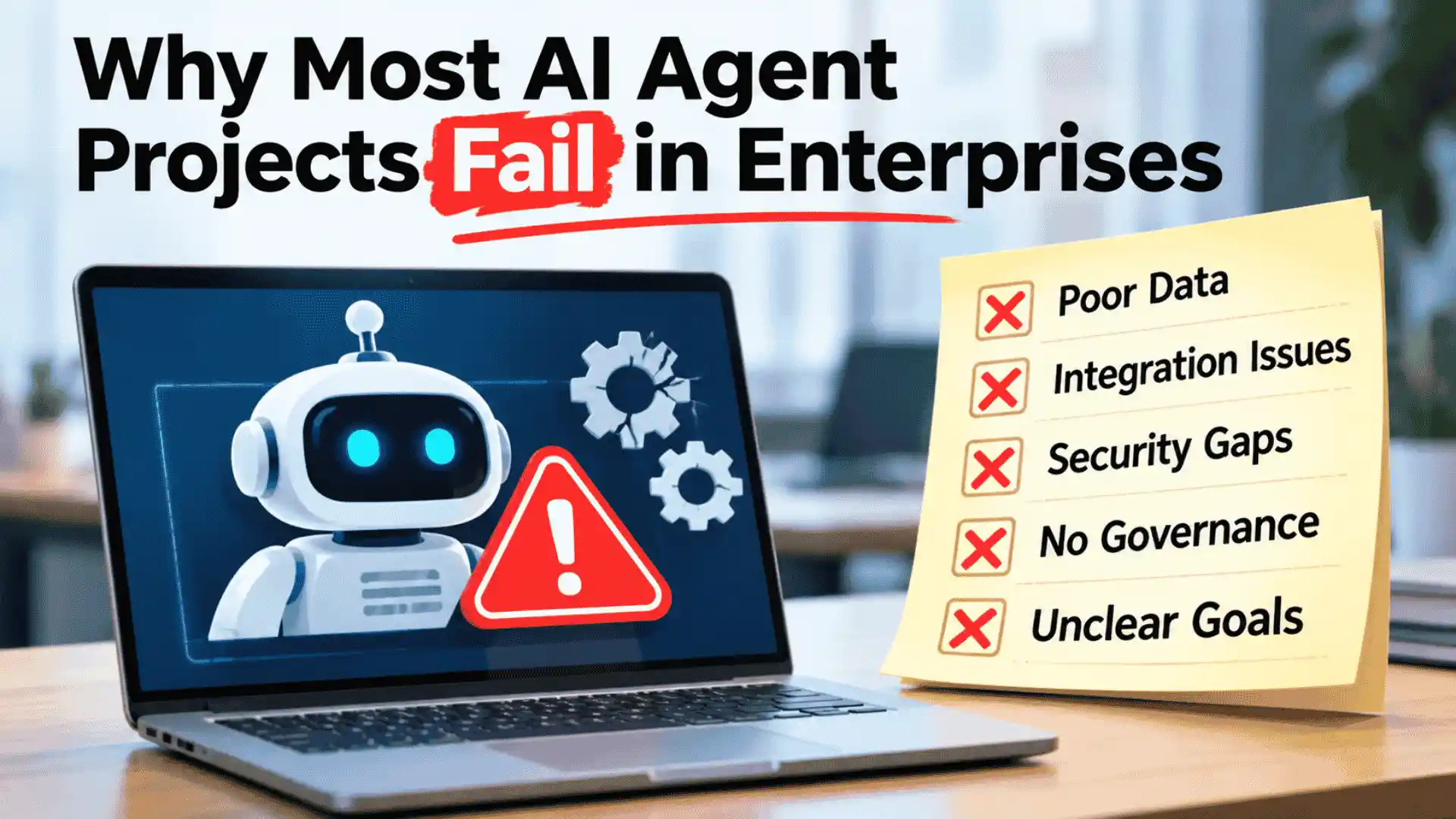
Most AI agent projects fail because businesses focus on the AI model instead of the engineering behind it. Success depends on high-quality data, system integration, governance, monitoring, security, and clear business objectives. Companies that treat AI agents as engineering projects, rather than software purchases, achieve better ROI and long-term adoption.
Why do so many AI agent projects fail?
AI agents have become one of the biggest technology investments for enterprise companies.
However, many projects never move beyond pilot stages.
Common reasons include:
- Poor planning
- Unclear business objectives
- Weak data quality
- Limited system integration
- Unrealistic expectations
- Lack of engineering expertise
Many organizations believe deploying an AI model automatically creates business value.
In reality, the AI model is only one part of a successful AI agent.
What do businesses misunderstand about AI agents?
Many companies think an AI agent is simply a chatbot.
It isn't.
A true AI Agent can:
- Understand business goals
- Retrieve enterprise knowledge
- Interact with multiple systems
- Execute predefined workflows
- Make decisions within approved rules
- Learn from user interactions
- Support employees across departments
Building this requires much more than selecting an LLM.
Why is engineering more important than the AI model?
Many AI projects spend weeks selecting the "best" model.
Far fewer invest time designing the engineering architecture.
A production-ready AI agent requires:
- Reliable APIs
- Authentication
- Data pipelines
- Business logic
- Error handling
- Monitoring
- Logging
- Security controls
- Human approval workflows
Without these components, even the most advanced language model struggles in production.
Successful AI agents are built on strong engineering foundations, not just powerful AI models.
How does poor data cause AI agent failures?
AI agents can only work with the information available to them.
If business data is:
- Outdated
- Incomplete
- Duplicated
- Poorly organized
- Difficult to access
the AI agent produces unreliable responses.
Before deploying AI, organizations should improve:
- Documentation
- Internal knowledge bases
- Data quality
- Content governance
- Information architecture
Many companies underestimate how much preparation is required before AI delivers reliable results.
Why is AI integration one of the biggest challenges?
An AI agent becomes valuable only after it connects with existing business systems.
Without proper AI Integration Services, an AI agent cannot:
- Access CRM data
- Retrieve ERP information
- Update customer records
- Create support tickets
- Trigger workflows
- Read internal documentation
Integration is often more complex than building the AI itself.
Organizations that plan integration early usually achieve faster adoption and higher business value.
Why do businesses choose the wrong AI use cases?
Many organizations start with technology instead of business problems.
Instead, ask:
- Which tasks consume the most employee time?
- Which workflows are repetitive?
- Where do delays occur?
- Which processes follow predictable rules?
These are often the best opportunities for AI Automation Services.
Starting with high-value business problems improves adoption and delivers measurable ROI.
Can Generative AI solve every business problem?
No.
Generative AI Solutions are excellent for:
- Content generation
- Knowledge retrieval
- Document summarization
- Customer support
- Internal assistants
They are less suitable for:
- Real-time financial decisions
- Regulatory approvals
- High-risk medical decisions
- Legal compliance without human review
- Autonomous business decisions
The best enterprise AI systems combine automation with human oversight.
Why is choosing the right LLM only a small part of the project?
Many businesses spend weeks comparing AI models.
Should we use GPT?
Claude?
Gemini?
Open-source models?
While model selection matters, it is rarely the biggest reason AI agent projects succeed or fail.
A production-ready LLM Development project also requires:
- Reliable APIs
- Context management
- Retrieval systems
- Prompt engineering
- Security controls
- Monitoring
- Performance optimization
- Cost management
A powerful model cannot compensate for weak engineering.
Why do AI agents produce incorrect answers?
One of the biggest enterprise concerns is AI hallucination.
This happens when an AI agent generates responses that sound confident but are inaccurate or unsupported.
Common causes include:
- Poor prompts
- Missing business context
- Outdated documentation
- Weak knowledge retrieval
- Low-quality training data
- Missing validation rules
Rather than allowing AI to answer every question independently, successful organizations combine Generative AI Solutions with trusted company knowledge and human review for critical workflows.
Why does prompt engineering alone not solve the problem?
Many companies believe better prompts automatically create better AI agents.
Prompt engineering is important, but it cannot replace:
- Clean business data
- Reliable integrations
- Access controls
- Workflow design
- Business rules
- Engineering architecture
Good prompts improve responses.
Good engineering creates reliable AI systems.
Why are security and compliance often overlooked?
Enterprise AI agents frequently access sensitive business information.
Without proper controls, they may expose:
- Customer data
- Financial records
- Internal documentation
- Employee information
- Business strategies
Every enterprise AI implementation should include:
- Role-based access control
- Encryption
- Audit logging
- Authentication
- Data masking
- Approval workflows
Working with experienced AI Consulting Services helps organizations design AI systems that meet security and compliance requirements from the beginning.
Why is monitoring important after deployment?
Many businesses treat AI deployment as the finish line.
In reality, deployment is only the beginning.
AI agents should continuously monitor:
- Response quality
- Accuracy
- API failures
- Latency
- User satisfaction
- Token usage
- Operating costs
- Business outcomes
Without ongoing monitoring, performance often declines as business data and user needs change.
Can AI agents scale without proper engineering?
Usually not.
As usage grows, AI agents must handle:
- Thousands of users
- Multiple business systems
- Large knowledge bases
- High API traffic
- Complex workflows
- Enterprise security policies
Scalable AI Development Services focus on architecture that supports long-term growth rather than just delivering a successful pilot.
Should businesses build AI agents internally?
It depends on internal expertise.
Organizations with experienced AI engineers may choose to build internally.
Others reduce project risk by combining internal teams with external specialists through:
This approach provides faster access to AI engineers, solution architects, and machine learning specialists while maintaining business control.
What separates successful AI agent projects from failed ones?
Successful organizations share several characteristics.
They:
- Start with a clear business problem.
- Build strong engineering foundations.
- Invest in high-quality business data.
- Integrate AI with existing systems.
- Establish governance and security controls.
- Continuously monitor performance.
- Improve AI using real user feedback.
Instead of asking, "Which AI model should we use?" they ask, "How will this AI agent improve our business?"
AI agents succeed when engineering, data, security, and business strategy work together. The AI model is only one piece of the solution.
What mistakes do businesses make during AI agent implementation?
Many AI initiatives fail before employees even begin using them.
Common implementation mistakes include:
- Starting without a business objective
- Trying to automate every process at once
- Ignoring user feedback
- Choosing technology before defining requirements
- Underestimating integration complexity
- Skipping security planning
- Expecting immediate ROI
Successful companies start with one high-impact business problem, measure results, and expand gradually.
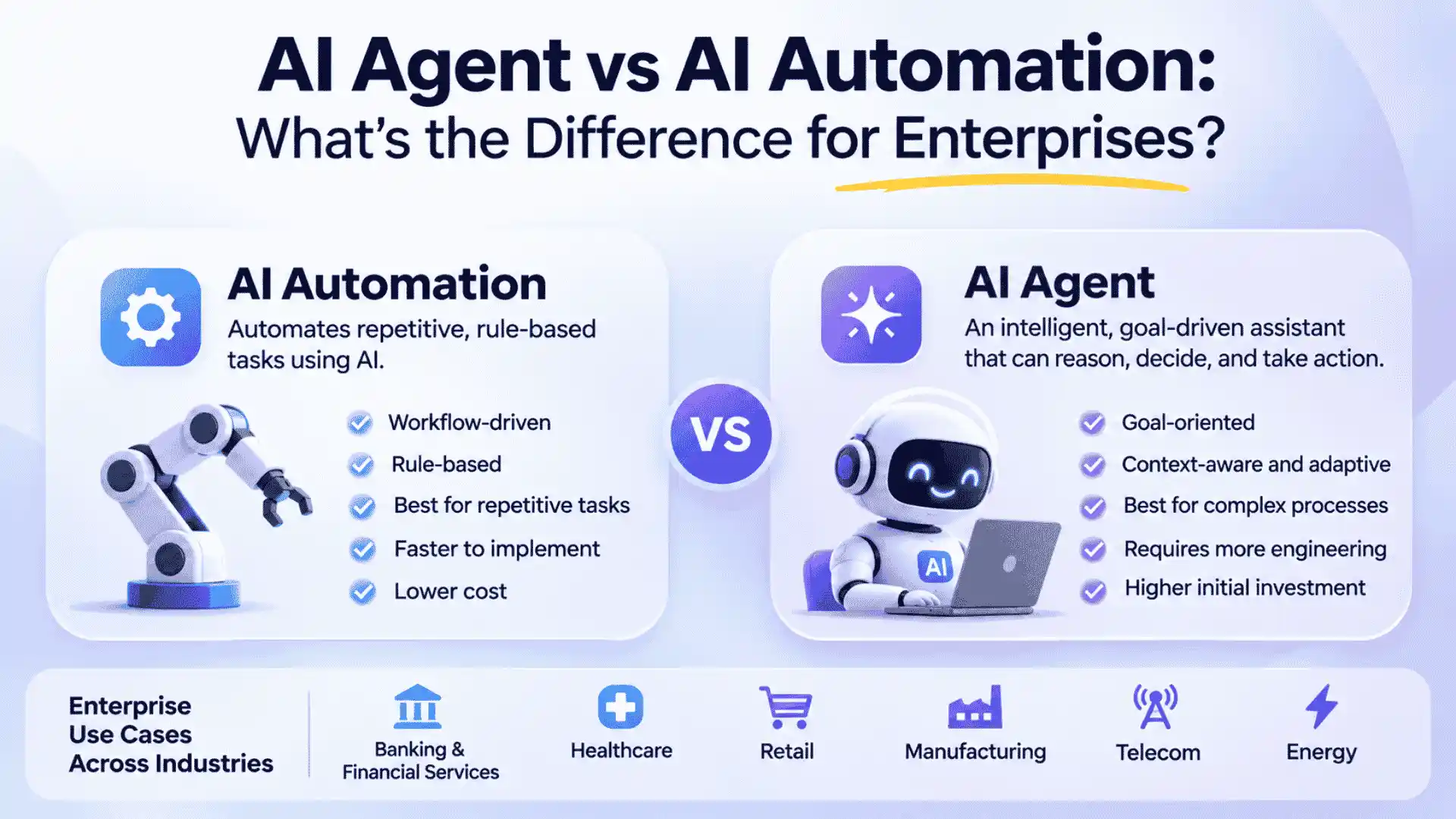
How are AI agents different from AI automation?
Although these terms are often used interchangeably, they solve different business challenges.
| AI Automation | AI Agents |
|---|---|
| Automates predefined workflows | Makes decisions within defined rules |
| Follows fixed business logic | Can adapt based on context |
| Best for repetitive tasks | Best for complex workflows |
| Limited reasoning | Context-aware reasoning |
| Lower implementation complexity | Higher engineering complexity |
Many organizations begin with AI Automation Services before expanding into enterprise AI Agents.
Why do businesses struggle to measure AI ROI?
Many companies expect AI to generate immediate financial returns.
In reality, successful AI projects often deliver value in stages.
Early benefits include:
- Faster employee productivity
- Reduced manual work
- Better customer response times
- Improved knowledge access
- Higher process consistency
Long-term benefits include:
- Lower operating costs
- Better customer experience
- Faster decision-making
- Greater scalability
- Increased business efficiency
Organizations that define measurable KPIs before implementation are more likely to achieve positive ROI.
Why should AI always include human oversight?
AI agents are becoming increasingly capable, but they should not operate without appropriate controls.
Human oversight is essential for:
- Financial approvals
- Legal decisions
- Medical recommendations
- Security incidents
- Customer escalations
- Strategic business decisions
The most reliable enterprise AI systems combine automation with human expertise rather than replacing decision-makers.
How can businesses prepare before building an AI agent?
Preparation often determines project success.
Before starting, businesses should ask:
- What business problem are we solving?
- Which processes are repetitive?
- Is our business data accurate?
- Which systems require integration?
- Who will maintain the AI solution?
- How will success be measured?
- What security requirements must be met?
- What happens if the AI cannot complete a task?
Answering these questions reduces implementation risks and improves adoption.
Why is the right engineering team critical?
Building enterprise AI requires expertise across multiple disciplines.
Successful projects often involve:
- AI engineers
- Software developers
- Data engineers
- Cloud engineers
- Security specialists
- Product managers
- Solution architects
Many organizations accelerate implementation through Staff Augmentation or Dedicated Development Teams, giving them access to experienced AI talent without lengthy recruitment cycles.
What role does AI consulting play in project success?
Many failed AI initiatives share one common issue: they started with technology instead of business strategy.
Experienced AI Consulting Services help organizations:
- Identify high-value AI opportunities
- Prioritize implementation phases
- Select the right architecture
- Estimate costs and ROI
- Reduce deployment risks
- Build long-term AI roadmaps
A clear strategy often delivers more value than simply adopting the latest AI tools.
What separates successful AI agent projects?
Successful organizations focus on solving business problems, not showcasing technology.
They:
- Define measurable objectives.
- Build scalable engineering architectures.
- Improve data quality.
- Integrate AI with existing systems.
- Implement strong governance.
- Monitor performance continuously.
- Keep humans involved in critical decisions.
- Improve the solution based on real user feedback.
These organizations view AI as a long-term capability rather than a one-time software project.
The most successful AI agent projects are built around business outcomes, supported by strong engineering, and continuously improved after deployment.
FAQs
Why do most AI agent projects fail?
Most AI agent projects fail because organizations focus on choosing an AI model instead of building the engineering foundation around it. Poor data quality, weak system integration, unclear business goals, security gaps, and lack of monitoring are the most common reasons projects fail.
What is the biggest challenge when building AI agents?
Engineering is usually the biggest challenge.
A successful AI agent requires:
- Reliable data
- Secure integrations
- Business workflows
- Human approval processes
- Monitoring
- Governance
- Performance optimization
The AI model itself is only one component of the overall solution.
Do AI agents replace employees?
No.
AI agents automate repetitive and rule-based work, allowing employees to focus on strategic decisions, customer relationships, innovation, and problem-solving.
The best enterprise organizations use AI to increase employee productivity rather than replace their workforce.
Should businesses build custom AI agents?
If AI will become part of your long-term business strategy, custom AI agents often provide better value.
Custom solutions offer:
- Business-specific workflows
- Better security
- Greater scalability
- Integration with enterprise systems
- More control over business data
Many organizations build these solutions through AI Development Services and LLM Development Services.
Why is AI integration so important?
An AI agent becomes useful only when it can interact with your existing business systems.
Using AI Integration Services allows AI agents to securely connect with CRMs, ERPs, internal knowledge bases, support platforms, and business applications, making automation far more effective.
How can businesses improve AI project success?
Successful organizations usually follow these best practices:
- Start with one business problem.
- Improve data quality.
- Build secure integrations.
- Measure business outcomes.
- Keep humans involved in critical decisions.
- Monitor AI performance continuously.
- Expand gradually after proving ROI.
This approach reduces implementation risks and improves long-term adoption.
How can TeamBees help build enterprise AI agents?
Building enterprise AI agents requires more than selecting a language model. It requires the right engineering expertise, scalable architecture, and deep integration with business systems.
TeamBees helps organizations:
- Build custom AI applications
- Develop enterprise AI agents
- Create Generative AI solutions
- Build custom LLM applications
- Automate business workflows
- Integrate AI with existing software
- Design secure AI architectures
- Scale AI engineering teams
Our enterprise AI capabilities include:
- AI Development Services
- AI Agents
- Generative AI Solutions
- LLM Development Services
- AI Automation Services
- AI Consulting Services
- AI Integration Services
For organizations that need additional engineering capacity, we also provide:
- Staff Augmentation
- Hire Dedicated Developers
- Dedicated Development Teams
- Offshore Development Center
Final thoughts
AI agents are transforming how enterprises operate, but technology alone does not guarantee success.
The organizations achieving the strongest results focus on solving real business problems, building reliable engineering foundations, integrating AI with existing systems, and continuously improving performance after deployment.
Instead of asking, "Which AI model should we choose?", ask, "How can AI create measurable business value for our organization?"
That shift in thinking is what separates successful AI projects from expensive experiments.
Successful AI agents are built on strong engineering, trusted data, secure integrations, and clear business objectives, not just advanced AI models.
Ready to build AI agents that deliver real business value?
Whether you're planning your first AI initiative or scaling enterprise AI across your organization, TeamBees can help.
From AI strategy and consulting to custom AI agents, LLM development, automation, and system integration, our experts build secure, scalable AI solutions designed for enterprise growth.
Explore our AI Development Services or connect with our team to discuss your AI roadmap.