Why Your Teams Still Waste Hours on Manual Work
Despite digital transformation, many enterprise teams still waste hours on repetitive manual tasks. Learn why it happens and how IT Staff Augmentation accelerates automation and productivity.
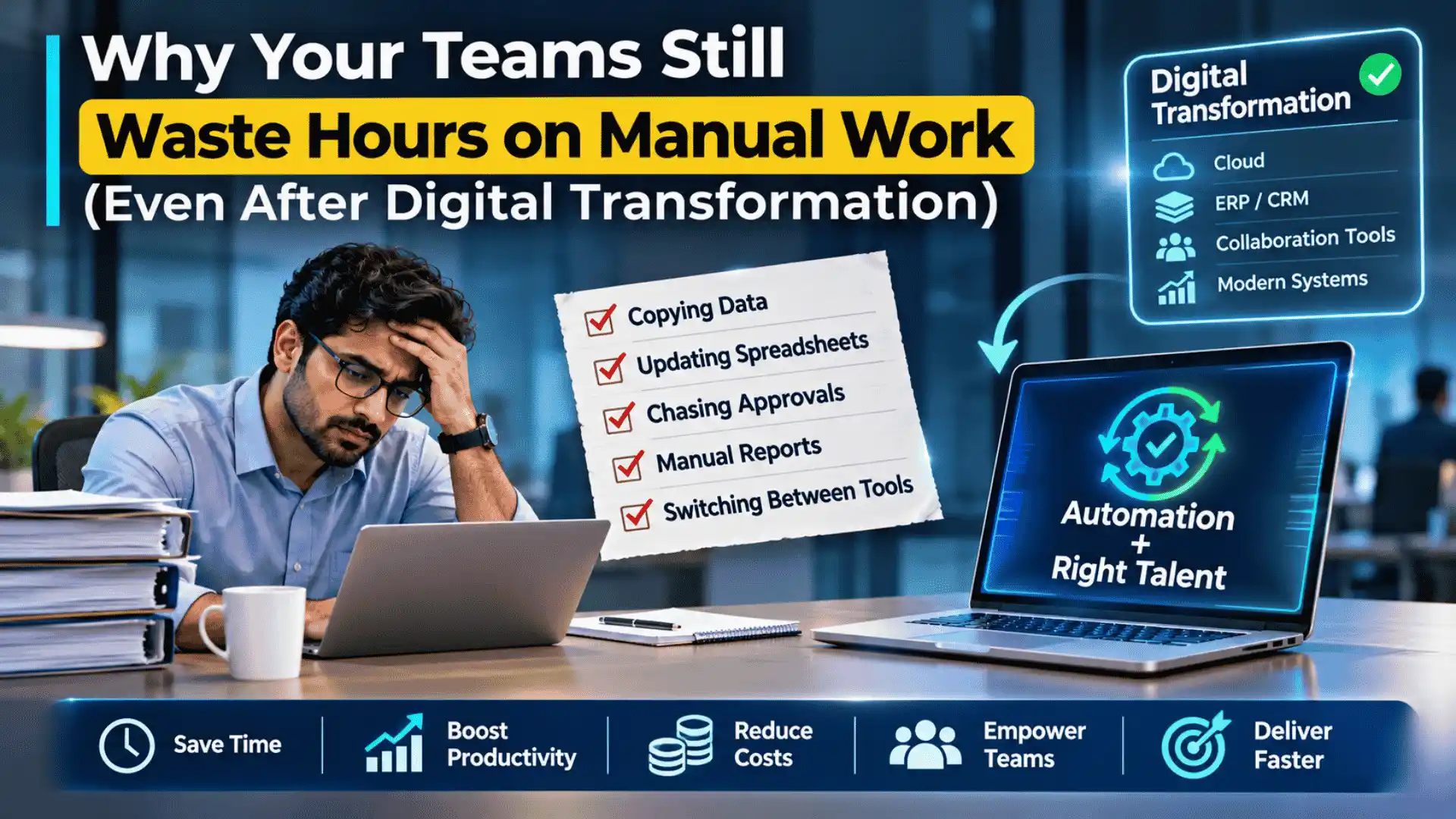
Most enterprises have invested heavily in digital transformation, cloud platforms, ERP systems, CRMs, and collaboration tools. Yet many teams still spend hours every week copying data, chasing approvals, updating spreadsheets, and switching between applications.
If your employees are still doing repetitive work, your digital transformation is incomplete.
According to Smartsheet's Automation in the Workplace Report, more than 40% of employees spend at least one-quarter of their work week on repetitive manual tasks, while nearly 60% believe automation could save them six or more hours every week.
The issue isn't a lack of technology.
The issue is disconnected systems, inefficient workflows, and limited engineering capacity to automate business processes.
Why Are Enterprises Still Losing Productivity After Digital Transformation?
Digital transformation often focuses on purchasing software instead of improving business processes.
Many organizations successfully implement platforms like:
- Microsoft 365
- Salesforce
- SAP
- Oracle
- ServiceNow
- Workday
- Jira
- HubSpot
Yet employees continue to:
- Copy information between systems
- Export and import Excel files
- Send approval emails
- Prepare weekly reports manually
- Follow up across departments
- Search for information in multiple applications
The software changed.
The workflow didn't.
The Hidden Cost of Manual Work
Most executives only see payroll costs.
They rarely calculate the hidden operational cost of repetitive work.
| Business Impact | Hidden Cost |
|---|---|
| Manual reporting | Slow business decisions |
| Data entry | Human errors |
| Approval delays | Lost productivity |
| Repetitive tasks | Employee burnout |
| Multiple systems | Lower customer experience |
| Hiring more staff | Higher operating costs |
Every hour spent on repetitive work is an hour not spent serving customers or growing the business.
Digital Doesn't Mean Automated
Many companies believe they've automated because they've digitized paperwork.
Unfortunately, these are two very different things.
Before Digital Transformation
- Employee fills paper form
- Manager signs document
- HR updates records manually
After Digital Transformation
- Employee fills online form
- Manager approves through email
- HR still updates multiple systems manually
The process became digital.
It never became automated.
Why CEOs and CXOs Should Care
Manual work doesn't only affect employees.
It directly impacts business growth.
Slower Decision Making
Executives often wait days for reports because someone still prepares them manually.
By the time the report reaches leadership, the information is already outdated.
Rising Operational Costs
Many organizations solve workflow problems by hiring more employees.
Instead of improving productivity, they increase headcount.
Employee Burnout
Nobody enjoys copying data between applications all day.
High-performing employees want to solve business problems, not repetitive administrative work.
Lower Customer Satisfaction
Every manual approval, delayed invoice, or disconnected workflow slows customer response times.
Customers notice.
The Biggest Bottleneck Isn't AI
Many organizations believe Artificial Intelligence will solve productivity challenges overnight.
It won't.
AI performs best when workflows, systems, and data are already connected.
According to EY's Generative AI research, organizations can unlock 8 to 10 hours of productivity every week per knowledge worker, but only when AI is combined with workflow redesign, quality data, and operational transformation.
Without that foundation, AI simply automates inefficient processes.
AI doesn't fix broken workflows.
It accelerates them.
Common Manual Processes That Enterprises Still Handle Every Day
Even large organizations continue performing these tasks manually:
- Employee onboarding
- Vendor onboarding
- Invoice approvals
- Purchase requests
- Contract reviews
- Compliance reporting
- Customer onboarding
- Sales reporting
- Expense approvals
- HR documentation
- IT ticket routing
- Data synchronization
- Weekly dashboards
- Executive reporting
Each manual process creates delays, errors, and unnecessary costs.
Why Internal IT Teams Can't Fix Everything
This isn't because IT teams lack expertise.
It's because they're already busy.
Most enterprise engineering teams focus on:
- Production support
- Security updates
- Infrastructure management
- Customer issues
- Compliance
- Legacy system maintenance
- Product development
Workflow automation projects usually remain on the backlog for months.
Meanwhile, business teams continue losing valuable hours every week.
How IT Staff Augmentation Helps Enterprises Move Faster
Hiring permanent engineers for every automation initiative isn't always practical.
Recruitment can take months.
Business requirements can't wait.
This is where IT Staff Augmentation creates immediate value.
Experienced engineers integrate directly with your internal teams to accelerate delivery without increasing permanent headcount.
Organizations use Staff Augmentation to:
- Build workflow automation faster
- Modernize legacy applications
- Develop AI-powered business solutions
- Integrate enterprise systems
- Reduce project delays
- Scale engineering teams on demand
- Deliver transformation projects faster
Instead of waiting months to hire, enterprises can begin execution immediately.
Signs Your Organization Needs Automation Support
If any of these sound familiar, your business is likely losing productivity every day.
- Teams rely heavily on Excel
- Employees copy data between systems
- Reports take hours to prepare
- Approval processes are slow
- Systems don't communicate
- Departments work in silos
- Hiring increases but productivity doesn't
- Employees complain about repetitive work
These aren't employee problems.
They're workflow problems.
Questions Every CEO, CTO, and COO Should Ask
Before investing in another software platform, ask:
- Which workflows are still manual?
- Where do employees spend the most repetitive time?
- Which approvals create delays?
- Which business processes can AI automate?
- Do our systems communicate effectively?
- Do we have enough engineering capacity to implement automation?
The answers often reveal opportunities that deliver far greater ROI than purchasing another enterprise application.
How TeamBees Helps Enterprises Reduce Manual Work
At TeamBees, we help enterprises accelerate digital transformation through experienced engineering talent.
Our specialists work alongside your internal teams to:
- Build AI-powered business applications
- Automate repetitive workflows
- Integrate enterprise platforms
- Modernize legacy systems
- Develop intelligent automation solutions
- Scale engineering teams through IT Staff Augmentation
Whether you're launching an enterprise AI initiative, automating operations, or modernizing business systems, our engineers become an extension of your team and help deliver projects faster.
Final Thoughts
Digital transformation doesn't end when new software is deployed.
It succeeds when employees stop wasting time on repetitive work.
The organizations gaining the biggest competitive advantage today aren't simply buying more technology.
They're redesigning workflows, automating business operations, and strengthening their engineering capabilities.
If your enterprise is planning workflow automation, AI implementation, or digital transformation initiatives, TeamBees can help you accelerate delivery with experienced technology professionals who are ready to contribute from day one.