Custom AI vs Off-the-Shelf AI: Which Saves More Money?
Should you build a custom AI solution or use an off-the-shelf AI platform? This guide compares costs, ROI, scalability, security, and business value to help enterprises choose the right AI strategy for long-term success.
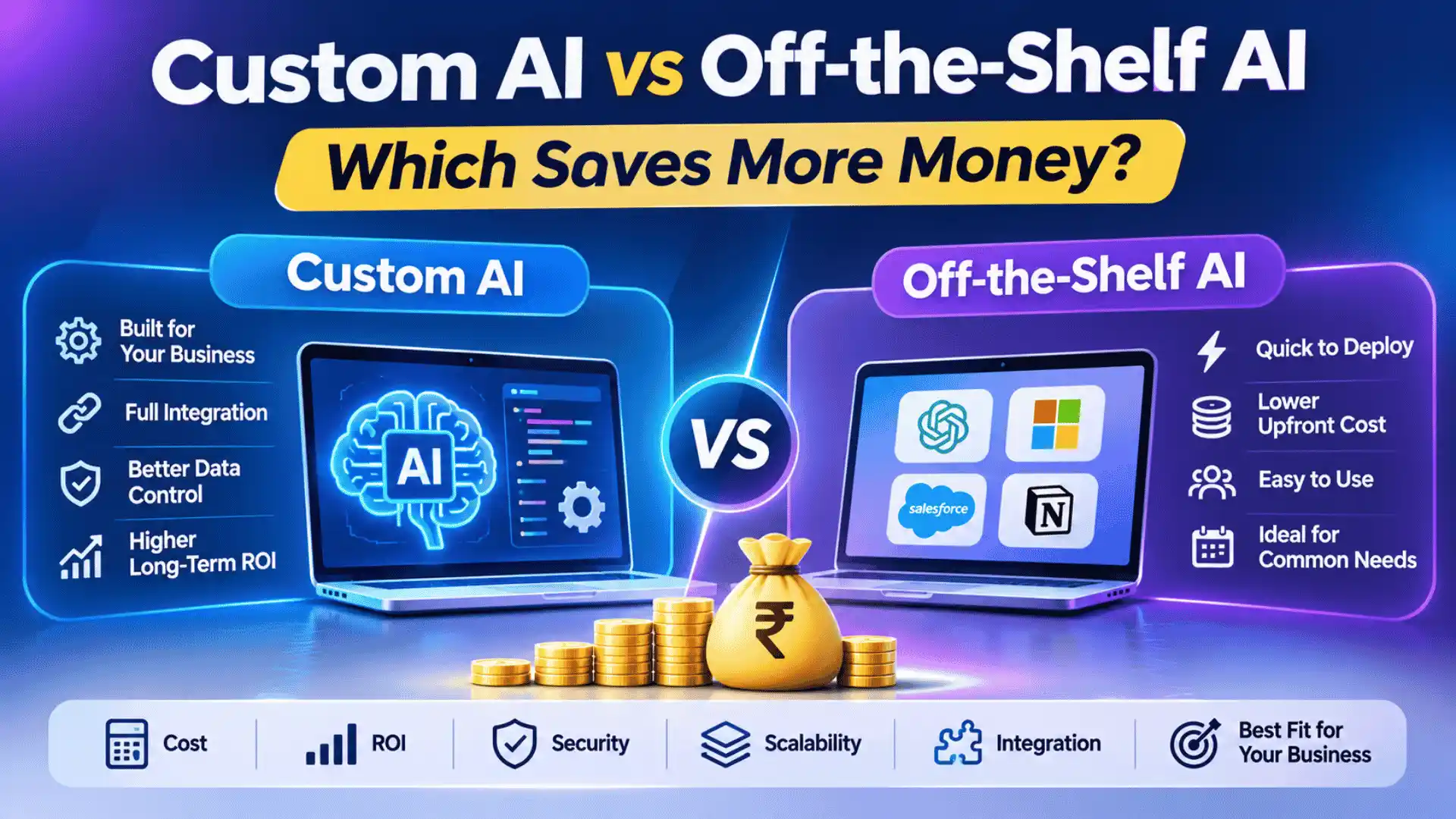
Custom AI vs Off-the-Shelf AI: Which Saves More Money?
AI is becoming a core investment for modern businesses. But before allocating budget, executives face a critical question:
Should we build a custom AI solution or buy an off-the-shelf AI platform?
The answer depends on your business goals, data, workflows, and long-term strategy.
Many organizations purchase AI software expecting immediate ROI, only to discover that generic tools don't fit their processes. Others invest heavily in custom AI when a ready-made solution would have solved the problem faster and at a lower cost.
According to McKinsey, organizations typically follow three approaches to AI adoption:
- Takers use off-the-shelf AI tools.
- Shapers customize existing AI models.
- Makers build proprietary AI solutions from scratch.
Interestingly, about 53% of enterprise AI use cases still rely primarily on off-the-shelf solutions, while 47% involve significant customization or proprietary development.
This article explains which option actually saves more money over time.
What Is Off-the-Shelf AI?
Off-the-shelf AI refers to software that's already built and ready to use.
Examples include:
- Microsoft Copilot
- ChatGPT Enterprise
- Salesforce Einstein
- GitHub Copilot
- Notion AI
- Zendesk AI
These platforms require little development and can often be deployed within days.
Businesses simply subscribe and start using them.
Advantages
- Fast deployment
- Low upfront investment
- Vendor-managed updates
- Easy implementation
- Suitable for common business tasks
Limitations
- Limited customization
- Monthly subscription costs
- Generic workflows
- Vendor lock-in
- Limited competitive differentiation
What Is Custom AI?
Custom AI is designed specifically for your organization.
Instead of adapting your business around software, the AI is built around your business.
Examples include:
- Custom AI Agents
- Private enterprise copilots
- Industry-specific document processing
- Intelligent workflow automation
- AI-powered customer support
- Predictive analytics
These systems are often developed using LLM Development and integrated with existing business applications.
Cost Comparison
| Cost Factor | Off-the-Shelf AI | Custom AI |
|---|---|---|
| Initial Cost | Low | High |
| Monthly Cost | Continuous | Lower after deployment |
| Customization | Limited | Unlimited |
| Ownership | Vendor | Business |
| Scalability | Moderate | High |
| Competitive Advantage | Low | High |
| Integration | Limited | Full |
| Data Control | Shared/Vendor | Private |
Hidden Costs Most Businesses Ignore
Many executives compare only subscription costs.
The real costs include:
- Employee productivity
- Manual work
- Integration complexity
- Data migration
- Security reviews
- Compliance
- Workflow redesign
- Vendor licensing
- API charges
These hidden costs often exceed software licensing.
Where Off-the-Shelf AI Saves Money
Buying ready-made AI makes sense when:
You Need Immediate Results
Implementation often takes days instead of months.
McKinsey reports that organizations commonly deploy off-the-shelf generative AI faster than highly customized solutions, while heavily customized implementations are significantly more likely to take five months or longer.
Your Use Case Is Common
Examples include:
- Email writing
- Meeting summaries
- Code generation
- Translation
- Content drafting
- Knowledge search
These don't require extensive customization.
Your Team Is Small
Small businesses usually don't need dedicated AI engineers.
Subscription software provides sufficient functionality.
Where Custom AI Saves More Money
Custom AI delivers better ROI when your workflows are unique.
Complex Business Processes
Enterprise operations rarely follow generic workflows.
For example:
- Insurance claims
- Banking approvals
- Manufacturing quality control
- Healthcare documentation
- Procurement workflows
These require custom automation.
Using AI Automation eliminates repetitive work while matching existing business processes.
Large Employee Base
Imagine:
2,000 employees
Each saves 30 minutes daily.
That's approximately 1,000 hours saved every day.
At enterprise scale, productivity gains quickly outweigh development costs.
McKinsey's latest global survey found that 80% of respondents say AI improves individual productivity, but only organizations that redesign workflows consistently achieve significant enterprise value.
Better Data Security
Many enterprises cannot send confidential data to public AI tools.
Custom AI enables:
- Private deployment
- Internal document access
- Secure APIs
- Compliance controls
- Role-based permissions
This is especially important in banking, healthcare, legal, and government sectors.
Better Integration
Businesses rarely operate with one system.
Typical enterprise stack includes:
- SAP
- Salesforce
- Oracle
- Microsoft 365
- Jira
- ServiceNow
- ERP
- CRM
Custom AI Integration connects AI directly into existing workflows instead of forcing employees to switch between applications.
ROI Comparison
| Scenario | Best Choice |
|---|---|
| Startup | Off-the-Shelf AI |
| Small Business | Off-the-Shelf AI |
| Growing Company | Hybrid Approach |
| Enterprise | Custom AI |
| Regulated Industry | Custom AI |
| Large Customer Support Team | Custom AI |
| Internal Knowledge Assistant | Custom AI |
| Content Creation | Off-the-Shelf AI |
Enterprise Reality
Many organizations start with ChatGPT or Copilot.
Later they discover problems:
- Employees use different prompts
- Data isn't connected
- AI cannot access internal systems
- Manual work continues
- Workflows remain fragmented
This is why enterprises gradually move toward customized AI.
McKinsey found that organizations increasingly combine ready-made AI with customized models rather than relying on a single approach.
The Hybrid Approach Is Often Best
Many successful companies don't choose one approach.
They combine both.
Example:
- ChatGPT Enterprise for general productivity
- Generative AI for internal knowledge
- Custom AI Agents for customer support
- AI Automation for workflows
- LLM Development for proprietary applications
This balances cost, speed, and long-term value.
Questions Every CEO Should Ask
Before choosing AI, ask:
- Will this reduce operational costs?
- Will this improve employee productivity?
- Can it integrate with our systems?
- Who owns the data?
- Can it scale?
- What happens after three years?
- Are subscription costs sustainable?
- Will this create competitive advantage?
How TeamBees Helps
At TeamBees, we help enterprises choose the right AI strategy based on business goals rather than technology trends.
Our services include:
- AI Consulting to identify high-value use cases
- AI Automation to eliminate manual work
- AI Integration with enterprise systems
- Generative AI applications
- LLM Development for secure enterprise solutions
- AI Agents for customer service and business operations
We focus on measurable ROI, secure deployment, and production-ready AI that aligns with your business objectives.
Final Verdict
There is no universal winner.
Choose Off-the-Shelf AI if:
- You need quick deployment.
- Your use case is standard.
- Your budget is limited.
- You need immediate productivity gains.
Choose Custom AI if:
- Your workflows are unique.
- Security and compliance are critical.
- You require deep system integration.
- You want long-term competitive advantage.
- You expect AI to become a core business capability.
The question isn't "Which AI costs less?"
The better question is:
"Which AI delivers the highest business value over the next five years?"
That shift in thinking is what separates organizations experimenting with AI from those generating measurable business outcomes. Recent McKinsey research shows that the highest-performing organizations redesign workflows, invest strategically, and measure AI impact rather than simply deploying new tools.