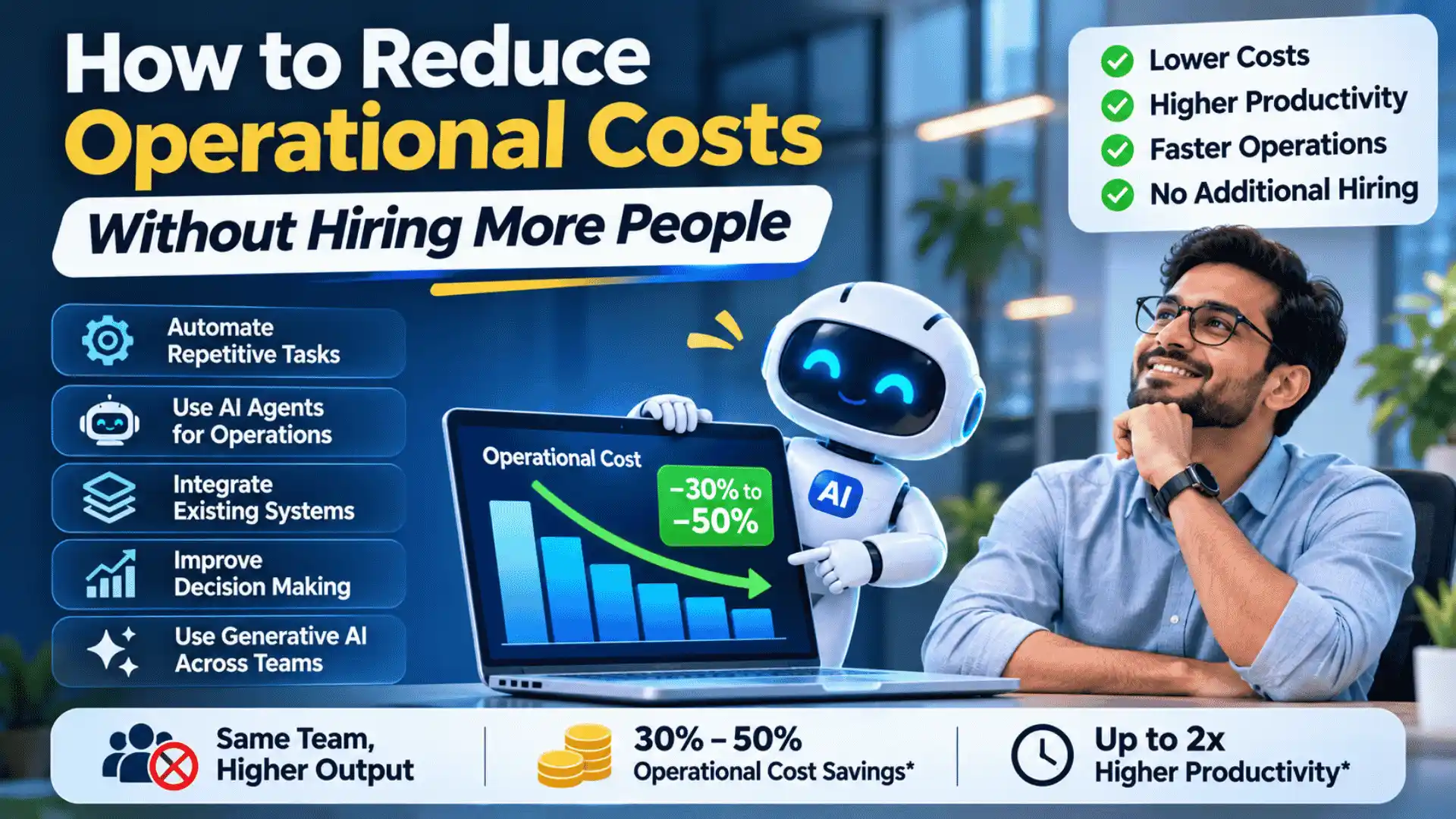
How to Reduce Operational Costs Without Hiring More People
Hiring more employees isn't the only way to grow. Learn how AI automation, AI agents, workflow optimization, and intelligent process improvements can reduce operational costs while helping your existing teams accomplish more.
Every growing business reaches a point where costs increase faster than productivity.
More customers require more support.
More projects require more coordination.
More data creates more manual work.
The traditional solution has always been simple: hire more people.
Today, that approach is becoming increasingly expensive.
Higher salaries, longer hiring cycles, onboarding costs, and employee turnover make workforce expansion a significant operational expense.
Fortunately, there is another way.
Modern businesses are reducing operational costs by redesigning workflows, automating repetitive tasks, and using AI to help existing teams accomplish more without increasing headcount.
According to McKinsey's 2026 State of AI survey, 80% of employees report higher productivity from AI, while organizations that redesign workflows around AI achieve the strongest financial outcomes.
This guide explains how business leaders can reduce operating expenses while increasing productivity, without hiring additional employees.
Why Hiring More People Isn't Always the Answer
Hiring solves capacity problems temporarily.
It rarely fixes inefficient processes.
Many companies unknowingly pay employees to perform repetitive tasks like:
- Copying data between systems
- Preparing reports
- Responding to common customer questions
- Manual invoice processing
- Email follow-ups
- Scheduling meetings
- Updating CRMs
- Document approvals
These activities consume valuable time but create little strategic value.
Instead of expanding teams, businesses should first eliminate unnecessary work.
Where Operational Costs Usually Increase
Most operational expenses fall into four categories.
| Cost Area | Common Problem |
|---|---|
| Labor | Growing headcount |
| Software | Multiple disconnected tools |
| Manual Processes | Repetitive work |
| Delays | Slow approvals and decision-making |
Most organizations can reduce costs by improving processes before increasing staff.
The Hidden Cost of Manual Work
Manual work creates expenses that rarely appear on financial statements.
Examples include:
- Slow customer response times
- Human errors
- Duplicate data entry
- Rework
- Delayed approvals
- Employee burnout
- Missed business opportunities
McKinsey notes that companies embedding AI across core operations report higher productivity and stronger profitability than those limiting AI to isolated experiments.
Strategy 1: Automate Repetitive Business Processes
Automation removes repetitive work instead of adding employees.
Examples include:
- Invoice processing
- HR onboarding
- Customer ticket routing
- Sales follow-ups
- Purchase approvals
- Contract generation
Businesses using AI Automation can reduce processing time while improving consistency.
Instead of asking employees to perform repetitive actions every day, workflows complete them automatically.
Strategy 2: Use AI Agents for Internal Operations
Many business tasks don't require human intervention.
Examples include:
- Answering employee questions
- Searching company documents
- Creating reports
- Updating CRMs
- Scheduling meetings
- Tracking projects
Custom AI Agents can perform these tasks around the clock, allowing employees to focus on higher-value work.
Strategy 3: Integrate Existing Systems
Employees waste hours switching between applications.
Common enterprise stack:
- CRM
- ERP
- HRMS
- Slack
- Microsoft Teams
- Accounting software
Instead of hiring coordinators, businesses can use AI Integration to connect these systems and automate information flow.
Strategy 4: Improve Decision Making
Operational costs aren't only about labor.
Slow decisions also cost money.
Managers often spend hours:
- Reviewing spreadsheets
- Gathering reports
- Chasing approvals
- Scheduling meetings
McKinsey highlights that AI creates value by improving decision speed and quality, not just by reducing labor costs.
Strategy 5: Deploy Generative AI Across Teams
Modern Generative AI can help employees:
- Draft proposals
- Summarize meetings
- Create documentation
- Analyze customer feedback
- Produce reports
- Generate presentations
Rather than replacing employees, AI increases the output of existing teams.
Strategy 6: Build AI Around Your Business
Generic AI tools improve individual productivity.
Custom AI improves business productivity.
With LLM Development, organizations can create secure AI solutions trained on internal knowledge, policies, and workflows.
This reduces dependency on manual searches and repetitive knowledge-sharing.
Example ROI
Imagine a company with:
- 100 employees
- Average hourly cost: $25
- One hour of repetitive work per employee each day
| Metric | Value |
|---|---|
| Hours saved daily | 100 |
| Monthly hours saved | 2,200+ |
| Annual hours saved | 26,000+ |
Instead of hiring additional staff, automation allows the existing workforce to accomplish substantially more.
How TeamBees Helps
At TeamBees, we help organizations reduce operational costs by improving the way work gets done, not simply by adding more software.
Our services include:
- AI Consulting to identify automation opportunities
- AI Automation for repetitive workflows
- AI Integration with enterprise applications
- Generative AI solutions for knowledge work
- LLM Development for secure enterprise AI
- AI Agents for customer service and internal operations
Our goal is measurable ROI through higher productivity, lower operational costs, and scalable AI adoption.
Final Thoughts
Hiring more people isn't always the most effective way to grow.
Before increasing headcount, evaluate how much time your existing teams spend on repetitive, low-value work.
Organizations that redesign workflows, automate routine processes, and embed AI into daily operations consistently achieve stronger productivity and financial performance than those relying on manual processes alone.
The question is no longer:
"How many people do we need?"
The better question is:
"How can we help the people we already have accomplish more?"
That shift in thinking is often where the biggest operational savings begin.