IT Staff Augmentation Pricing Guide for Enterprise Companies: How Much Should You Budget?
How much does IT staff augmentation cost? This enterprise pricing guide explains pricing models, dedicated developers, development teams, industry-specific costs, budgeting tips, and key factors that influence software engineering investment and ROI.

Enterprise IT staff augmentation typically costs anywhere from $25 to $150+ per hour, depending on the developer's location, experience, technology stack, and engagement model. However, pricing alone shouldn't drive your decision. The best enterprise partners deliver skilled engineers, faster hiring, predictable costs, and long-term business value instead of simply offering the lowest hourly rates.
What Is IT Staff Augmentation Pricing?
IT staff augmentation pricing is the cost an enterprise pays to temporarily extend its engineering team with external technology professionals.
Instead of hiring full-time employees, businesses can add experienced developers, QA engineers, DevOps specialists, cloud architects, AI engineers, data scientists, or project managers for a specific project or long-term engagement.
Most enterprises choose IT Staff Augmentation Pricing because it offers flexibility without the long-term commitments associated with permanent hiring.
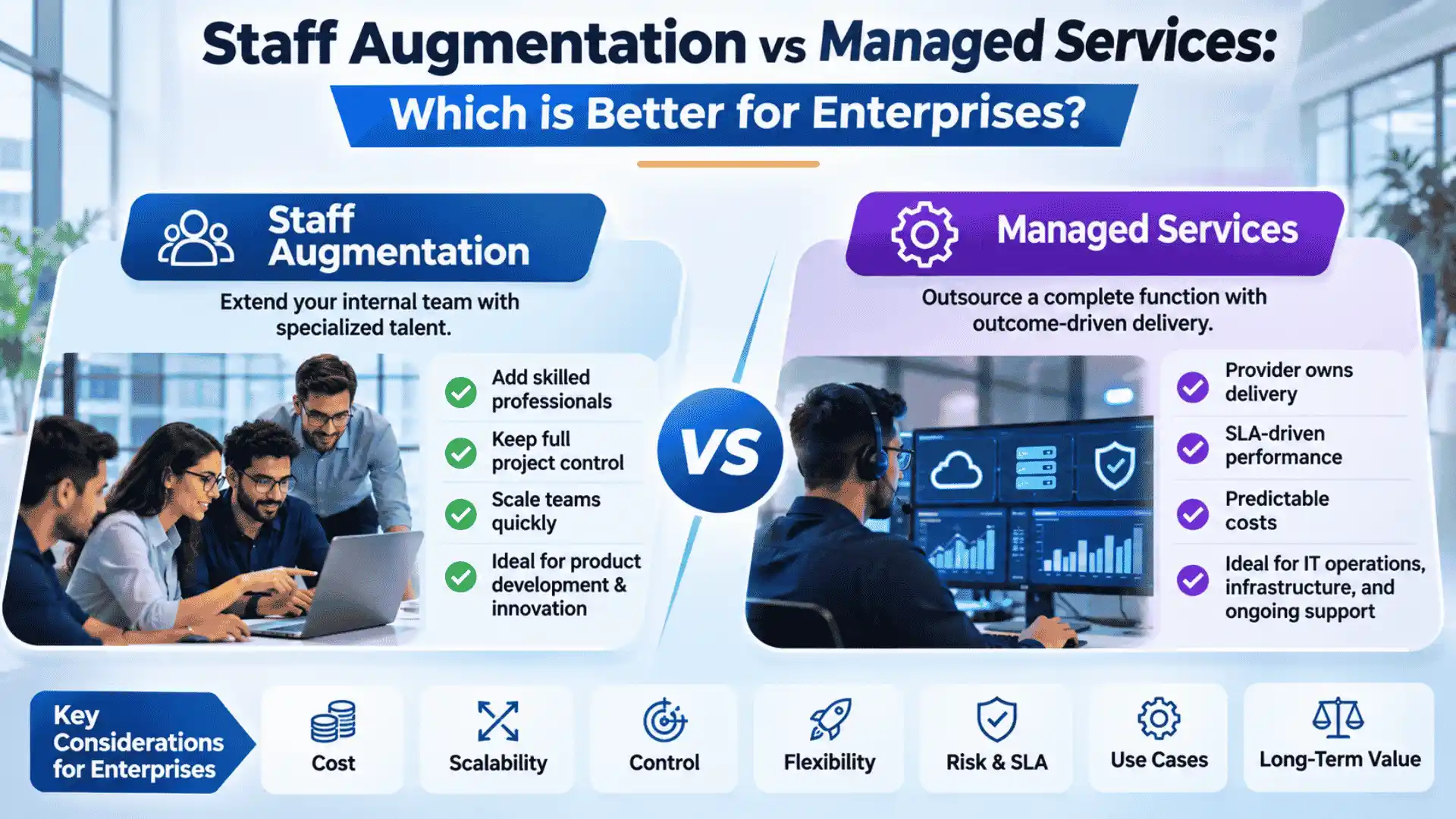
Unlike outsourcing an entire project, staff augmentation allows external engineers to work directly with your in-house team, following your development process, sprint planning, coding standards, and product roadmap.
Why Are Enterprise Companies Choosing Staff Augmentation?
Hiring experienced software engineers has become increasingly difficult across the US, UK, Australia, and Europe.
According to industry research, recruiting skilled technical talent can take several weeks or even months, delaying product releases and increasing development costs. Enterprise companies use staff augmentation to reduce hiring time while maintaining delivery speed. (Deloitte Global Outsourcing Survey)
Common business reasons include:
- Scaling engineering teams quickly
- Filling specialized technology skill gaps
- Reducing recruitment costs
- Accelerating software delivery
- Accessing global engineering talent
- Supporting digital transformation initiatives
- Managing seasonal or project-based workloads
How Does IT Staff Augmentation Pricing Work?
Most providers offer flexible engagement models based on business requirements.
The total cost usually depends on:
- Developer experience
- Technology stack
- Project complexity
- Team size
- Contract duration
- Geographic location
- Required communication overlap
- Security and compliance requirements
Rather than charging a fixed project fee, enterprises generally pay monthly or hourly based on the dedicated resources assigned to their projects.
What Pricing Models Do Enterprise Companies Use?
Different projects require different commercial models.
1. Hourly Pricing
The enterprise pays only for the actual hours worked.
This model is suitable for:
- Small projects
- Maintenance
- Bug fixes
- Technical consulting
- Short-term engineering support
2. Monthly Dedicated Resource Pricing
This is the most common enterprise engagement model.
A business hires one or more dedicated engineers for a fixed monthly cost.
Companies looking to Hire Dedicated Developers often prefer this pricing model because it provides predictable monthly budgeting and stable engineering capacity.
Best suited for:
- SaaS products
- Enterprise platforms
- Long-term development
- Product engineering
- AI applications
3. Dedicated Development Team Pricing
Large organizations often require multiple engineers working together as one product team.
Instead of hiring individual developers, enterprises build Dedicated Development Teams consisting of:
- Backend Developers
- Frontend Developers
- Mobile Developers
- QA Engineers
- DevOps Engineers
- UI/UX Designers
- Scrum Masters
- Technical Architects
This model provides greater scalability and simplifies project management.
What Is Included in Staff Augmentation Pricing?
A common misconception is that companies only pay for a developer's salary.
In reality, enterprise staff augmentation pricing often includes much more.
Typical services include:
- Technical recruitment
- Candidate screening
- HR management
- Payroll processing
- Employee benefits
- Equipment coordination
- Replacement guarantee
- Administrative support
- Account management
- Performance monitoring
- Legal compliance
- Employment contracts
This bundled approach helps enterprises reduce administrative overhead while focusing on software delivery.
What Factors Affect IT Staff Augmentation Pricing?
Several variables influence the final cost.
Developer Experience
Senior engineers command higher rates because they contribute to architecture, technical leadership, mentoring, and complex problem-solving.
Typical experience levels include:
- Junior Developer
- Mid-Level Developer
- Senior Developer
- Lead Engineer
- Solution Architect
Technology Stack
Demand for specialized skills can significantly impact pricing.
For example:
- Artificial Intelligence
- Machine Learning
- Cloud Engineering
- Cybersecurity
- Data Engineering
- Kubernetes
- Platform Engineering
often cost more than general web development roles due to limited talent availability.
Team Size
Hiring one engineer costs less than building a full engineering squad.
As team size increases, enterprises often negotiate volume-based pricing, especially for long-term engagements.
Contract Duration
Longer contracts generally offer better commercial value.
Annual or multi-year engagements often reduce recruitment costs and improve talent retention compared to short-term hiring.
Enterprise Insight
The cheapest hourly rate rarely delivers the lowest total project cost.
A highly experienced engineer may complete work faster, reduce technical debt, improve software quality, and require less supervision, leading to a lower overall cost of ownership.
Enterprise buyers should evaluate staff augmentation partners based on delivery quality, hiring speed, engineering expertise, and business outcomes—not hourly rates alone.
What Does IT Staff Augmentation Cost? Rates, Hidden Costs & Budget Planning
How Much Does IT Staff Augmentation Cost in 2026?
Enterprise IT staff augmentation pricing varies based on location, experience, technology stack, and engagement model.
Typical market rates are:
| Experience | Typical Hourly Rate |
|---|---|
| Junior Developer | $20–45/hr |
| Mid-Level Developer | $35–70/hr |
| Senior Developer | $60–120/hr |
| Tech Lead | $80–150/hr |
| Solution Architect | $100–180+/hr |
These are planning estimates. Actual pricing depends on the country, required skills, contract duration, and what's included in the engagement. :chatgpt-content-reference{index="0"}
Does Geography Affect IT Staff Augmentation Pricing?
Yes.
Developer location is one of the biggest pricing factors.
However, lower hourly rates don't always translate into lower project costs.
Businesses should evaluate:
- Technical expertise
- Communication
- Time-zone overlap
- Delivery quality
- Team stability
- Industry experience
instead of comparing rates alone.
Typical Hourly Rates by Region
| Region | Average Hourly Rate |
|---|---|
| India | $25–50 |
| Eastern Europe | $40–80 |
| Latin America | $35–75 |
| United Kingdom | $60–120 |
| United States | $90–180+ |
These figures represent common enterprise pricing ranges published by staffing providers and industry marketplaces. :chatgpt-content-reference{index="1"}
Which Roles Cost More?
Not every engineer costs the same.
Highly specialized roles generally command higher rates because of talent shortages and business impact.
Typical premium roles include:
- AI Engineers
- Machine Learning Engineers
- Cloud Architects
- DevOps Engineers
- Data Engineers
- Cybersecurity Specialists
- Enterprise Architects
General web developers typically cost less than niche specialists.
Typical Pricing by Role
| Role | Relative Cost |
|---|---|
| QA Engineer | Low |
| Frontend Developer | Medium |
| Backend Developer | Medium |
| Full-Stack Developer | Medium |
| Mobile Developer | Medium |
| DevOps Engineer | High |
| Cloud Architect | High |
| AI Engineer | Very High |
| Enterprise Architect | Premium |
What Hidden Costs Should Enterprises Consider?
Many pricing discussions focus only on hourly rates.
The real cost includes much more.
Hidden expenses may include:
- Onboarding time
- Knowledge transfer
- Internal engineering management
- Collaboration tools
- Security reviews
- Compliance audits
- Software licenses
- Training
- Productivity ramp-up
Experienced augmentation partners often include recruitment, HR, payroll, and employee management within their pricing, reducing administrative overhead.
Is Staff Augmentation Cheaper Than Hiring Full-Time?
In many situations, yes.
Hiring full-time employees involves costs beyond salary, including:
- Recruitment fees
- Payroll taxes
- Employee benefits
- Equipment
- Office space
- HR management
- Training
- Retention programs
With staff augmentation, many of these operational responsibilities remain with the service provider.
This allows enterprises to scale engineering capacity without significantly increasing internal overhead.
Monthly Budget Example
Suppose a SaaS company needs:
- 3 Backend Developers
- 2 Frontend Developers
- 1 QA Engineer
- 1 DevOps Engineer
Instead of recruiting seven permanent employees individually, the company builds a dedicated engineering pod.
Many organizations choose Dedicated Development Teams because they receive an integrated team with predictable monthly pricing, faster onboarding, and simplified management.
Should You Hire Individual Developers or a Complete Team?
It depends on your project.
Choose Hire Dedicated Developers when you need:
- One specialist
- Skill gap coverage
- Team expansion
- Temporary engineering support
Choose a Dedicated Development Team when you need:
- End-to-end product development
- Multiple engineering disciplines
- Long-term product ownership
- Cross-functional collaboration
What Should Be Included in Enterprise Pricing?
Before signing a contract, verify what's included.
A complete enterprise pricing package should cover:
- Technical recruitment
- Candidate screening
- Payroll
- HR support
- Compliance
- Equipment assistance
- Account management
- Performance reviews
- Replacement guarantee
- Engineering support
When comparing providers, review the complete service offering rather than hourly rates alone.
Enterprise Budget Planning Tips
Before requesting a proposal, answer these questions:
- How many engineers do you need?
- Which technologies are required?
- Is the engagement short-term or long-term?
- Do you need individual developers or a complete team?
- Are AI or cloud specialists required?
- What level of seniority is necessary?
Clear answers help create more accurate budgets and reduce unexpected costs.
Enterprise Insight
Longer engagements often provide better commercial value.
Monthly dedicated-resource pricing is the most common enterprise model because it offers predictable costs and stronger team continuity. Vendors may also offer better rates for larger teams or longer commitments. :chatgpt-content-reference{index="2"}
The best enterprise pricing model balances cost, engineering quality, hiring speed, and long-term productivity—not just the lowest hourly rate.
IT Staff Augmentation Pricing by Industry & ROI
Does IT Staff Augmentation Pricing Differ by Industry?
Yes.
Industry requirements have a significant impact on pricing.
Businesses operating in highly regulated industries often require engineers with specialized domain knowledge, security expertise, and compliance experience. This increases both hiring complexity and project costs.
Industries such as healthcare, financial services, and enterprise SaaS frequently command premium rates because engineers must understand industry-specific regulations, security standards, and complex business workflows. :chatgpt-content-reference{index="0"}
Healthcare Staff Augmentation Pricing
Healthcare organizations require developers familiar with:
- HIPAA compliance
- Electronic Health Records (EHR)
- Telemedicine
- Healthcare APIs
- Data Security
- Patient Privacy
Because healthcare applications handle sensitive patient information, companies often prioritize experienced engineers over lower hourly rates.
Organizations building digital health platforms commonly use Healthcare Staff Augmentation to accelerate product development while maintaining compliance requirements.
Typical healthcare projects include:
- Hospital Management Systems
- Healthcare Mobile Apps
- Remote Patient Monitoring
- AI Diagnostics
- Medical Device Software
FinTech Staff Augmentation Pricing
Financial applications require engineers experienced in:
- PCI DSS
- Banking APIs
- Payment Gateways
- Fraud Detection
- Digital Wallets
- Risk Management
These specialized requirements generally increase engineering costs compared to standard web development.
Companies modernizing financial platforms often choose FinTech Staff Augmentation to rapidly access engineers with domain expertise.
Typical FinTech projects include:
- Digital Banking
- Lending Platforms
- Wealth Management
- Insurance Technology
- Cryptocurrency Platforms
- Payment Processing
SaaS Staff Augmentation Pricing
SaaS companies usually focus on:
- Product velocity
- Feature releases
- Platform scalability
- Cloud-native development
- Customer experience
Because SaaS products evolve continuously, businesses frequently hire dedicated engineers rather than relying on project-based outsourcing.
Using SaaS Staff Augmentation enables companies to expand engineering capacity without slowing product delivery.
Common SaaS technologies include:
- AWS
- Azure
- Kubernetes
- React
- Node.js
- Python
- AI Integrations
Ecommerce Staff Augmentation Pricing
Ecommerce businesses often need engineers who understand:
- Shopify
- Magento
- Commerce APIs
- Payment Systems
- Inventory Management
- Customer Experience
- High-Traffic Platforms
Seasonal sales events also require flexible engineering capacity.
Many retailers use Ecommerce Staff Augmentation to scale development teams during major platform upgrades or peak shopping periods.
Manufacturing Staff Augmentation Pricing
Manufacturing companies increasingly invest in:
- Industry 4.0
- IoT
- ERP Systems
- Supply Chain Automation
- Smart Factories
- Predictive Maintenance
These projects often require engineers with industrial software expertise.
Businesses modernizing operations frequently adopt Manufacturing Staff Augmentation to support digital transformation initiatives.
Logistics Staff Augmentation Pricing
Modern logistics platforms depend on software for:
- Route Optimization
- Fleet Management
- Warehouse Automation
- Shipment Tracking
- Supply Chain Visibility
Organizations expanding transportation platforms often leverage Logistics Staff Augmentation to build scalable systems without delaying delivery schedules.
Education Staff Augmentation Pricing
Educational institutions and EdTech companies require developers experienced in:
- Learning Management Systems
- Virtual Classrooms
- Student Information Systems
- Assessment Platforms
- AI Learning Tools
Using Education Staff Augmentation allows organizations to launch new digital learning products faster while keeping internal teams focused on innovation.
Travel Staff Augmentation Pricing
Travel technology companies typically develop:
- Booking Platforms
- Reservation Systems
- Airline APIs
- Hotel Integrations
- Travel Portals
- Customer Loyalty Platforms
Businesses expanding global travel platforms often choose Travel Staff Augmentation to quickly onboard engineers familiar with complex travel ecosystems.
Should You Hire Individual Developers or a Dedicated Team?
This depends on project scope.
Hire Dedicated Developers
Choose Hire Dedicated Developers when you need:
- One or two specialists
- Temporary engineering support
- Technology expertise
- Team expansion
This model works well for companies filling skill gaps.
Dedicated Development Teams
For enterprise products, a complete Dedicated Development Team often provides greater value.
Typical team composition includes:
- Backend Developers
- Frontend Developers
- Mobile Developers
- QA Engineers
- DevOps Engineers
- Scrum Masters
- UI/UX Designers
- Technical Architects
This structure improves collaboration, accountability, and delivery speed.
What Is the ROI of IT Staff Augmentation?
Staff augmentation isn't simply about reducing hourly rates.
The real return comes from:
- Faster hiring
- Reduced recruitment costs
- Shorter time-to-market
- Improved engineering productivity
- Flexible team scaling
- Lower operational overhead
- Faster product releases
Enterprise companies often realize greater business value by delivering products sooner rather than minimizing engineering costs alone.
Enterprise Budgeting Tip
When evaluating proposals, don't compare vendors solely on price.
Instead, compare:
- Engineering expertise
- Industry experience
- Hiring speed
- Candidate quality
- Replacement policy
- Communication
- Delivery process
- Scalability
- Security standards
A provider with slightly higher rates but stronger delivery capabilities often generates a better long-term return on investment.
The best IT staff augmentation partner helps you deliver software faster, reduce hiring risk, and build high-performing engineering teams—not just lower your hourly costs. :chatgpt-content-reference{index="1"}
Frequently Asked Questions (FAQs)
1. How much should an enterprise budget for IT staff augmentation?
There isn't a fixed price because every engagement is different. Your budget depends on:
- Number of engineers
- Seniority level
- Technology stack
- Project duration
- Geographic location
- Engagement model
For most enterprise projects, budgeting should focus on the total monthly engineering investment rather than individual hourly rates. Industry data shows many enterprise staff augmentation engagements range from tens of thousands to hundreds of thousands of dollars depending on team size and scope. :chatgpt-content-reference{index="0"}
2. Is staff augmentation cheaper than hiring full-time employees?
In many cases, yes.
Hiring full-time employees involves additional costs beyond salary, including:
- Recruitment
- Payroll taxes
- Employee benefits
- Equipment
- Office space
- HR administration
- Training
- Employee retention
With IT Staff Augmentation Pricing, many of these operational responsibilities remain with the service provider, helping enterprises scale faster without increasing internal overhead.
3. When should companies hire dedicated developers?
Hiring Dedicated Developers is ideal when you need:
- One or two engineers
- Specialized technical expertise
- Temporary team expansion
- Faster hiring
- Flexible resource planning
This model works well when your existing engineering team only needs additional specialists.
4. When should enterprises build a dedicated development team?
Choose Dedicated Development Teams when your project requires:
- Multiple engineers
- Long-term product development
- Agile delivery
- Cross-functional collaboration
- Continuous feature releases
Instead of managing multiple vendors, enterprises receive one integrated engineering team working toward shared business goals.
5. Which industries benefit most from staff augmentation?
Almost every technology-driven industry benefits from staff augmentation.
Common examples include:
- Healthcare Staff Augmentation
- FinTech Staff Augmentation
- SaaS Staff Augmentation
- Ecommerce Staff Augmentation
- Manufacturing Staff Augmentation
- Logistics Staff Augmentation
- Education Staff Augmentation
- Travel Staff Augmentation
Each industry has different compliance, security, and technical requirements, so choosing engineers with domain expertise is often more valuable than selecting the lowest-cost provider.
6. What should enterprises look for besides hourly rates?
Price is only one part of the decision.
Evaluate your partner based on:
- Technical expertise
- Industry experience
- Hiring speed
- Candidate quality
- Communication
- Security standards
- Replacement guarantee
- Scalability
- Long-term partnership
The lowest hourly rate rarely delivers the highest return on investment.
Enterprise Budget Planning Checklist
Before requesting a proposal, answer these questions:
| Question | Yes | No |
|---|---|---|
| Do you know how many engineers you need? | ☐ | ☐ |
| Have you identified required technologies? | ☐ | ☐ |
| Do you need individual developers or a complete team? | ☐ | ☐ |
| Is your project short-term or long-term? | ☐ | ☐ |
| Do you require industry-specific experience? | ☐ | ☐ |
| Have you defined your monthly engineering budget? | ☐ | ☐ |
| Do you need AI, Cloud, or DevOps specialists? | ☐ | ☐ |
| Have you planned future team expansion? | ☐ | ☐ |
Common Pricing Mistakes Enterprises Make
Choosing the Cheapest Vendor
Lower hourly rates often lead to:
- Slower delivery
- More defects
- Higher management effort
- Increased technical debt
Hiring Junior Engineers for Senior Problems
Complex enterprise platforms require experienced engineers.
A lower hourly rate can result in higher total project costs if productivity and quality suffer.
Ignoring Scalability
Choose a partner that can grow with your business.
Hiring one developer today is easy.
Scaling to 50 engineers within six months is much more challenging.
Comparing Hourly Rates Instead of Total Value
Instead of asking:
"Who is the cheapest?"
Ask:
- Who hires faster?
- Who delivers higher-quality engineers?
- Who understands our industry?
- Who can scale globally?
- Who reduces hiring risk?
Final Recommendation
IT staff augmentation pricing should never be evaluated on hourly rates alone.
The right partner helps your business:
- Launch products faster
- Scale engineering teams quickly
- Reduce recruitment costs
- Access specialized technical talent
- Improve software delivery
- Increase engineering productivity
If you need a few specialists, Hire Dedicated Developers may be the most effective option.
If you're building a product from the ground up or expanding engineering capacity, Dedicated Development Teams provide greater stability, collaboration, and long-term value.
For organizations comparing providers, reviewing a transparent IT Staff Augmentation Pricing guide helps establish realistic budgets and avoid unexpected costs.
Industry-specific expertise also matters. Whether you're building healthcare software, financial platforms, SaaS products, ecommerce solutions, manufacturing systems, logistics platforms, education technology, or travel applications, working with engineers who understand your industry can significantly improve project outcomes.
Why Choose TeamBees?
TeamBees helps enterprise companies build high-performing engineering teams with flexible engagement models tailored to business goals.
Our expertise includes:
- IT Staff Augmentation Pricing
- Hire Dedicated Developers
- Dedicated Development Teams
- Healthcare Staff Augmentation
- FinTech Staff Augmentation
- SaaS Staff Augmentation
- Ecommerce Staff Augmentation
- Manufacturing Staff Augmentation
- Logistics Staff Augmentation
- Education Staff Augmentation
- Travel Staff Augmentation
Whether you need one software engineer or an enterprise-scale development team, TeamBees helps you hire faster, scale confidently, and maximize your technology investment.
The best IT staff augmentation strategy isn't about finding the lowest hourly rate. It's about building the right engineering team that delivers long-term business value, accelerates innovation, and supports sustainable growth.