Offshore Development Center vs Global Capability Center (GCC): Which Is Better for Your Business?
Should you build an Offshore Development Center or invest in a Global Capability Center (GCC)? This guide compares costs, hiring, scalability, ownership, security, and enterprise use cases to help business leaders choose the right global delivery model.
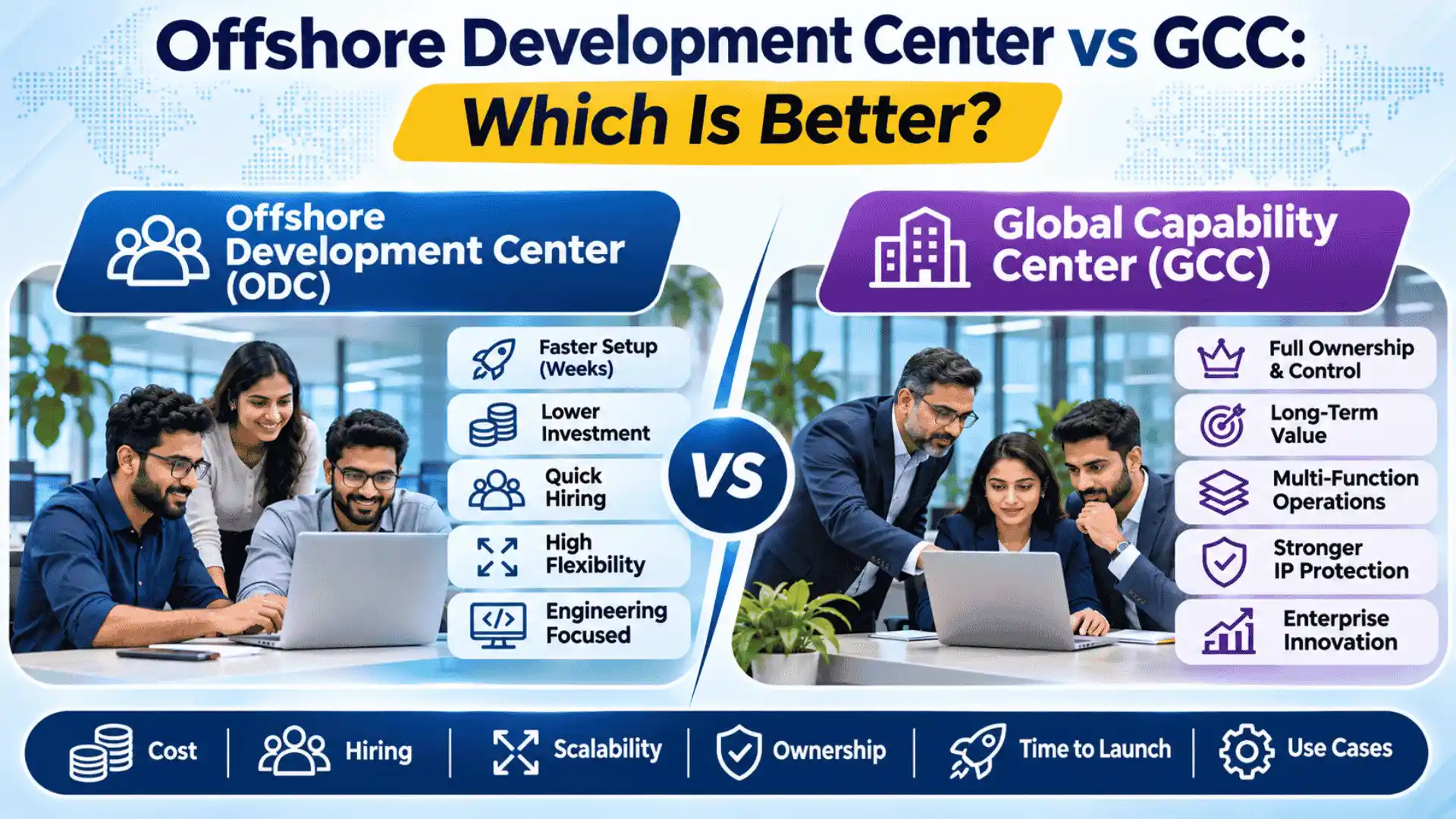
If your goal is to scale engineering teams quickly with minimal investment, an Offshore Development Center is usually the better choice. If you want complete ownership, long-term operational control, and strategic innovation, a Global Capability Center (GCC) is the right model. The best option depends on your hiring strategy, budget, growth plans, and business objectives.
What is an Offshore Development Center (ODC)?
An Offshore Development Center is a dedicated engineering team located in another country that works exclusively for your company. Unlike traditional outsourcing, the team follows your product roadmap, development standards, sprint planning, and business priorities while the technology partner manages recruitment, HR, payroll, office infrastructure, and administration.
Companies choose an Offshore Development Center to:
- Scale engineering teams quickly
- Reduce software development costs
- Access global engineering talent
- Accelerate product delivery
- Expand development capacity without opening a new office
- Focus internal teams on innovation instead of hiring
Many enterprises also combine an Offshore Development Center with Talent Augmentation to hire specialized developers, AI engineers, DevOps experts, cloud architects, and QA professionals based on changing project requirements.
What Is a Global Capability Center (GCC)?
A Global Capability Center (GCC) is a wholly owned offshore business unit established by an enterprise to perform strategic business functions. Unlike an Offshore Development Center, a GCC is owned and operated by the parent company, including its employees, infrastructure, leadership, governance, and business operations. Modern GCCs have evolved from cost-saving centers into innovation hubs responsible for product engineering, artificial intelligence, cloud operations, cybersecurity, finance, analytics, and research.
A GCC typically includes:
- Software Engineering
- Product Development
- Artificial Intelligence
- Cloud Engineering
- Cybersecurity
- Data Engineering
- Finance Operations
- HR Operations
- Digital Transformation
- Research & Development
Many Fortune 500 organizations operate GCCs to strengthen global innovation while maintaining complete ownership of intellectual property and engineering capabilities.
How Does an Offshore Development Center Differ From a GCC?
Although both models help companies access global talent, they serve different business goals.
An Offshore Development Center provides a dedicated engineering team managed through a technology partner, while a Global Capability Center is a fully owned offshore business unit managed directly by the enterprise.
This difference impacts:
- Ownership
- Hiring
- Governance
- Investment
- Compliance
- Scalability
- Intellectual Property
- Operational Control
Offshore Development Center vs GCC Comparison
| Feature | Offshore Development Center | Global Capability Center |
|---|---|---|
| Ownership | Technology Partner | Enterprise |
| Engineering Team | Dedicated | Fully Owned |
| Initial Investment | Low | High |
| Office Setup | Partner Managed | Company Managed |
| Recruitment | Partner | Internal HR |
| Payroll | Partner | Company |
| Infrastructure | Included | Company Investment |
| Time to Launch | 2–8 Weeks | 4–12 Months |
| Scalability | Very High | Moderate |
| Best For | Fast Scaling | Long-Term Global Operations |
Why Are More Companies Choosing Offshore Development Centers?
Hiring software engineers in the United States, United Kingdom, or Australia has become increasingly expensive and competitive.
An Offshore Development Center allows businesses to:
- Hire faster
- Reduce recruitment costs
- Access experienced software engineers
- Scale teams without opening international offices
- Maintain product development speed
Instead of spending months creating a legal entity overseas, businesses can begin development within weeks using a dedicated offshore engineering team.
Why Are Enterprises Investing in Global Capability Centers?
Large enterprises often prioritize long-term strategic control over short-term cost savings.
A GCC enables organizations to:
- Build internal engineering capabilities
- Protect intellectual property
- Create global leadership teams
- Develop innovation centers
- Support multiple business functions
- Standardize global operations
Many multinational corporations now view GCCs as innovation centers rather than traditional back-office operations. India alone hosts more than 1,800 GCCs supporting technology, engineering, operations, analytics, and digital transformation initiatives.
How Can Companies Build an Offshore Team Faster?
Whether you're building an Offshore Development Center or planning a Global Capability Center, hiring experienced engineers remains one of the biggest challenges.
An effective Talent Sourcing strategy helps enterprises identify, assess, and onboard qualified software engineers, AI specialists, cloud architects, DevOps professionals, and technology leaders much faster.
For organizations establishing a Global Capability Center, working with a specialized GCC Talent partner can significantly reduce hiring timelines while improving access to high-quality engineering talent and leadership candidates.
Which Model Is Right for Growing Enterprises?
There isn't a single answer.
Businesses focused on rapid growth, product development, and faster engineering expansion usually benefit from an Offshore Development Center because it offers speed, flexibility, and lower operational complexity.
Organizations planning long-term global operations, innovation hubs, and strategic ownership often choose a GCC because it provides complete control over talent, culture, governance, and intellectual property.
The decision ultimately depends on:
- Company size
- Hiring goals
- Budget
- Time-to-market
- Long-term expansion strategy
Cost, Hiring, Scalability & Ownership Comparison
Which Model Costs Less: Offshore Development Center or GCC?
Cost is one of the biggest reasons companies compare these two delivery models.
The answer depends on your business goals.
If you need to launch quickly with minimal upfront investment, an Offshore Development Center is usually the more cost-effective option.
If you're building a 500+ person engineering organization for the next 10 years, a GCC may deliver better long-term value despite higher initial investment.
Offshore Development Center Cost Breakdown
With an Offshore Development Center, most operational expenses are included in one monthly engagement fee.
Typical costs include:
- Recruitment
- HR Management
- Payroll
- Office Infrastructure
- IT Equipment
- Security
- Employee Benefits
- Administrative Support
- Delivery Management
This allows enterprises to avoid major capital expenditure and focus directly on product development.
Global Capability Center Cost Breakdown
A GCC requires significantly higher upfront investment because the enterprise owns the operation.
Typical investments include:
- Company Registration
- Legal Compliance
- Office Leasing
- IT Infrastructure
- HR Department
- Finance Team
- Recruitment Team
- Payroll Operations
- Employee Benefits
- Cybersecurity
- Local Leadership
- Business Operations
Although the setup costs are higher, enterprises gain complete ownership of the organization.
Cost Comparison
| Cost Area | Offshore Development Center | Global Capability Center |
|---|---|---|
| Initial Investment | Low | Very High |
| Monthly Operations | Predictable | Variable |
| Office Setup | Included | Enterprise |
| Recruitment Cost | Included | Enterprise |
| HR Management | Included | Enterprise |
| Payroll | Included | Enterprise |
| Infrastructure | Included | Enterprise |
| Legal Entity | Not Required | Required |
| Best for | Fast Growth | Long-Term Scale |
Which Model Launches Faster?
Time-to-market is critical for modern software companies.
The faster you build engineering capacity...
The sooner products reach customers.
Offshore Development Center
Typical setup time:
2 to 8 weeks
Because your technology partner already has:
- Recruitment process
- Office infrastructure
- HR
- Payroll
- IT support
your engineering team can begin development quickly.
Global Capability Center
Typical setup time:
4 to 12 months
The enterprise must establish:
- Local company registration
- Legal compliance
- Office space
- Hiring process
- Payroll systems
- Leadership
- Corporate governance
Launching takes longer but provides full operational ownership.
Which Model Makes Hiring Easier?
Hiring software engineers is one of the biggest challenges for growing enterprises.
An Offshore Development Center simplifies recruitment because the technology partner already has access to qualified engineers.
Instead of building an internal recruitment function, businesses can focus on selecting candidates while the partner manages:
- Screening
- Interviews
- HR
- Documentation
- Payroll
- Onboarding
Many organizations accelerate this process further through Talent Sourcing, enabling faster access to experienced software engineers, AI specialists, cloud engineers, and DevOps professionals.
Hiring Through a GCC
A GCC provides complete ownership of hiring.
However, enterprises must build:
- Recruitment Teams
- Employer Branding
- Hiring Pipelines
- Interview Panels
- Campus Programs
- Leadership Hiring
Many organizations launching new capability centers partner with GCC Talent specialists to reduce hiring timelines and access experienced engineering leaders.
Hiring Comparison
| Hiring Factor | Offshore Development Center | GCC |
|---|---|---|
| Recruitment Speed | Excellent | Moderate |
| Employer Branding Required | No | Yes |
| HR Team Needed | No | Yes |
| Payroll Management | Vendor | Enterprise |
| Talent Ownership | Vendor | Enterprise |
| Leadership Hiring | Optional | Essential |
Which Model Scales Faster?
Business priorities change quickly.
Your engineering model should support that growth.
An Offshore Development Center makes scaling simple.
Need:
- Five Backend Engineers?
- Three AI Engineers?
- Two DevOps Specialists?
Your partner expands the team without requiring new infrastructure.
Large enterprises often combine:
- Talent Augmentation
- Offshore Development Centers
- Internal Engineering Teams
to balance flexibility with long-term ownership.
A GCC can also scale.
However, every expansion requires:
- Additional hiring
- Office capacity
- HR support
- Infrastructure
- Local leadership
Scaling remains possible but generally takes more planning.
Which Model Provides Better Intellectual Property Protection?
For enterprises building:
- AI Platforms
- Healthcare Software
- Banking Applications
- Cybersecurity Products
Intellectual Property (IP) protection is often a top priority.
Offshore Development Center
IP protection depends on:
- Contract Terms
- NDA
- Vendor Policies
- Security Standards
Well-structured agreements can provide strong protection, but legal ownership remains contract-driven.
Global Capability Center
A GCC offers maximum control because:
- Employees belong to your company.
- Systems belong to your company.
- Infrastructure belongs to your company.
- Engineering governance belongs to your company.
This makes GCCs attractive for organizations developing highly sensitive technologies.
Governance Comparison
| Governance Area | Offshore Development Center | GCC |
|---|---|---|
| Company Policies | Partner | Enterprise |
| Engineering Standards | Shared | Enterprise |
| Compliance | Shared | Enterprise |
| Security | Shared | Enterprise |
| IP Ownership | Contract-Based | Direct Ownership |
| Business Governance | Shared | Enterprise |
Which Model Is Better for AI Development?
AI products evolve rapidly.
Models improve.
Data changes.
Customer expectations grow.
For organizations building AI products over several years, both models can work.
An Offshore Development Center provides rapid access to AI engineers and lower operational complexity.
A GCC offers long-term ownership of AI research, intellectual property, and enterprise innovation.
The right choice depends on whether speed or ownership is the primary objective.
Enterprise Trend
Global enterprises are increasingly expanding their engineering presence through both Offshore Development Centers and GCCs. India has become one of the world's leading destinations for these models because of its deep engineering talent pool, mature technology ecosystem, and growing AI expertise. Industry reports estimate more than 2,000 GCCs operating in India, with continued growth driven by AI, product engineering, and digital transformation.
Which Model Fits Your Business? Real-World Use Cases, Pros & Cons, and Decision Framework
Should Startups Choose an Offshore Development Center or a GCC?
For most startups, an Offshore Development Center is the better option.
Startups need to:
- Launch products quickly
- Preserve cash flow
- Hire experienced engineers fast
- Avoid legal and administrative complexity
Setting up a GCC requires significant investment, operational maturity, and long-term planning, which most early-stage companies do not yet need.
Best Choice for Startups
✅ Offshore Development Center
What Is Best for Mid-Sized Companies?
As businesses grow, engineering requirements become more complex.
Mid-sized organizations often need:
- Faster product releases
- AI engineering talent
- Cloud specialists
- DevOps engineers
- Product scalability
An Offshore Development Center continues to provide excellent flexibility while reducing operational overhead.
Many companies also expand through Talent Augmentation, allowing them to add specialists without increasing permanent headcount.
If long-term expansion into India becomes part of corporate strategy, transitioning from an ODC to a GCC may become a natural next step.
Should Large Enterprises Build a GCC?
Large enterprises often prioritize:
- Intellectual Property ownership
- Enterprise governance
- Global innovation
- Internal engineering capabilities
- Long-term cost optimization
For organizations planning 100+ engineers across multiple business functions, a GCC becomes an attractive long-term investment.
Many Fortune 500 companies use GCCs for:
- Product Engineering
- Artificial Intelligence
- Cybersecurity
- Cloud Platforms
- Finance Operations
- Data Analytics
- Shared Services
India has become one of the world's largest GCC ecosystems because of its skilled engineering workforce and mature technology infrastructure.
Which Industries Benefit Most From an Offshore Development Center?
An Offshore Development Center is ideal for industries requiring continuous software development.
Examples include:
- SaaS
- FinTech
- HealthTech
- EdTech
- E-commerce
- Artificial Intelligence
- Cybersecurity
- Cloud Software
These businesses release software continuously and benefit from dedicated engineering teams that integrate closely with internal product managers.
Which Industries Commonly Build GCCs?
Global Capability Centers are commonly established by enterprises operating across multiple countries.
Examples include:
- Banking
- Financial Services
- Insurance
- Healthcare
- Retail
- Manufacturing
- Telecommunications
- Automotive
- Pharmaceutical Companies
These organizations often centralize technology, analytics, finance, and operations within a GCC to improve global efficiency.
Real Enterprise Example 1
A SaaS Company Expanding Its Engineering Team
A US-based SaaS company needs:
- 15 Backend Developers
- 5 Frontend Engineers
- 3 DevOps Engineers
- 4 QA Engineers
The roadmap changes every sprint.
Instead of creating a legal entity overseas, the company launches an Offshore Development Center and begins product development within weeks.
Result
- Faster hiring
- Lower operational costs
- Faster feature delivery
- No entity setup
- Better engineering flexibility
Real Enterprise Example 2
A Fortune 500 Company Building an Innovation Hub
A multinational enterprise plans to establish:
- AI Research
- Product Engineering
- Cloud Operations
- Finance Shared Services
- Data Analytics
Projected headcount:
700 employees over five years.
Instead of relying on an external delivery partner, the company establishes a Global Capability Center.
Result
- Full ownership
- Global engineering leadership
- Internal innovation
- Stronger IP protection
- Long-term operational efficiency
Pros and Cons of an Offshore Development Center
Advantages
- Fast setup
- Lower upfront investment
- Easy scaling
- Reduced hiring effort
- Lower administrative burden
- Predictable monthly pricing
- Access to experienced engineering talent
Limitations
- Shared operational governance
- Vendor dependency
- Contract-based IP protection
- Less direct control over HR policies
Pros and Cons of a Global Capability Center
Advantages
- Complete ownership
- Full engineering control
- Strong IP governance
- Long-term strategic value
- Enterprise culture
- Direct hiring
- Better integration across business functions
Limitations
- High setup cost
- Longer implementation timeline
- Greater compliance responsibilities
- Internal HR and operations required
- Higher administrative overhead
Common Mistakes Companies Make
Mistake 1: Choosing Only Based on Cost
The lowest hourly rate rarely produces the highest business value.
Consider:
- Time-to-market
- Product quality
- Hiring speed
- Engineering productivity
- Long-term scalability
Mistake 2: Building a GCC Too Early
Some organizations establish a GCC before validating long-term offshore operations.
This often results in:
- Slow hiring
- Higher operating costs
- Underutilized infrastructure
For many businesses, starting with an ODC and transitioning later is a more practical path.
Mistake 3: Ignoring Talent Strategy
Technology alone doesn't build successful engineering teams.
Businesses also need:
- Employer branding
- Technical assessments
- Leadership hiring
- Talent retention
- Workforce planning
Working with experienced Talent Sourcing partners can significantly improve hiring outcomes.
Mistake 4: Underestimating Leadership
Whether building an ODC or a GCC, engineering success depends on strong leadership.
Successful organizations invest in:
- Engineering Managers
- Product Managers
- Technical Architects
- Delivery Managers
- Engineering Directors
People—not just processes—drive long-term success.
Decision Framework
Answer these questions before choosing your operating model.
Do you need engineers within the next 60 days?
✅ Choose an Offshore Development Center.
Do you plan to establish a long-term business presence?
✅ Consider a GCC.
Is engineering your primary requirement?
✅ Offshore Development Center.
Do you also need Finance, HR, Analytics, and Shared Services?
✅ Global Capability Center.
Is minimizing upfront investment important?
✅ Offshore Development Center.
Is complete ownership your top priority?
✅ Global Capability Center.
Enterprise Decision Matrix
| Business Requirement | Offshore Development Center | GCC |
|---|---|---|
| Fast Hiring | ✅ | ❌ |
| Low Initial Investment | ✅ | ❌ |
| Product Development | ✅ | ✅ |
| AI Engineering | ✅ | ✅ |
| Enterprise Innovation | ⚠ | ✅ |
| Full Ownership | ❌ | ✅ |
| Multi-Function Operations | ❌ | ✅ |
| Long-Term Global Expansion | ⚠ | ✅ |
| Easy Exit | ✅ | ❌ |
Enterprise Insight
Many organizations don't see this as an either-or decision.
A common growth path is:
- Launch an Offshore Development Center to validate the offshore strategy.
- Scale through Talent Augmentation as engineering needs grow.
- Use Talent Sourcing to build specialized teams.
- Transition to a GCC Talent model when long-term ownership, governance, and multi-functional operations become strategic priorities.
This phased approach helps enterprises balance speed, cost, and long-term control while reducing implementation risk.
FAQs, Enterprise Checklist & Final Recommendation
Frequently Asked Questions (FAQs)
1. What is the main difference between an Offshore Development Center and a Global Capability Center?
The biggest difference is ownership.
An Offshore Development Center is managed by a technology partner that provides dedicated engineering resources, infrastructure, HR, and operational support.
A Global Capability Center (GCC) is a fully owned offshore business unit where the enterprise manages employees, infrastructure, governance, and business operations directly.
ODC = Partner Managed Engineering Team
GCC = Enterprise-Owned Global Operation
2. Which model is better for startups?
For most startups, an Offshore Development Center is the better option.
It enables businesses to:
- Hire engineers quickly
- Launch products faster
- Reduce recruitment costs
- Avoid legal entity setup
- Scale teams with minimal operational overhead
Building a GCC generally makes sense only after the business reaches significant scale.
3. Which model is better for large enterprises?
Large enterprises often benefit from a Global Capability Center because it provides:
- Complete ownership
- Long-term engineering capabilities
- Intellectual property protection
- Enterprise governance
- Global innovation
However, many enterprises begin with an Offshore Development Center before transitioning into a GCC once operations mature.
4. Can an Offshore Development Center become a GCC later?
Yes.
Many organizations follow this journey:
Startup
↓
Offshore Development Center
↓
Product Growth
↓
Engineering Expansion
↓
Global Capability Center
This phased approach reduces risk while allowing companies to validate offshore operations before making a significant investment.
5. Which model offers better scalability?
Both models support growth, but they scale differently.
Offshore Development Center
Best for:
- Rapid hiring
- Flexible team expansion
- Short hiring cycles
- Product engineering
Global Capability Center
Best for:
- Long-term expansion
- Multi-functional teams
- Enterprise governance
- Strategic operations
6. How does Talent Augmentation support an ODC?
Many companies complement their Offshore Development Center with Talent Augmentation.
This allows businesses to quickly add:
- AI Engineers
- DevOps Specialists
- Cloud Architects
- Backend Developers
- QA Engineers
- Product Designers
without restructuring the entire engineering organization.
7. Why is Talent Sourcing important?
Finding experienced engineers is often the biggest challenge when scaling globally.
A structured Talent Sourcing strategy helps companies:
- Reduce hiring time
- Improve candidate quality
- Access specialized engineering talent
- Build stronger technical teams
- Scale hiring efficiently
This becomes especially valuable when engineering demand increases rapidly.
8. When should companies use GCC Talent solutions?
Organizations planning to establish or expand a Global Capability Center often require experienced engineering leaders and specialized professionals.
Working with a GCC Talent partner can help enterprises:
- Build leadership teams
- Hire faster
- Improve candidate quality
- Reduce recruitment risk
- Accelerate GCC expansion
Enterprise CTO Checklist
Use this checklist before deciding between an Offshore Development Center and a GCC.
| Question | Offshore Development Center | Global Capability Center |
|---|---|---|
| Need engineers within 2 months? | ✅ | ❌ |
| Limited upfront investment? | ✅ | ❌ |
| Want complete ownership? | ❌ | ✅ |
| Building long-term innovation center? | ❌ | ✅ |
| Need fast product delivery? | ✅ | ⚠ |
| Hiring 20–100 engineers? | ✅ | ⚠ |
| Hiring 500+ professionals? | ⚠ | ✅ |
| Need Finance, HR & Shared Services? | ❌ | ✅ |
| Focused only on engineering? | ✅ | ❌ |
Key Takeaways
- Offshore Development Centers provide speed, flexibility, and lower upfront investment.
- Global Capability Centers provide complete ownership and long-term strategic value.
- ODCs are ideal for software engineering and rapid product development.
- GCCs are ideal for multinational organizations building global innovation hubs.
- Many enterprises start with an ODC before evolving into a GCC.
- Combining Talent Augmentation and Talent Sourcing can accelerate engineering growth regardless of the chosen model.
Final Recommendation
There is no one-size-fits-all answer.
If your business needs to:
- Launch products quickly
- Expand engineering capacity
- Reduce hiring complexity
- Lower operational costs
- Access experienced global developers
an Offshore Development Center is often the fastest and most cost-effective choice.
If your organization plans to:
- Build a permanent global presence
- Own engineering operations
- Protect intellectual property
- Establish enterprise governance
- Create long-term innovation capabilities
a Global Capability Center is the stronger long-term investment.
Many successful enterprises don't choose one model exclusively. They start with an Offshore Development Center, strengthen hiring through Talent Sourcing, scale with Talent Augmentation, and eventually establish a GCC supported by specialized GCC Talent solutions.
This phased approach balances speed, cost efficiency, and long-term strategic control.
Why Partner with TeamBees?
TeamBees helps enterprises accelerate global growth with flexible talent and engineering solutions.
Our expertise includes:
Whether you're expanding your engineering team, building an offshore development center, or establishing a Global Capability Center, TeamBees provides the talent, expertise, and delivery capabilities to help you scale with confidence.
The right operating model isn't the one with the lowest cost. It's the one that helps your business innovate faster, hire smarter, and build sustainable competitive advantage.