Staff Augmentation vs Managed Services: Which is Better for Enterprises?
Should your enterprise choose Staff Augmentation or Managed Services? This guide compares costs, flexibility, ownership, scalability, and real-world use cases to help CTOs, CIOs, and business leaders select the right engagement model for faster growth and better ROI.
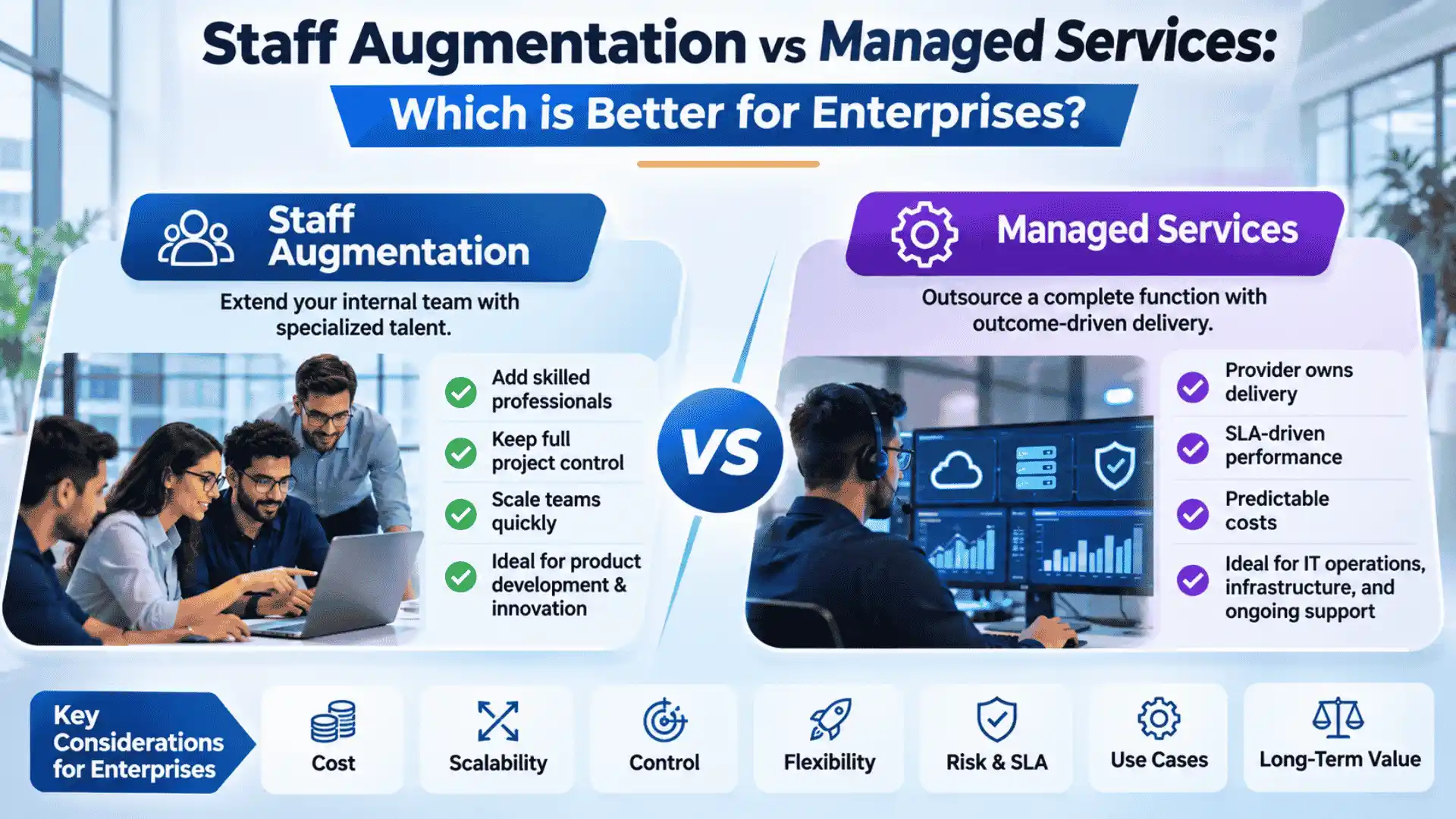
Enterprise leaders are under constant pressure to deliver software faster, reduce operational costs, and access specialized talent without increasing permanent headcount.
The biggest question many CTOs, CIOs, CEOs, and Engineering Directors ask is:
Should we extend our internal team through staff augmentation or outsource an entire function using managed services?
Both models help organizations accelerate digital transformation, but they solve different business challenges.
Choosing the wrong model can lead to:
- Increased project costs
- Missed delivery deadlines
- Poor resource utilization
- Knowledge gaps
- Low engineering productivity
- Unnecessary hiring expenses
According to Deloitte's Global Outsourcing Survey, 80% of organizations plan to maintain or increase investment in third-party outsourcing, while outcome-based delivery models continue to grow as enterprises seek greater flexibility and specialized expertise. :chatgpt-content-reference{index="0"}
This guide explains:
- What Staff Augmentation is
- What Managed Services are
- Key differences
- Cost comparison
- Advantages and disadvantages
- Enterprise use cases
- Which model is best for your business
What is Staff Augmentation?
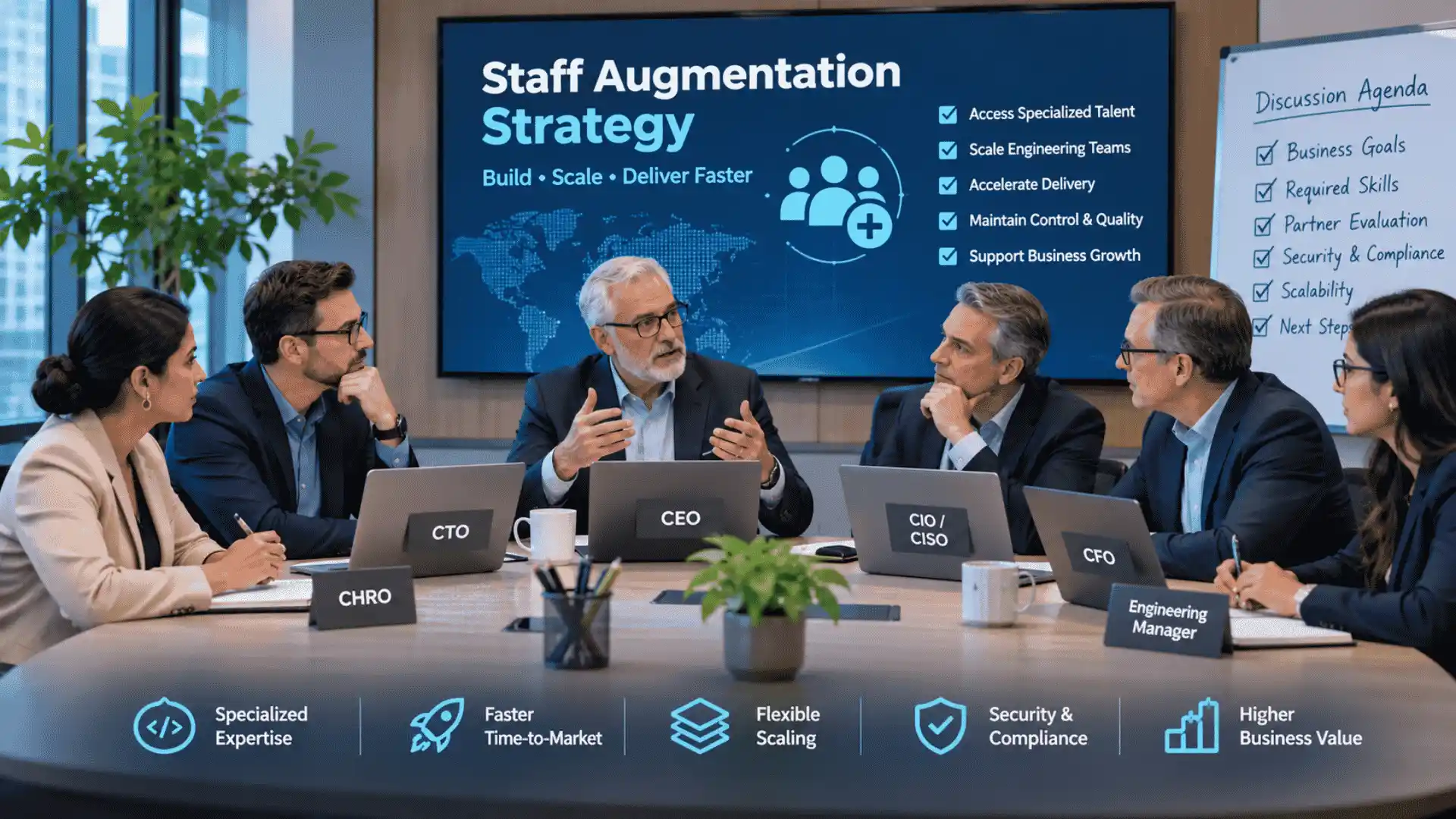
Staff augmentation is an outsourcing model where organizations temporarily hire external professionals to work alongside their existing internal teams.
Instead of spending months recruiting permanent employees, enterprises quickly onboard experienced professionals through a trusted technology partner.
These professionals become part of your engineering team while your managers retain complete control over priorities, sprint planning, architecture, and delivery.
Learn more about Staff Augmentation.
Typical Roles Include
- Software Developers
- AI Engineers
- DevOps Engineers
- Cloud Architects
- QA Engineers
- Data Engineers
- Product Designers
- Cybersecurity Specialists
Why Enterprises Choose Staff Augmentation
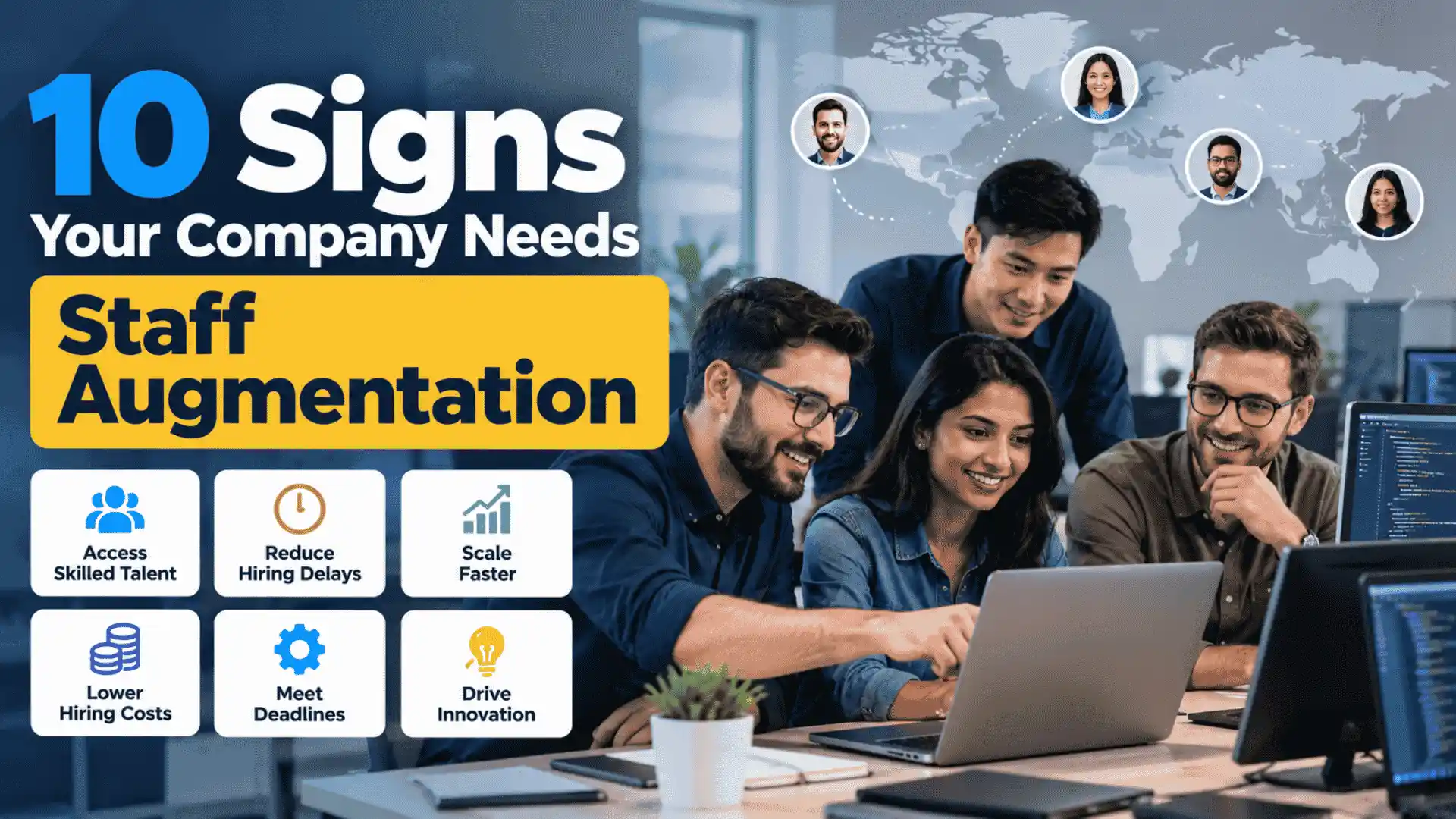
Enterprise organizations typically use staff augmentation when they need to:
- Scale engineering teams quickly
- Fill skill gaps
- Speed up product development
- Support cloud migration
- Build AI products
- Reduce hiring delays
- Access specialized expertise
Instead of replacing internal teams, external professionals strengthen existing capabilities.
Common Staff Augmentation Models
Different business objectives require different engagement models.
Dedicated Development Teams
For long-term product development, enterprises often choose Dedicated Development Teams.
This model provides a stable engineering team working exclusively on your products.
Best suited for:
- SaaS Products
- Enterprise Applications
- AI Platforms
- Digital Transformation Programs
Project Based Staffing
Organizations with fixed timelines often choose Project Based Staffing.
Ideal examples include:
- ERP Implementation
- Cloud Migration
- Mobile Applications
- AI Proof of Concepts
- Legacy System Modernization
Contract IT Staffing
Need experienced professionals immediately?
Contract IT Staffing enables enterprises to quickly hire developers, architects, or engineers for temporary assignments.
Permanent IT Staffing
Some positions require long-term employees.
Permanent IT Staffing helps organizations recruit experienced technology professionals without lengthy recruitment cycles.
Recruitment Process Outsourcing (RPO)
Large enterprises hiring at scale often use Recruitment Process Outsourcing to streamline recruitment, improve hiring quality, and reduce time-to-fill positions.
Benefits of Staff Augmentation
Organizations choose staff augmentation because it offers several business advantages.
- Faster hiring
- Flexible team scaling
- Lower recruitment costs
- Access to global talent
- Complete project control
- Reduced administrative burden
- Faster product delivery
Staff augmentation works best when enterprises want to expand delivery capacity while keeping full ownership of engineering decisions.
What Are Managed Services?
Managed Services follow a different engagement model.
Instead of providing individual professionals, a Managed Service Provider (MSP) assumes responsibility for delivering an agreed service or business function.
The enterprise defines expected outcomes.
The provider manages:
- Hiring
- Delivery
- Operations
- Monitoring
- Reporting
- Continuous Improvement
- Service Level Agreements (SLAs)
Rather than measuring developer productivity, organizations measure business outcomes.
Examples of Managed Services
Typical Managed Services include:
- Cloud Infrastructure Management
- DevOps Operations
- Application Maintenance
- Cybersecurity Monitoring
- Database Administration
- IT Helpdesk
- Network Operations
- AI Operations (AIOps)
- Infrastructure Monitoring
Managed Services are particularly valuable when enterprises want predictable service delivery without managing day-to-day operations.
How Managed Services Work
Unlike staff augmentation, managed services focus on outcomes rather than resources.
Business Requirement
          │
          ▼
Define SLA & KPIs
          │
          ▼
Managed Service Provider
          │
          ▼
Build Delivery Team
          │
          ▼
Operate & Monitor Service
          │
          ▼
Monthly Reporting & Continuous Improvement
The enterprise manages business priorities.
The provider manages delivery.
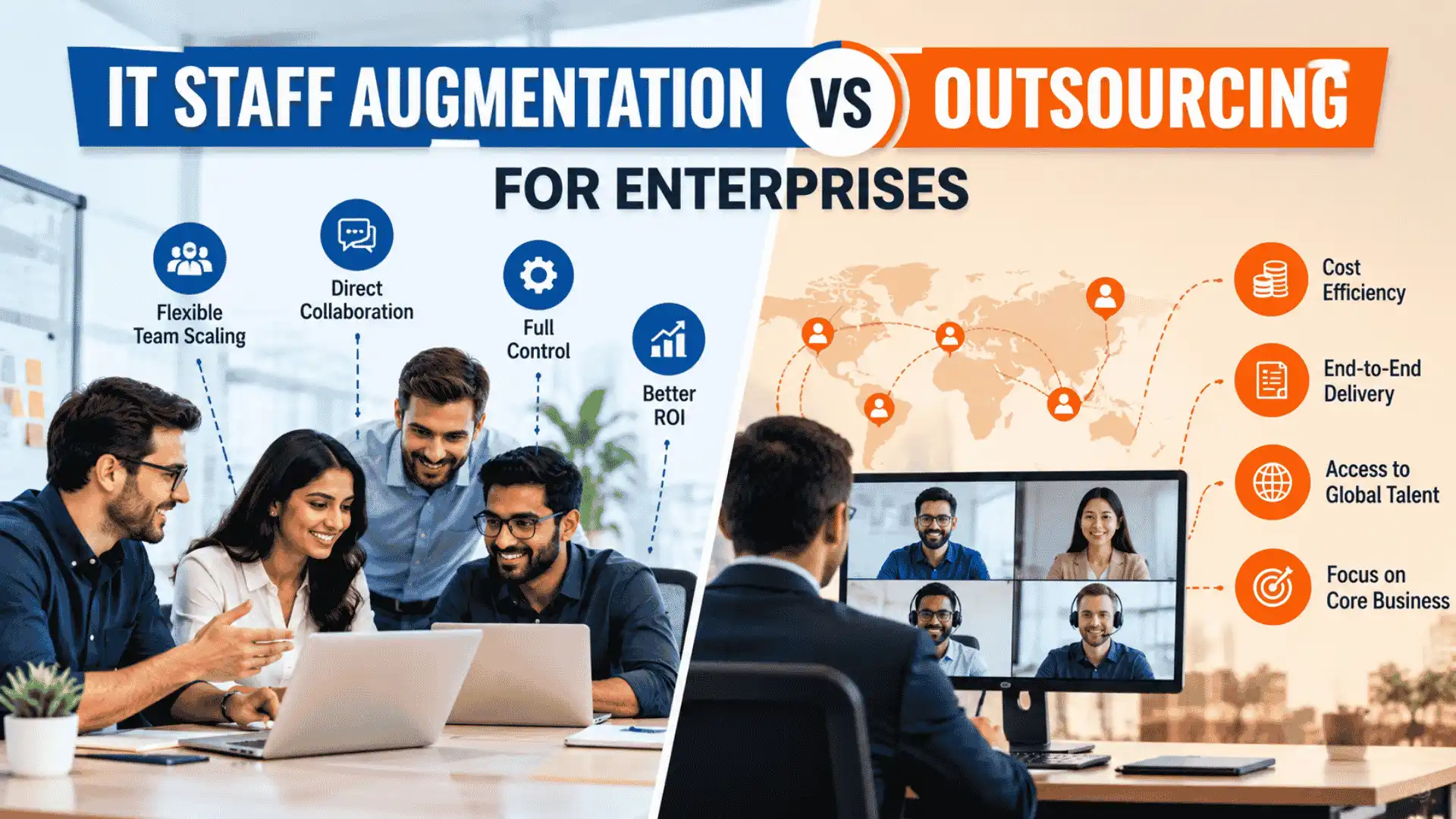
Staff Augmentation vs Managed Services: Quick Comparison
| Feature | Staff Augmentation | Managed Services |
|---|---|---|
| Primary Goal | Add skilled professionals | Outsource business outcomes |
| Team Management | Client | Provider |
| Delivery Ownership | Client | Provider |
| Internal Control | High | Medium |
| Flexibility | Very High | Moderate |
| SLA Based | No | Yes |
| Best For | Product Development | Business Operations |
| Pricing Model | Resource-Based | Outcome-Based |
| Team Scalability | High | Medium |
| Long-Term Operations | Limited | Excellent |
Enterprise Market Trends
Enterprise sourcing strategies continue to evolve.
Recent Deloitte research found:
- 80% of organizations plan to maintain or increase investment in outsourcing.
- 83% of enterprises are already using AI within outsourced services.
- Organizations increasingly prefer outcome-based delivery models over traditional resource-based engagements. :chatgpt-content-reference{index="1"}
These trends indicate that enterprises are moving beyond simply hiring more people. Instead, they are choosing engagement models that align with business objectives, operational efficiency, and long-term scalability.
Which Model Should You Choose?
The answer depends on one question:
Do you need more people, or do you need someone to own the outcome?
If you already have experienced engineering leadership and simply need additional expertise, Staff Augmentation is usually the better option.
If you want a technology partner to take complete responsibility for service delivery, Managed Services often provide greater long-term value.
Staff Augmentation vs Managed Services: What's the Biggest Difference?
The biggest difference comes down to ownership.
With Staff Augmentation, you're hiring additional talent to strengthen your internal team.
With Managed Services, you're hiring a company to deliver a business outcome.
Think of it this way.
Staff Augmentation provides people. Managed Services provide results.
This single difference affects everything from pricing and accountability to delivery speed and long-term scalability.
Detailed Comparison
| Category | Staff Augmentation | Managed Services |
|---|---|---|
| Primary Goal | Add skilled professionals | Deliver a business outcome |
| Who manages the team? | Client | Service Provider |
| Who owns delivery? | Client | Service Provider |
| Hiring Responsibility | Shared | Provider |
| Project Management | Internal | Provider |
| Architecture Decisions | Client | Shared / Provider |
| Service Level Agreement (SLA) | Usually No | Yes |
| Pricing Model | Per resource | Outcome or SLA based |
| Flexibility | Very High | Moderate |
| Best For | Product Development | Business Operations |
| Team Scaling | Easy | Depends on contract |
| Knowledge Retention | Internal | Provider |
| Long-Term Operations | Limited | Excellent |
| Risk Ownership | Client | Shared / Provider |
Who Controls the Project?
This is usually the deciding factor.
Staff Augmentation
Your internal team controls:
- Sprint planning
- Product roadmap
- Technical decisions
- Architecture
- Code reviews
- Daily stand-ups
- Performance reviews
External engineers simply become part of your team.
Managed Services
The provider controls:
- Resource allocation
- Daily operations
- Incident management
- Delivery process
- Reporting
- SLA compliance
- Service improvement
You define business goals.
The provider decides how those goals are delivered.
Which Model Gives More Flexibility?
If priorities change every week...
Choose Staff Augmentation.
Your engineering managers can immediately:
- Change sprint priorities
- Add new features
- Shift developers
- Pause projects
- Increase team size
without renegotiating contracts.
If your work is predictable...
Managed Services usually make more sense.
Examples include:
- Infrastructure Monitoring
- Cloud Operations
- Help Desk
- Database Management
- Security Operations
- Network Management
Cost Comparison
Many executives assume Managed Services are always cheaper.
This isn't necessarily true.
The total cost depends on:
- Internal leadership
- Project complexity
- Delivery model
- Governance
- Team size
- Contract duration
Typical Cost Drivers
| Cost Factor | Staff Augmentation | Managed Services |
|---|---|---|
| Recruitment | Low | Included |
| Salaries | Monthly | Included |
| Project Management | Internal | Included |
| Delivery Risk | Client | Provider |
| SLA Management | No | Yes |
| Operational Support | Internal | Included |
| Infrastructure Management | Internal | Included |
| Knowledge Transfer | Internal | Contract Driven |
Which Model Saves More Money?
Staff Augmentation usually saves money when:
- You already have experienced engineering managers.
- Your architecture is well defined.
- You only need additional capacity.
- Your project scope changes frequently.
- You need niche technical skills.
For example,
A SaaS company launching an AI feature may hire:
- 2 AI Engineers
- 1 Backend Developer
- 1 QA Engineer
using Staff Augmentation instead of spending months recruiting full-time employees.
Managed Services save money when:
- You require 24/7 support.
- You operate multiple production environments.
- You need predictable monthly costs.
- Your workloads rarely change.
- You lack internal operational expertise.
Examples include:
- Infrastructure Management
- Cloud Operations
- Security Monitoring
- Help Desk
- Database Administration
Pros and Cons of Staff Augmentation
Advantages
- Faster hiring
- Lower recruitment costs
- Complete engineering control
- Flexible scaling
- Access to global talent
- Easy knowledge sharing
- Better collaboration with internal teams
Disadvantages
- Requires internal project management
- Internal managers remain responsible for delivery
- Onboarding still takes time
- Engineering leadership must be mature
Pros and Cons of Managed Services
Advantages
- Provider owns delivery
- SLA-driven performance
- Predictable monthly pricing
- Lower operational workload
- Continuous monitoring
- Easier long-term operations
Disadvantages
- Less day-to-day flexibility
- Change requests may increase costs
- Reduced engineering visibility
- Knowledge can remain with the provider
Which Model Scales Faster?
When speed matters...
Staff Augmentation usually wins.
Need five engineers next week?
Your staffing partner can quickly provide:
without months of recruitment.
Managed Services generally require:
- Scope definition
- SLA agreement
- Transition planning
- Service onboarding
before delivery begins.
Enterprise Trends
Enterprise sourcing strategies continue to evolve.
According to Deloitte's Global Outsourcing Survey:
- 80% of organizations plan to maintain or increase investment in third-party outsourcing.
- 83% are already using AI as part of outsourced services.
- Organizations are increasingly adopting outcome-based delivery models instead of relying only on traditional staff augmentation. :chatgpt-content-reference{index="0"}
This doesn't mean Staff Augmentation is disappearing.
Instead, enterprises increasingly combine multiple engagement models depending on business objectives.
Can Enterprises Use Both Models?
Absolutely.
Many Fortune 500 organizations use both.
For example:
| Business Function | Recommended Model |
|---|---|
| Product Development | Staff Augmentation |
| AI Development | Staff Augmentation |
| Cloud Migration | Staff Augmentation |
| ERP Upgrade | Project Based Staffing |
| IT Help Desk | Managed Services |
| Cybersecurity Monitoring | Managed Services |
| Cloud Infrastructure | Managed Services |
| Database Operations | Managed Services |
This hybrid approach gives enterprises:
- Flexibility
- Faster hiring
- Better governance
- Predictable operations
- Improved business continuity
The most successful enterprises don't choose one model over the other. They choose the right model for each business function.
When Should Enterprises Choose Staff Augmentation?
Not every business needs a Managed Service Provider.
If your company already has experienced engineering leaders, product managers, architects, and delivery managers, Staff Augmentation is usually the smarter investment.
The goal isn't to outsource responsibility.
The goal is to increase delivery capacity.
Choose Staff Augmentation when your organization wants to:
- Launch products faster
- Scale engineering teams quickly
- Fill specialized skill gaps
- Reduce recruitment time
- Keep intellectual property (IP) in-house
- Maintain complete control over engineering decisions
- Expand teams without increasing permanent headcount
Best for organizations that need more engineers, not another management layer.
Enterprise Use Cases for Staff Augmentation
1. Scaling a SaaS Product
A SaaS company plans to release five new features before the next quarter.
Hiring permanent developers could take 60 to 90 days.
Instead, the company hires a Dedicated Development Team consisting of:
- 4 Backend Developers
- 2 Frontend Developers
- 1 QA Engineer
- 1 DevOps Engineer
The internal Product Manager continues leading the roadmap while the augmented team accelerates delivery.
Result
- Faster releases
- No long-term hiring commitments
- Internal leadership remains in control
2. AI Product Development
A healthcare company wants to build an AI-powered document processing platform.
Existing developers understand healthcare systems but lack AI expertise.
Instead of building a new AI department, they augment the team with:
- Machine Learning Engineers
- LLM Engineers
- AI Architects
- Data Engineers
This approach shortens hiring time while keeping all product decisions within the organization. :chatgpt-content-reference{index="0"}
3. Cloud Migration
Migrating hundreds of applications to AWS or Azure often requires temporary cloud specialists.
Organizations frequently use:
because migration has:
- Defined scope
- Fixed timeline
- Specialized expertise requirements
Once migration is complete, the external specialists leave.
When Should Enterprises Choose Managed Services?
Managed Services work best when businesses want to outsource responsibility instead of simply adding resources.
Typical objectives include:
- Reduce operational overhead
- Improve SLA compliance
- Lower infrastructure management effort
- Improve service reliability
- Focus internal teams on innovation
Enterprise Use Cases for Managed Services
1. IT Infrastructure Operations
Instead of hiring:
- Infrastructure Engineers
- Network Engineers
- Database Administrators
- Security Specialists
an enterprise outsources infrastructure management to a Managed Service Provider.
The provider becomes responsible for:
- Monitoring
- Incident response
- Patch management
- Performance optimization
- SLA reporting
2. Cybersecurity Operations
Many organizations operate Security Operations Centers (SOC) through Managed Services.
The provider handles:
- Threat monitoring
- Vulnerability management
- Incident response
- Compliance reporting
while the enterprise focuses on governance and security strategy.
3. 24×7 Application Support
Global organizations require continuous application availability.
Instead of maintaining multiple support shifts internally, they outsource application support under agreed SLAs.
Benefits include:
- Predictable costs
- Round-the-clock monitoring
- Faster incident resolution
- Dedicated operational teams
Which Industries Prefer Staff Augmentation?
| Industry | Why Staff Augmentation Works |
|---|---|
| SaaS | Rapid feature development |
| FinTech | Specialized engineering skills |
| Healthcare | AI and compliance expertise |
| Manufacturing | ERP and digital transformation |
| Retail | Seasonal engineering demand |
| Startups | Fast scaling without permanent hiring |
Which Industries Prefer Managed Services?
| Industry | Typical Managed Service |
|---|---|
| Banking | Infrastructure Operations |
| Healthcare | IT Support & Security |
| Telecom | Network Operations |
| Government | Help Desk Services |
| Retail | Cloud Operations |
| Manufacturing | ERP Support |
Staff Augmentation vs Managed Services: Decision Framework
Before selecting an engagement model, answer these questions.
Question 1
Do you already have experienced engineering leadership?
✅ Yes → Staff Augmentation
❌ No → Managed Services
Question 2
Do you need additional people or a complete service?
Additional people
→ Staff Augmentation
Complete service ownership
→ Managed Services
Question 3
Will project priorities change frequently?
Yes
→ Staff Augmentation
No
→ Managed Services
Question 4
Who should own delivery risk?
Your company
→ Staff Augmentation
Technology partner
→ Managed Services
Quick Decision Matrix
| Business Need | Recommended Model |
|---|---|
| Build a Product | Staff Augmentation |
| AI Development | Staff Augmentation |
| Cloud Migration | Staff Augmentation |
| ERP Implementation | Project Based Staffing |
| Long-term IT Operations | Managed Services |
| Infrastructure Monitoring | Managed Services |
| Cybersecurity Operations | Managed Services |
| Help Desk | Managed Services |
Can Enterprises Combine Both Models?
Absolutely.
Many Fortune 500 companies do not choose one model exclusively.
Instead, they combine them.
Example:
| Department | Engagement Model |
|---|---|
| Product Engineering | Dedicated Development Teams |
| AI Development | Contract IT Staffing |
| Large Hiring Initiative | Recruitment Process Outsourcing |
| Cloud Infrastructure | Managed Services |
| IT Help Desk | Managed Services |
| Security Operations | Managed Services |
This hybrid approach allows enterprises to:
- Scale faster
- Reduce hiring costs
- Maintain engineering control
- Improve operational efficiency
- Focus leadership on innovation instead of staffing
Industry guidance increasingly recommends treating these models as complementary rather than mutually exclusive. Many enterprises use staff augmentation for changing, product-focused work while relying on managed services for stable, SLA-driven operations. :chatgpt-content-reference{index="1"}
Common Mistakes Enterprises Make
Mistake 1: Choosing the Cheapest Option
The lowest hourly rate rarely produces the lowest total cost.
Hidden costs include:
- Onboarding
- Project delays
- Rework
- Knowledge transfer
- Management overhead
Focus on Total Cost of Ownership (TCO) instead of hourly pricing.
Mistake 2: Using Staff Augmentation Without Strong Leadership
Staff augmentation is successful only when internal managers provide:
- Clear priorities
- Technical direction
- Regular feedback
- Effective sprint planning
Without experienced leadership, delivery quality often suffers because responsibility remains with the client. :chatgpt-content-reference{index="2"}
Mistake 3: Outsourcing an Undefined Process
Managed Services require:
- Clearly defined scope
- KPIs
- SLAs
- Governance
- Reporting
If the work changes every week, Staff Augmentation is usually the better choice.
Mistake 4: Ignoring Knowledge Transfer
Whether you're using:
- Permanent IT Staffing
- Project Based Staffing
- Managed Services
always document:
- Architecture
- Processes
- Deployment
- Security
- Runbooks
Knowledge retention reduces long-term business risk.
Enterprise Insight: The highest-performing organizations don't ask, "Which model is better?" They ask, "Which model best fits this specific business function?"
Frequently Asked Questions (FAQs)
1. What is the difference between Staff Augmentation and Managed Services?
The biggest difference is ownership.
With Staff Augmentation, external professionals become part of your internal team, while your managers retain control over delivery, priorities, and technical decisions.
With Managed Services, the service provider takes responsibility for delivering agreed outcomes under predefined Service Level Agreements (SLAs).
2. Which is more cost-effective for enterprises?
It depends on your business objectives.
Staff Augmentation is often more cost-effective when:
- You already have experienced engineering leadership.
- You need specialized skills quickly.
- Project requirements change frequently.
- You want complete engineering control.
Managed Services often provide better value when:
- Operations run continuously.
- Service levels must be guaranteed.
- Internal management capacity is limited.
- Predictable monthly costs are important.
3. Can enterprises use both models together?
Yes.
Many enterprise organizations combine both engagement models.
For example:
| Business Function | Recommended Model |
|---|---|
| Product Engineering | Staff Augmentation |
| AI Development | Dedicated Development Teams |
| Cloud Migration | Project Based Staffing |
| Long-Term Infrastructure | Managed Services |
| Cybersecurity Monitoring | Managed Services |
| IT Support | Managed Services |
This hybrid strategy provides greater flexibility while improving operational efficiency.
4. Which model is better for AI projects?
Most AI initiatives begin with Staff Augmentation because organizations require specialized expertise while maintaining control over data, architecture, compliance, and business strategy.
Typical AI specialists include:
- AI Engineers
- Machine Learning Engineers
- Data Scientists
- LLM Engineers
- AI Architects
As AI platforms mature, organizations may transition operational support to Managed Services.
5. Is Staff Augmentation better than outsourcing?
Not necessarily.
Traditional outsourcing usually transfers both people and project ownership to a third party.
Staff Augmentation simply extends your existing team.
If maintaining control over engineering decisions is important, Staff Augmentation is often the preferred model.
6. When should I choose Dedicated Development Teams?
Dedicated Development Teams are ideal when:
- Product development is ongoing.
- Teams need long-term collaboration.
- Business knowledge must remain within the organization.
- Continuous feature development is required.
7. When should I use Contract IT Staffing?
Contract IT Staffing is suitable when:
- You need specialists immediately.
- Project duration is short.
- Technical expertise is temporary.
- Hiring permanent employees isn't practical.
8. Is Project Based Staffing suitable for digital transformation?
Yes.
Project Based Staffing works well for:
- Cloud migration
- ERP implementation
- AI proof of concepts
- Legacy modernization
- Enterprise application upgrades
because the work has a defined scope and timeline.
9. Can Recruitment Process Outsourcing replace internal hiring?
No.
Recruitment Process Outsourcing complements internal HR teams by improving hiring speed, candidate quality, and recruitment efficiency.
Large enterprises often use RPO for high-volume technology hiring.
10. Which engagement model offers better scalability?
If your engineering priorities change frequently, Staff Augmentation typically provides greater flexibility.
If your objective is operational stability with measurable service outcomes, Managed Services are often the better long-term choice.
Enterprise Decision Checklist
Before selecting an engagement model, ask the following questions.
| Question | Staff Augmentation | Managed Services |
|---|---|---|
| Need additional engineers? | ✅ | ❌ |
| Need complete service ownership? | ❌ | ✅ |
| Internal engineering leadership available? | ✅ | ❌ |
| Need SLA-based operations? | ❌ | ✅ |
| Frequently changing priorities? | ✅ | ❌ |
| Long-term operational support? | ❌ | ✅ |
| Product development? | ✅ | ❌ |
| Infrastructure management? | ❌ | ✅ |
If most of your answers fall under the Staff Augmentation column, extending your engineering team is likely the better choice.
If most answers align with Managed Services, outsourcing operational responsibility may deliver greater long-term value.
Key Takeaways
- Staff Augmentation extends your internal engineering team while keeping delivery under your control.
- Managed Services transfer operational responsibility to a service provider.
- Staff Augmentation works best for product engineering, digital transformation, AI initiatives, and rapid scaling.
- Managed Services are ideal for infrastructure, cloud operations, cybersecurity, and ongoing IT support.
- Many enterprise organizations combine both models to balance agility with operational efficiency.
- Choose the engagement model that aligns with your business goals rather than selecting based solely on hourly rates.
The right engagement model isn't about reducing costs alone. It's about improving delivery speed, accessing the right expertise, reducing business risk, and enabling long-term growth.
Final Thoughts
There is no universal winner in the debate between Staff Augmentation and Managed Services.
The right decision depends on your organization's priorities.
If your business needs experienced professionals who can integrate seamlessly into your existing engineering team, Staff Augmentation offers flexibility, faster hiring, and complete project control.
If your goal is to reduce operational complexity, improve service reliability, and focus internal teams on strategic initiatives, Managed Services provide a structured, outcome-driven approach.
Many successful enterprises adopt a hybrid strategy, using Dedicated Development Teams for innovation while relying on Managed Services to operate and maintain critical technology environments.
The best engagement model is the one that helps your organization deliver projects faster, optimize costs, and achieve measurable business outcomes.
Ready to Scale Your Engineering Team?
Whether you need a single specialist or an entire development team, TeamBees helps enterprises build high-performing engineering teams tailored to their business goals.
Explore our services:
- Staff Augmentation
- Dedicated Development Teams
- Project Based Staffing
- Contract IT Staffing
- Permanent IT Staffing
- Recruitment Process Outsourcing
Choose the engagement model that fits your business today while preparing your organization for tomorrow's growth.