Dedicated Team vs Outsourcing: Which Delivery Model Fits Your Business?
Not sure whether to choose a Dedicated Development Team or Outsourcing? This enterprise guide compares costs, flexibility, scalability, project ownership, and real-world use cases to help CTOs, CIOs, and business leaders select the right software delivery model.
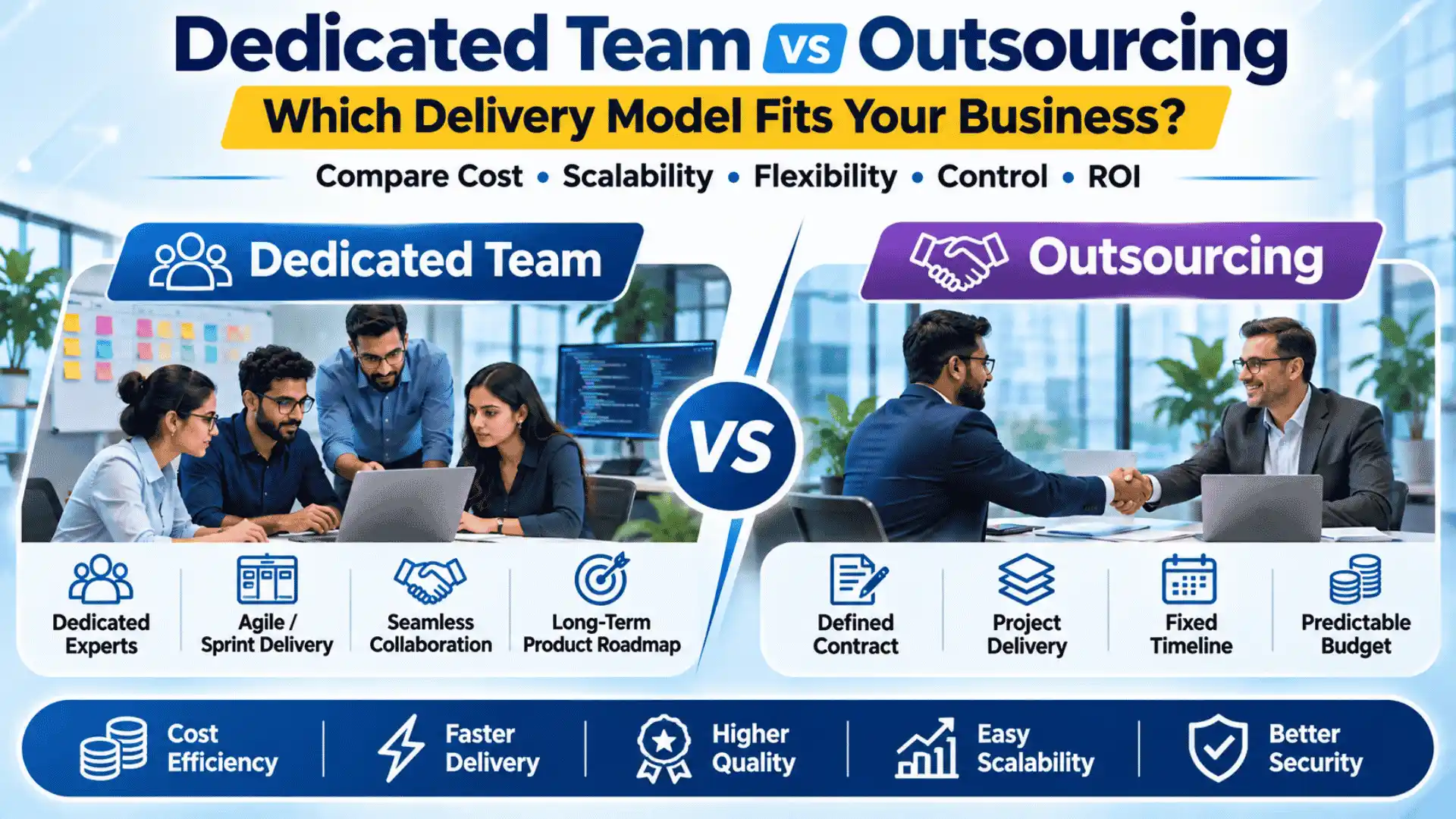
Building software successfully is no longer just about hiring developers. Today's enterprise leaders must choose the right delivery model to accelerate innovation, control costs, and reduce project risks.
One of the most common questions asked by CTOs, CIOs, CEOs, and Product Leaders is:
Should we build with a Dedicated Development Team or outsource the entire project?
While both models involve working with an external technology partner, they differ significantly in terms of ownership, collaboration, flexibility, and long-term business value.
Selecting the wrong engagement model can lead to:
- Delayed product launches
- Budget overruns
- Poor communication
- Knowledge loss
- Limited scalability
- Lower software quality
According to Deloitte's Global Outsourcing Survey, 80% of organizations plan to maintain or increase outsourcing investments, but the most successful enterprises choose different engagement models based on business objectives rather than cost alone. :chatgpt-content-reference{index="0"}
This guide explains:
- What is a Dedicated Development Team?
- What is Project Outsourcing?
- Key differences
- Advantages and disadvantages
- Which model fits different business scenarios
- How enterprise companies make the decision
What Is a Dedicated Development Team?
A Dedicated Development Team is a long-term group of software professionals assigned exclusively to your business.
Unlike traditional outsourcing, the team works only on your projects, understands your business goals, and becomes an extension of your internal engineering organization.
You continue to own:
- Product roadmap
- Sprint planning
- Priorities
- Technical decisions
- Product vision
Meanwhile, your technology partner manages:
- Recruitment
- HR
- Team continuity
- Infrastructure
- Administrative tasks
Learn more about Dedicated Development Teams.
How Does a Dedicated Team Work?
A dedicated team integrates directly into your development process.
Enterprise Company
        │
        ▼
Product Roadmap
        │
        ▼
Dedicated Development Team
        │
        ▼
Sprint Planning
        │
        ▼
Continuous Development
        │
        ▼
Release & Support
The team typically joins your:
- Daily stand-ups
- Sprint reviews
- Planning meetings
- Product discussions
- Engineering documentation
Over time, they develop deep knowledge of your product, architecture, and business processes.
Typical Roles in a Dedicated Team
Depending on project complexity, the team may include:
- Software Developers
- Frontend Engineers
- Backend Engineers
- Mobile Developers
- QA Engineers
- DevOps Engineers
- UI/UX Designers
- Business Analysts
- Product Owners
- Scrum Masters
- Cloud Engineers
The exact team structure grows alongside your product roadmap.
Why Enterprises Choose Dedicated Teams
Large organizations often select dedicated teams because they need continuous product development rather than one-time project delivery.
Common reasons include:
- Long-term software development
- AI product development
- Digital transformation
- SaaS platform development
- Product modernization
- Engineering team expansion
- Faster time-to-market
Instead of repeatedly onboarding new vendors, enterprises retain a stable engineering team that understands the product over time.
Benefits of Dedicated Development Teams
Dedicated teams provide several advantages for growing businesses.
- Long-term product knowledge
- Better collaboration
- High flexibility
- Faster scaling
- Stable engineering capacity
- Lower hiring overhead
- Better quality control
Dedicated teams work best when your product roadmap continues evolving and priorities frequently change. :chatgpt-content-reference{index="1"}
What Is Software Outsourcing?
Software outsourcing is an engagement model where a company hires an external vendor to deliver a predefined project or business outcome.
Instead of managing developers daily, the client defines:
- Scope
- Timeline
- Budget
- Deliverables
The outsourcing partner manages:
- Development
- Team structure
- Delivery
- Quality assurance
- Deployment
Once the project is completed, the engagement usually ends.
How Project Outsourcing Works
Unlike dedicated teams, project outsourcing focuses on delivering a specific outcome.
Business Requirement
        │
        ▼
Project Scope
        │
        ▼
Software Vendor
        │
        ▼
Development
        │
        ▼
Testing
        │
        ▼
Final Delivery
The vendor determines how the work gets completed while remaining accountable for the agreed deliverables.
Common Examples of Software Outsourcing
Organizations commonly outsource:
- Mobile applications
- Website development
- ERP implementation
- CRM customization
- API integrations
- Legacy system migration
- Proof of Concept (PoC)
- MVP development
These projects usually have:
- Fixed requirements
- Defined timelines
- Limited scope changes
When Does Outsourcing Make Sense?
Project outsourcing is often the better option when:
- Requirements are already finalized.
- Budget is fixed.
- Delivery timeline is predictable.
- Internal technical leadership is limited.
- The project has a clear beginning and end.
For example,
A manufacturing company wants to build an employee attendance application with clearly defined features.
Rather than hiring a long-term engineering team, outsourcing the project allows them to receive the finished application within the agreed timeline.
Dedicated Team vs Outsourcing: Quick Comparison
| Feature | Dedicated Team | Project Outsourcing |
|---|---|---|
| Team Focus | Long-term product development | Fixed project delivery |
| Client Control | High | Medium |
| Product Ownership | Client | Client |
| Team Continuity | High | Limited |
| Flexibility | Very High | Low after scope approval |
| Scope Changes | Easy | Usually Change Request |
| Best For | Growing Products | Fixed Projects |
| Pricing | Monthly Team Cost | Fixed Price / Milestones |
| Collaboration | Continuous | Limited |
| Knowledge Retention | Strong | Often Lost After Project |
Dedicated Team or Outsourcing: Which One Gives More Control?
Control is one of the biggest differences.
With a Dedicated Team:
- You prioritize features.
- You manage the backlog.
- You review sprint progress.
- You approve releases.
- You guide product direction.
With Project Outsourcing:
- You approve requirements.
- The vendor manages execution.
- Communication follows agreed milestones.
- Delivery happens according to the Statement of Work (SOW).
If your roadmap changes frequently, a Dedicated Development Team usually offers greater flexibility than project-based outsourcing. :chatgpt-content-reference{index="2"}
Dedicated Teams Are Not the Same as Staff Augmentation
Many organizations confuse these two engagement models.
Staff Augmentation provides individual professionals who work directly under your managers.
A Dedicated Development Team provides an established engineering unit with shared collaboration and long-term product focus.
Organizations often start with Staff Augmentation before expanding into a full Dedicated Development Team as the product grows.
Related Staffing Models
Depending on your business objectives, you may also consider:
- Project Based Staffing for fixed-duration initiatives.
- Contract IT Staffing for temporary specialists.
- Permanent IT Staffing for long-term hiring.
- Recruitment Process Outsourcing to scale enterprise hiring efficiently.
Each engagement model solves a different business challenge, and many enterprises combine multiple models based on project needs.
Dedicated Team vs Outsourcing: What's the Biggest Difference?
Although both models involve working with an external technology partner, they differ significantly in how projects are managed, teams collaborate, and business goals are achieved.
The biggest difference is simple.
A Dedicated Team becomes part of your company. An Outsourcing vendor delivers a project.
A dedicated team works alongside your internal stakeholders for months or even years, while outsourcing vendors focus on completing a predefined scope within an agreed timeline.
This difference affects:
- Product ownership
- Engineering collaboration
- Budget flexibility
- Delivery speed
- Knowledge retention
- Long-term scalability
Detailed Comparison
| Feature | Dedicated Team | Project Outsourcing |
|---|---|---|
| Engagement | Long-term | Short-term |
| Team Focus | Your Product | Your Project |
| Team Management | Shared | Vendor |
| Product Ownership | Client | Client |
| Technical Decisions | Client | Mostly Vendor |
| Flexibility | Very High | Limited |
| Scope Changes | Easy | Change Requests |
| Delivery Model | Agile | Fixed Scope / Milestone |
| Team Continuity | Excellent | Limited |
| Knowledge Retention | High | Medium |
| Communication | Daily | Weekly / Milestone |
| Best For | Product Companies | Fixed Projects |
Team Structure Comparison
A Dedicated Team functions like an extension of your engineering department.
Internal Product Team
        │
        ▼
Dedicated Development Team
        │
        ▼
Daily Collaboration
        │
        ▼
Continuous Releases
Traditional outsourcing usually follows this approach.
Business Requirement
        │
        ▼
Vendor Proposal
        │
        ▼
Development
        │
        ▼
Testing
        │
        ▼
Final Delivery
The first model emphasizes collaboration.
The second emphasizes project completion.
Which Model Offers More Flexibility?
Today's enterprise products evolve continuously.
Customer feedback...
Market changes...
New AI opportunities...
Security updates...
All require rapid development.
This is where Dedicated Teams excel.
With a Dedicated Development Team you can:
- Add engineers
- Remove engineers
- Change sprint priorities
- Introduce new features
- Pivot product direction
without renegotiating an entire contract.
With Outsourcing...
Most changes require:
- Scope approval
- Cost estimation
- Contract amendment
- Timeline adjustment
which often slows delivery.
Collaboration Comparison
Dedicated Team
Communication happens continuously.
Typical meetings include:
- Daily Stand-ups
- Sprint Planning
- Sprint Review
- Backlog Refinement
- Architecture Discussions
- Product Workshops
The external engineers gradually become part of your company culture.
Project Outsourcing
Communication usually revolves around:
- Weekly Updates
- Milestone Reviews
- Client Feedback
- Acceptance Testing
- Final Delivery
The vendor focuses primarily on delivering agreed requirements.
Which Model Gives Better Product Quality?
Software quality depends heavily on business understanding.
Dedicated Teams continuously learn:
- Customer behavior
- Business processes
- Product architecture
- Technical debt
- User feedback
Over time this results in:
- Better code quality
- Better architecture
- Faster feature delivery
- Fewer production bugs
because engineers understand the "why" behind every feature.
Outsourcing vendors generally optimize for:
- Delivery
- Budget
- Timeline
- Contract completion
rather than long-term product evolution.
Cost Comparison
Many decision makers assume outsourcing is always cheaper.
In reality...
It depends on what you're measuring.
Consider the total business cost.
Cost Drivers
| Cost Factor | Dedicated Team | Outsourcing |
|---|---|---|
| Recruitment | Included | Included |
| Knowledge Transfer | Excellent | Moderate |
| Team Stability | High | Medium |
| Communication Cost | Low | Medium |
| Scope Changes | Low Cost | Expensive |
| Delivery Risk | Shared | Vendor |
| Product Learning Curve | Improves Over Time | Restarts Per Project |
| Long-Term ROI | High | Moderate |
Which Model Saves More Money?
Dedicated Teams reduce costs when:
- Products evolve continuously.
- Features are released every sprint.
- Engineering knowledge must stay within the company.
- Multiple releases are planned.
- Roadmaps change frequently.
Instead of repeatedly onboarding new vendors, enterprises continue working with the same engineering team.
Outsourcing reduces costs when:
- Scope is fixed.
- Budget is fixed.
- Timeline is fixed.
- Business requirements won't change.
Examples include:
- Corporate Website
- Mobile App MVP
- ERP Implementation
- CRM Customization
- Internal Portal
Pros and Cons of Dedicated Teams
Advantages
- Deep product knowledge
- Continuous collaboration
- Faster releases
- Better communication
- Easy scaling
- Greater flexibility
- High engineering ownership
- Lower hiring effort
Disadvantages
- Requires internal product leadership.
- Long-term engagement.
- Monthly investment continues while the team remains active.
- Client remains responsible for roadmap decisions.
Pros and Cons of Outsourcing
Advantages
- Predictable pricing
- Faster project kickoff
- Lower management effort
- Vendor owns delivery
- Suitable for fixed projects
Disadvantages
- Limited flexibility
- Change requests increase costs
- Less product knowledge
- Communication delays
- Team usually dissolves after project completion
Delivery Speed Comparison
Which model launches products faster?
It depends.
Dedicated Teams
Best when:
- Continuous releases
- Agile development
- Product evolution
- AI development
- SaaS platforms
Each sprint builds upon previous knowledge.
Delivery becomes faster over time.
Outsourcing
Best when:
- Requirements are complete.
- Scope rarely changes.
- Timeline is fixed.
- Deliverables are clearly defined.
Which Model Scales Better?
Scaling a Dedicated Team is straightforward.
Need:
- 2 Backend Developers?
- 3 AI Engineers?
- DevOps Specialist?
- QA Automation Engineer?
Your technology partner expands the existing team.
Many enterprises also combine:
to rapidly increase engineering capacity.
Scaling outsourced projects, however, often requires:
- New Statement of Work
- New Budget Approval
- New Timeline
- Additional Contracts
Risk Comparison
| Risk Area | Dedicated Team | Outsourcing |
|---|---|---|
| Knowledge Loss | Low | Medium |
| Product Understanding | Excellent | Moderate |
| Communication Risk | Low | Medium |
| Scope Change Risk | Low | High |
| Delivery Control | High | Medium |
| Vendor Dependency | Moderate | High |
Enterprise Trends
Modern enterprises are shifting away from one-size-fits-all engagement models.
Industry research shows organizations increasingly prefer long-term collaborative engineering partnerships for digital products, while fixed-price outsourcing remains popular for clearly defined projects. This allows businesses to balance flexibility, innovation, and predictable delivery based on the nature of each initiative.
Enterprise Insight: Companies building digital products rarely think in terms of "projects" anymore. They think in terms of continuous product development, making Dedicated Development Teams an increasingly preferred model for long-term innovation.
Real Enterprise Use Cases, Decision Framework & Common Mistakes
When Should You Choose a Dedicated Development Team?
A Dedicated Development Team is ideal when your software is expected to evolve continuously rather than end after a single release.
Instead of hiring developers one by one, enterprises work with a stable engineering team that grows alongside the product.
Choose a Dedicated Development Team if your business needs:
- Continuous product development
- Long-term engineering support
- Faster feature releases
- Agile development
- Product scalability
- AI-driven innovation
- Better engineering collaboration
A Dedicated Team is an investment in long-term product success rather than short-term project completion.
Enterprise Use Cases for Dedicated Teams
1. SaaS Product Development
A growing SaaS company plans to release new features every two weeks.
Hiring permanent developers could take several months, delaying the product roadmap.
Instead, the company builds a Dedicated Development Team consisting of:
- Product Engineers
- Backend Developers
- Frontend Developers
- QA Engineers
- DevOps Engineers
The internal Product Manager continues owning priorities while the dedicated team focuses on execution.
Result
- Faster feature delivery
- Better product quality
- Stable engineering capacity
- Lower hiring effort
2. Enterprise AI Platform Development
A financial services company wants to build internal AI applications.
The roadmap includes:
- AI Chatbots
- Document Intelligence
- Predictive Analytics
- Internal Automation
Because AI products continuously evolve, a Dedicated Team provides better long-term value than project outsourcing.
The engineering team gains deep understanding of:
- Business workflows
- Compliance requirements
- Customer behavior
- AI model performance
This accumulated knowledge improves future releases.
3. Product Modernization
A retail company is modernizing its legacy platform.
The roadmap includes:
- Cloud Migration
- API Development
- Mobile Applications
- Customer Portal
- Payment Integration
Since priorities change throughout the project, the company uses a Dedicated Development Team instead of fixed-price outsourcing.
When Should You Choose Outsourcing?
Traditional outsourcing works best when the project has:
- Fixed scope
- Fixed timeline
- Fixed budget
- Clearly defined deliverables
Examples include:
- Corporate Websites
- ERP Implementation
- CRM Migration
- Internal Portals
- MVP Development
- Mobile Applications
The vendor becomes responsible for delivering the agreed solution.
Enterprise Use Cases for Outsourcing
1. Corporate Website Development
A manufacturing company wants to redesign its corporate website.
Requirements are already finalized.
Timeline: 12 weeks.
Budget: Fixed.
This is a perfect outsourcing project because:
- Scope won't change significantly.
- Delivery milestones are predefined.
- Maintenance can be handled separately.
2. ERP Implementation
An enterprise plans to implement a new ERP system.
The implementation follows:
- Defined milestones
- Vendor methodology
- Fixed implementation phases
This makes outsourcing an efficient option.
3. Mobile App MVP
A startup wants to validate its product idea quickly.
Instead of hiring an entire engineering department, it outsources MVP development to launch faster.
If the product succeeds, the startup can later transition to a Dedicated Development Team.
Industry Recommendations
Different industries benefit from different delivery models.
| Industry | Recommended Model | Why |
|---|---|---|
| SaaS | Dedicated Team | Continuous product evolution |
| FinTech | Dedicated Team | Security and long-term ownership |
| Healthcare | Dedicated Team | Compliance and product knowledge |
| Retail | Dedicated Team | Continuous feature releases |
| Manufacturing | Outsourcing | ERP and digital projects |
| Government | Outsourcing | Fixed procurement projects |
| Education | Outsourcing | Learning management systems |
| Real Estate | Outsourcing | Fixed business applications |
Dedicated Team vs Outsourcing: Decision Framework
Before selecting a delivery model, ask these questions.
Question 1
Will your product continue evolving after launch?
✅ Yes
Choose a Dedicated Development Team.
❌ No
Project Outsourcing is often sufficient.
Question 2
Do you already have Product Managers or Engineering Managers?
✅ Yes
A Dedicated Team integrates seamlessly with your leadership.
❌ No
Outsourcing may reduce management overhead.
Question 3
Will priorities change frequently?
If new features are expected every sprint...
Dedicated Teams provide much greater flexibility.
If requirements are fixed...
Outsourcing becomes easier to manage.
Question 4
Who should manage developers?
Internal Engineering Team
→ Dedicated Team
External Vendor
→ Outsourcing
Decision Matrix
| Business Need | Dedicated Team | Outsourcing |
|---|---|---|
| Long-term Product Development | ✅ | ❌ |
| SaaS Platform | ✅ | ❌ |
| AI Product | ✅ | ❌ |
| Continuous Releases | ✅ | ❌ |
| Corporate Website | ❌ | ✅ |
| ERP Project | ❌ | ✅ |
| Mobile MVP | ⚠ Depends | ✅ |
| Fixed Budget Project | ❌ | ✅ |
Can Enterprises Combine Both Models?
Absolutely.
Many global enterprises use multiple engagement models simultaneously.
For example:
| Business Function | Delivery Model |
|---|---|
| Product Development | Dedicated Development Teams |
| Specialized Engineers | Staff Augmentation |
| Short-Term Expertise | Contract IT Staffing |
| Fixed Digital Projects | Outsourcing |
| Large Hiring Programs | Recruitment Process Outsourcing |
| Temporary Delivery Teams | Project Based Staffing |
Using the right engagement model for each business objective improves agility while controlling costs.
Common Mistakes Companies Make
Mistake 1: Choosing Based Only on Hourly Rates
Lower hourly pricing doesn't always result in lower project costs.
Hidden costs often include:
- Communication delays
- Rework
- Scope changes
- Knowledge transfer
- Vendor onboarding
Focus on overall business value instead of the lowest bid.
Mistake 2: Outsourcing a Continuously Changing Product
If your roadmap changes every month, traditional outsourcing becomes difficult.
Every new requirement can trigger:
- Contract revisions
- Budget increases
- Timeline extensions
Dedicated Teams handle changing priorities much more effectively.
Mistake 3: Building a Dedicated Team Without Internal Leadership
A Dedicated Team still requires:
- Product Vision
- Sprint Planning
- Technical Leadership
- Engineering Governance
Without experienced internal leadership, productivity may decline.
Mistake 4: Ignoring Knowledge Retention
Each time a project changes vendors, valuable knowledge can be lost.
Document:
- Architecture
- Deployment
- APIs
- Infrastructure
- Product Decisions
Knowledge retention reduces long-term business risk and accelerates future development.
Enterprise Trends
Software delivery is shifting from project-based execution to continuous product engineering.
Organizations increasingly favor long-term engineering partnerships for products that require frequent updates, while fixed-scope outsourcing remains effective for one-time implementations and well-defined projects.
This hybrid approach helps enterprises balance innovation, speed, and operational efficiency.
Enterprise Insight: Modern software products rarely have a finish line. Businesses that continuously improve their products often gain more value from Dedicated Development Teams than from repeatedly outsourcing individual projects.
FAQs
1. What is the difference between a Dedicated Team and Outsourcing?
A Dedicated Team works exclusively on your product and integrates with your internal engineering team. Your company retains control over priorities, sprint planning, and product decisions.
With Outsourcing, the vendor is responsible for delivering a predefined project based on an agreed scope, timeline, and budget.
Dedicated Team = Long-term partnership.
Outsourcing = Project delivery.
2. Which delivery model is better for startups?
It depends on your product stage.
Choose a Dedicated Development Team if:
- You're building a SaaS product.
- You expect frequent feature releases.
- You need continuous engineering support.
- Product requirements evolve regularly.
Choose Outsourcing if:
- You're building an MVP.
- Budget is limited.
- Scope is clearly defined.
- You need a one-time project.
3. Which model is more cost-effective?
Neither model is universally cheaper.
Dedicated Teams reduce costs by:
- Eliminating repeated hiring
- Improving engineering productivity
- Reducing onboarding time
- Retaining product knowledge
- Accelerating future releases
Outsourcing reduces costs by:
- Delivering fixed-scope projects
- Offering predictable budgets
- Reducing management overhead
- Minimizing short-term hiring
The best choice depends on your long-term business objectives.
4. Can I scale a Dedicated Development Team?
Yes.
One of the biggest advantages is flexibility.
As your product grows, you can easily add:
- Backend Developers
- Frontend Engineers
- QA Engineers
- DevOps Specialists
- Cloud Engineers
- AI Engineers
- Product Designers
Many organizations begin with Staff Augmentation before expanding into a full Dedicated Development Team.
5. Is Outsourcing suitable for enterprise software?
Yes.
Outsourcing works well for projects with:
- Fixed requirements
- Defined budgets
- Predictable timelines
- Limited future changes
Examples include:
- ERP Implementation
- Corporate Websites
- CRM Deployment
- Internal Portals
- Mobile Applications
6. Can enterprises combine Dedicated Teams and Outsourcing?
Absolutely.
Many global organizations use multiple delivery models simultaneously.
For example:
| Department | Recommended Model |
|---|---|
| Product Engineering | Dedicated Team |
| AI Development | Dedicated Team |
| Legacy Modernization | Dedicated Team |
| ERP Implementation | Outsourcing |
| Website Redesign | Outsourcing |
| Cloud Migration | Depends on project complexity |
Using different engagement models allows enterprises to optimize cost, speed, and expertise for each initiative.
7. When should I choose Staff Augmentation instead?
If you only need a few specialists instead of an entire engineering team, Staff Augmentation is often a better choice.
Examples include hiring:
- React Developers
- Java Developers
- AI Engineers
- DevOps Engineers
- QA Automation Engineers
Staff augmentation lets your internal managers lead the work while external specialists integrate into your existing team.
8. Is a Dedicated Team better for AI projects?
In many cases, yes.
AI initiatives often require continuous experimentation, model improvements, and iterative development.
A Dedicated Team provides:
- Consistent collaboration
- Long-term product knowledge
- Faster iterations
- Better integration with business objectives
This makes it well-suited for enterprise AI platforms, automation solutions, and intelligent software products.
Enterprise Decision Checklist
Before selecting a delivery model, answer the following questions.
| Question | Dedicated Team | Outsourcing |
|---|---|---|
| Continuous product development? | ✅ | ❌ |
| Fixed project scope? | ❌ | ✅ |
| Internal Product Manager available? | ✅ | ❌ |
| Long-term roadmap? | ✅ | ❌ |
| Need rapid scaling? | ✅ | ❌ |
| Fixed timeline? | ❌ | ✅ |
| Frequent requirement changes? | ✅ | ❌ |
| Predictable one-time project? | ❌ | ✅ |
If most of your answers fall under the Dedicated Team column, building a dedicated engineering team is likely the better choice.
If most answers align with Outsourcing, a project-based engagement may be more suitable.
Key Takeaways
- Dedicated Teams become an extension of your internal engineering organization.
- Outsourcing focuses on delivering predefined projects.
- Dedicated Teams provide greater flexibility for evolving products.
- Outsourcing works best for fixed-scope initiatives.
- Product companies often benefit from Dedicated Teams because they support continuous innovation.
- Enterprises frequently combine multiple delivery models based on business needs.
Final Recommendation
Choosing between a Dedicated Team and Outsourcing isn't about selecting the cheaper option.
It's about selecting the delivery model that best supports your business goals.
If your organization is:
- Continuously releasing new features
- Scaling engineering capacity
- Building AI-powered products
- Expanding digital platforms
then a Dedicated Development Team offers greater flexibility, stronger collaboration, and long-term product ownership.
If your project has:
- Fixed requirements
- Defined milestones
- Limited scope changes
- Predictable timelines
traditional outsourcing may be the faster and more cost-effective solution.
Many successful enterprises use a hybrid strategy by combining:
- Staff Augmentation
- Dedicated Development Teams
- Project Based Staffing
- Contract IT Staffing
- Permanent IT Staffing
- Recruitment Process Outsourcing
to optimize hiring, accelerate delivery, and support long-term business growth.
The best delivery model isn't the one with the lowest hourly rate. It's the one that helps your business innovate faster, reduce delivery risk, and achieve sustainable growth.
Ready to Build a High-Performing Engineering Team?
Whether you're launching a new digital product, scaling an existing platform, or expanding your engineering capacity, TeamBees helps enterprises choose the right engagement model for every stage of growth.
Partner with TeamBees to build scalable engineering teams, accelerate software delivery, and support your long-term digital transformation goals.