AI Agent vs AI Automation: What's the Difference for Enterprises?
AI Agents and AI Automation solve different business challenges. Learn how they compare in terms of intelligence, implementation, cost, ROI, and enterprise use cases, and discover which approach is best for improving productivity, automating workflows, and accelerating digital transformation.
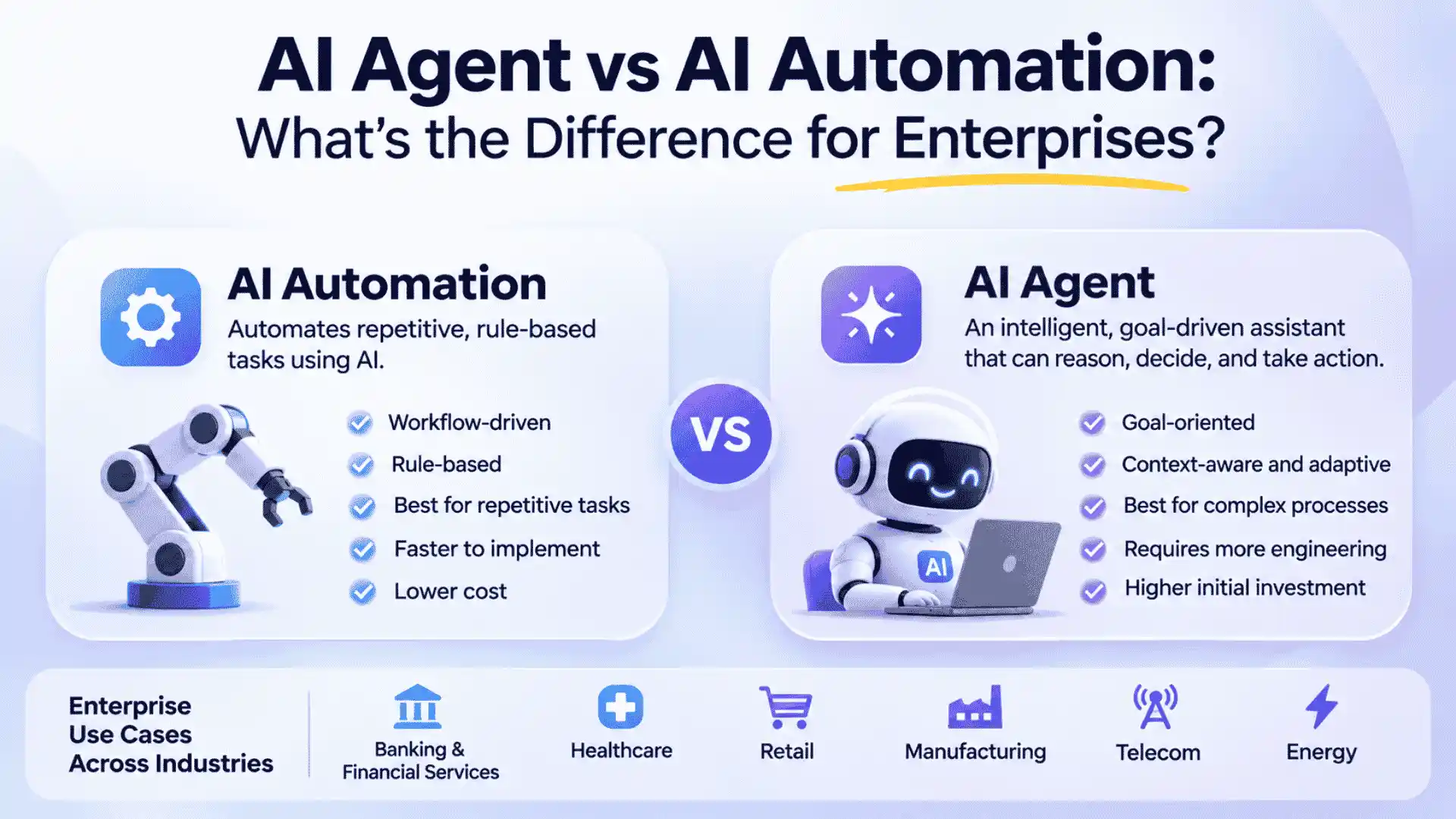
Many enterprises use the terms AI Agent and AI Automation interchangeably, but they solve different business problems. AI Automation follows predefined workflows to automate repetitive tasks, while AI Agents can understand context, make decisions, and execute multi-step actions. Choosing the right approach depends on your business goals, complexity, and operational requirements.
What is AI Automation?
AI Automation uses artificial intelligence to automate repetitive, rule-based business processes.
Instead of requiring employees to perform the same tasks repeatedly, AI handles them automatically using predefined workflows.
Typical examples include:
- Invoice processing
- Employee onboarding
- Email routing
- Document classification
- Customer support ticket routing
- Data extraction
- Report generation
Businesses invest in AI Automation Services to reduce manual work, improve efficiency, and lower operating costs.
What is an AI Agent?
An AI Agent goes beyond automation.
Instead of simply following rules, an AI agent can understand goals, retrieve information, reason through problems, and complete multiple actions to achieve an objective.
For example, an AI customer service agent can:
- Understand customer questions
- Search internal knowledge bases
- Retrieve CRM information
- Create support tickets
- Recommend solutions
- Escalate complex issues
- Learn from previous interactions
AI agents act more like intelligent digital employees than workflow automation tools.
What is the main difference between AI Agents and AI Automation?
Although both improve business efficiency, they work differently.
| AI Automation | AI Agents |
|---|---|
| Follows predefined workflows | Makes decisions within defined rules |
| Best for repetitive tasks | Best for complex business processes |
| Limited adaptability | Context-aware and adaptive |
| Rule-based execution | Goal-oriented execution |
| Predictable outputs | Dynamic responses |
| Easier to implement | Requires more engineering |
| Lower implementation cost | Higher initial investment |
For many organizations, AI Automation is the first step, while AI Agents are introduced as business needs become more advanced.
When should enterprises choose AI Automation?
AI Automation is ideal when processes are repetitive and predictable.
Common use cases include:
- HR onboarding
- Invoice approvals
- Payroll processing
- Document management
- Customer ticket routing
- Compliance reporting
- Workflow automation
These projects usually deliver faster implementation and measurable ROI.
Businesses often begin their AI journey with AI Automation Services before expanding into more intelligent AI solutions.
When should enterprises use AI Agents?
AI Agents are a better choice when work requires reasoning, multiple systems, and decision support.
Examples include:
- Enterprise knowledge assistants
- Customer service agents
- IT help desk assistants
- Financial advisory assistants
- Healthcare support agents
- Sales assistants
- Multi-step workflow execution
These projects typically combine LLM Development, enterprise integrations, and secure business workflows.
Which industries benefit the most from AI Agents?
Almost every industry can benefit from AI, but the right solution depends on the business challenge.
Here are some common enterprise use cases:
| Industry | AI Automation | AI Agents |
|---|---|---|
| Banking & Financial Services | Loan processing, KYC verification | Customer servicing, financial assistants |
| Healthcare | Appointment scheduling, claims processing | Clinical support, patient assistants |
| Retail | Inventory updates, order processing | Personalized shopping assistants |
| Manufacturing | Quality inspections, production reports | Predictive maintenance assistants |
| Telecom | Ticket routing, release workflows | Network support assistants |
| Energy | Compliance reporting | Asset monitoring assistants |
Explore industry-specific solutions:
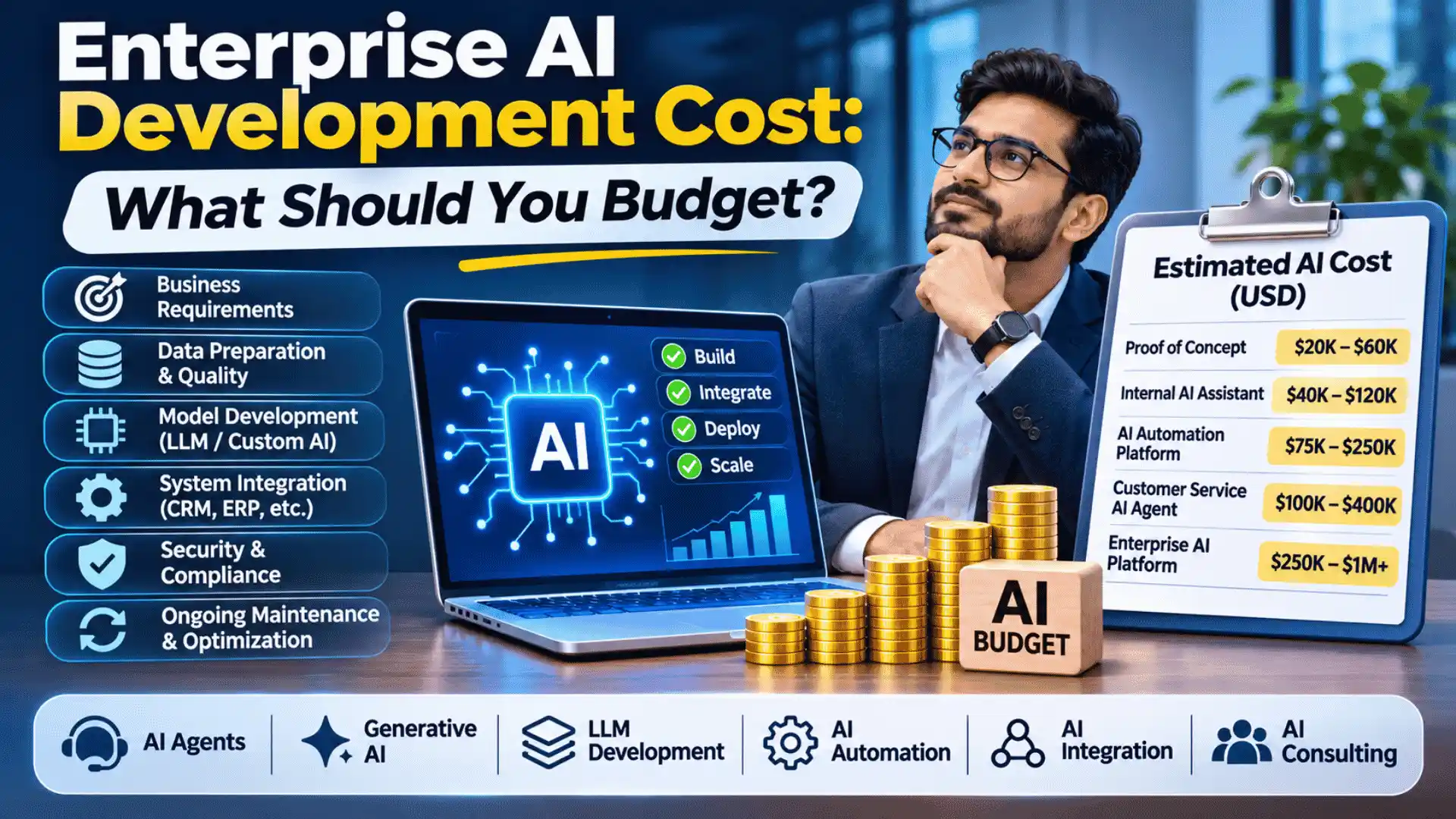
Which costs more: AI Automation or AI Agents?
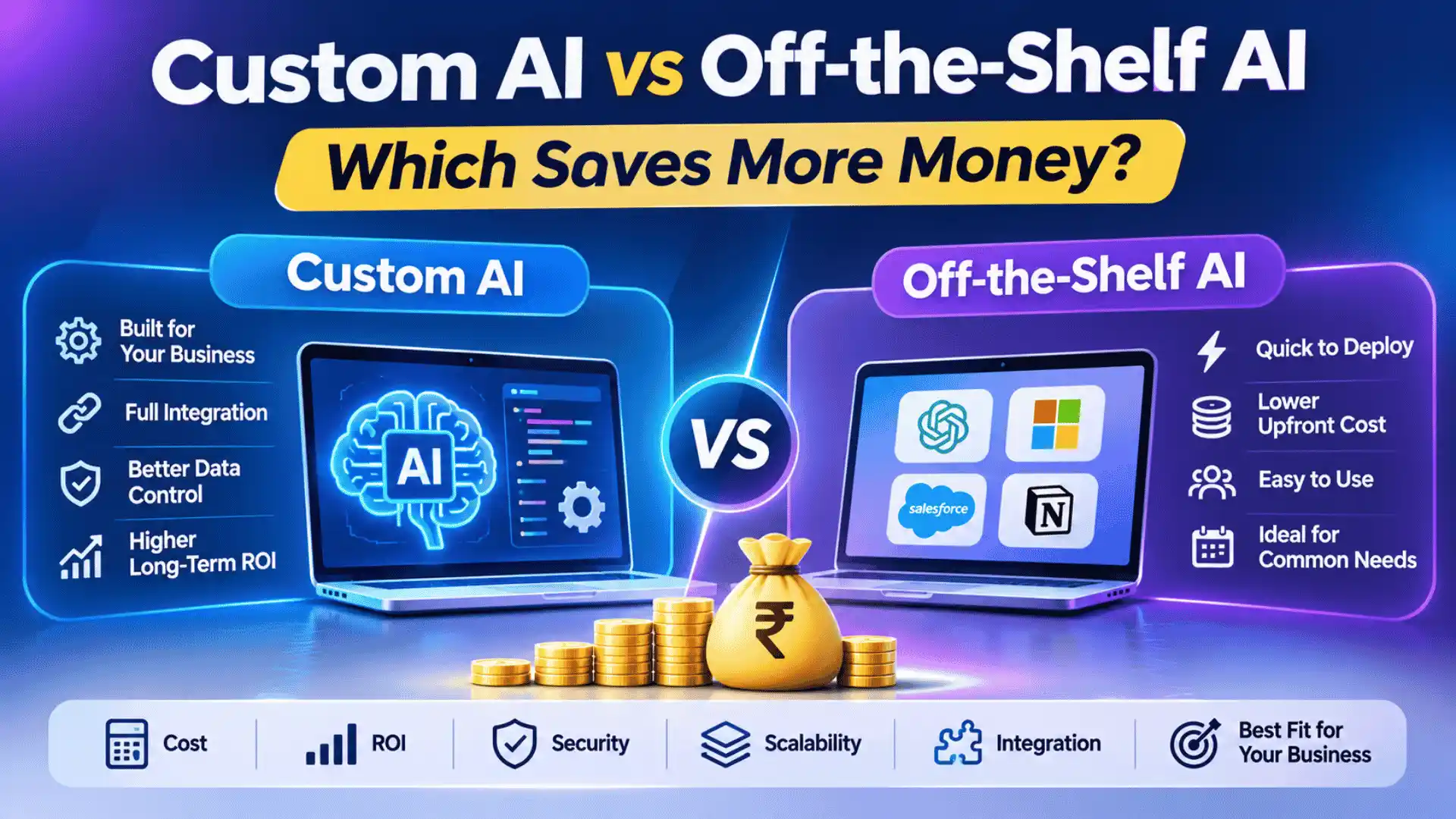
AI Automation projects generally cost less because they automate predefined workflows.
AI Agent projects require additional engineering for:
- LLM integration
- Business logic
- Enterprise APIs
- Knowledge retrieval
- Security
- Monitoring
- Human approval workflows
Although AI Agents require a higher initial investment, they often deliver greater long-term business value for complex operations.
Which solution is easier to implement?
AI Automation projects are usually completed faster because business rules are clearly defined.
AI Agents require:
- Clean enterprise data
- Prompt engineering
- Secure integrations
- Context management
- Governance
- Continuous monitoring
Working with experienced AI Consulting Services helps reduce implementation risks.
Can AI Automation and AI Agents work together?
Yes.
Many enterprises combine both solutions.
For example:
- AI Automation receives a customer request.
- An AI Agent understands the request.
- The AI Agent retrieves information from enterprise systems.
- AI Automation updates CRM records and triggers workflows.
- A human reviews critical decisions when necessary.
This hybrid approach improves efficiency while maintaining business control.
Real enterprise example
A global financial institution wanted to improve customer support.
Instead of building only automated workflows, they implemented intelligent AI agents capable of retrieving enterprise knowledge, assisting service teams, and handling complex customer interactions.
Read how TeamBees delivered this solution:
Global Bank AI Servicing Agents
https://teambeescorp.com/case-studies/global-bank-ai-servicing-agents
This project demonstrates how combining AI Agents with enterprise integrations creates significantly more value than workflow automation alone.
What are the biggest implementation mistakes?
Many organizations struggle because they:
- Choose technology before defining business goals.
- Expect AI to replace every employee.
- Ignore data quality.
- Skip system integration planning.
- Underestimate security requirements.
- Don't measure business outcomes.
- Deploy without ongoing monitoring.
Successful AI projects begin with a business problem, not an AI tool.
Which solution delivers better ROI?
The answer depends on the problem you're trying to solve.
If your goal is to eliminate repetitive work, AI Automation usually delivers a faster return because it is quicker to implement and focuses on improving operational efficiency.
If your goal is to improve customer experience, support decision-making, or automate complex business processes, AI Agents often provide greater long-term ROI.
Instead of asking which technology is better, enterprises should ask:
- What business problem are we solving?
- How complex is the workflow?
- Do employees need AI recommendations?
- Will AI interact with multiple business systems?
- What level of automation is required?
Choosing the right solution starts with understanding your business objectives.
How can enterprises prepare before implementing AI?
Successful AI projects begin long before development starts.
Before choosing AI Agents or AI Automation, organizations should evaluate:
- Current business processes
- Data quality
- Existing enterprise systems
- Security requirements
- Compliance needs
- Success metrics
- Employee adoption
Planning these areas early helps reduce project risks and improves implementation success.
How TeamBees helps enterprises build AI solutions
Whether your organization needs workflow automation or intelligent AI agents, TeamBees helps design, develop, and integrate AI solutions that align with your business goals.
Our enterprise AI capabilities include:
- AI Development Services
- AI Agents
- AI Automation Services
- LLM Development
- Generative AI
- AI Consulting
- AI Integration
We also help enterprises scale delivery through:
- Staff Augmentation
- Hire Dedicated Developers
- Dedicated Development Teams
- Offshore Development Center
Frequently Asked Questions
Can AI Automation become an AI Agent?
Not automatically.
AI Automation follows predefined rules, while AI Agents can reason, understand context, and make decisions within defined boundaries. An automation workflow can be enhanced with AI capabilities, but it does not become an AI Agent without additional intelligence and engineering.
Which is easier to maintain?
AI Automation is generally easier because workflows are rule-based and predictable.
AI Agents require ongoing monitoring, prompt improvements, knowledge updates, and model optimization to maintain performance.
Can small businesses use AI Agents?
Yes, but not every business needs one.
For many organizations, AI Automation is a practical starting point. As business processes become more complex, AI Agents can be introduced to support decision-making and multi-step workflows.
Should enterprises replace AI Automation with AI Agents?
Not necessarily.
The most successful enterprises combine both technologies. AI Automation handles repetitive workflows, while AI Agents manage tasks that require reasoning, context, and interaction with multiple systems.
Final thoughts
AI Agents and AI Automation are not competing technologies. They solve different business problems and often work best together.
If your goal is to automate repetitive tasks quickly, AI Automation is usually the right choice. If your organization needs intelligent decision support, enterprise knowledge retrieval, or complex workflow execution, AI Agents provide greater long-term value.
The best enterprise strategy is to automate routine work first, then introduce AI Agents where intelligence and business context create the greatest impact.
Don't choose AI because it's popular. Choose the solution that solves your business problem and delivers measurable ROI.
Related customer success stories
See how TeamBees helps enterprises implement AI and modernize operations:
-
Global Bank AI Servicing Agents
https://teambeescorp.com/case-studies/global-bank-ai-servicing-agents -
Retailer Demand Generation Engine
https://teambeescorp.com/case-studies/retailer-demand-generation-engine -
Telecom Release Assurance Automation
https://teambeescorp.com/case-studies/telecom-release-assurance-automation -
HRMS AI Workforce Platform
https://teambeescorp.com/case-studies/hrms-ai-workforce-platform -
DIVO Multi-Agent Finance CRM
https://teambeescorp.com/case-studies/divo-multi-agent-finance-crm
Explore industry solutions
Related articles
-
Why Most AI Agent Projects Fail: The Engineering Challenges Businesses Overlook
-
How to Reduce Software Development Costs Without Hiring More Developers
Which industries should choose AI Automation first?
If your organization spends significant time on repetitive, rule-based work, AI Automation is often the fastest starting point.
Industries that commonly see quick wins include:
Banking & Financial Services
- KYC verification
- Loan processing
- Compliance reporting
- Customer onboarding
Explore: https://teambeescorp.com/industries/banking-financial-services
Healthcare & Life Sciences
- Patient registration
- Claims processing
- Appointment scheduling
- Medical document management
Explore: https://teambeescorp.com/industries/healthcare
Retail
- Inventory updates
- Order processing
- Product catalog management
- Customer notifications
Explore: https://teambeescorp.com/industries/retail
Telecom
- Service request routing
- Release management
- Incident workflows
- Customer support operations
Explore: https://teambeescorp.com/industries/telecom
Manufacturing
- Production reporting
- Quality inspection workflows
- Asset documentation
- Compliance management
Explore: https://teambeescorp.com/industries/manufacturing
Which industries gain the most value from AI Agents?
AI Agents create the greatest impact when employees spend time making decisions, searching information, or managing complex workflows.
Examples include:
- Banking relationship assistants
- Healthcare clinical assistants
- Telecom support agents
- Manufacturing maintenance assistants
- HR support agents
- Enterprise knowledge assistants
- Financial operations assistants
The more knowledge-intensive the work, the greater the potential value of AI Agents.
Related customer success stories
Here are examples of how TeamBees helps enterprises solve real business challenges.
Banking & Financial Services
Global Bank AI Servicing Agents
https://teambeescorp.com/case-studies/global-bank-ai-servicing-agents
Implemented enterprise AI servicing agents to improve customer support and operational efficiency.
Insurer Core Platform Replatform
https://teambeescorp.com/case-studies/insurer-core-platform-replatform
Modernized a core insurance platform to improve scalability and future growth.
Retail
Retailer Demand Generation Engine
https://teambeescorp.com/case-studies/retailer-demand-generation-engine
Built an AI-powered demand generation solution to improve customer engagement and business growth.
Telecom
Telecom Release Assurance Automation
https://teambeescorp.com/case-studies/telecom-release-assurance-automation
Automated release assurance processes to reduce deployment risks and improve software quality.
Manufacturing
ServiceNow Manufacturing CMDB & CSDM
https://teambeescorp.com/case-studies/servicenow-manufacturing-cmdb-csdm
Improved IT service management and infrastructure visibility using ServiceNow.
Energy
Utility ETRM Modernisation
https://teambeescorp.com/case-studies/utility-etrm-modernisation
Modernized enterprise energy trading and risk management systems.
HR & Enterprise Operations
HRMS AI Workforce Platform
https://teambeescorp.com/case-studies/hrms-ai-workforce-platform
Built an AI-powered workforce platform to improve employee experience and HR operations.
AI & CRM
DIVO Multi-Agent Finance CRM
https://teambeescorp.com/case-studies/divo-multi-agent-finance-crm
Developed intelligent multi-agent workflows for finance and CRM operations.
How TeamBees can help
Whether your organization is beginning its AI journey or scaling enterprise-wide adoption, TeamBees helps businesses choose the right solution based on their goals.
Our capabilities include:
- AI Strategy & Consulting
- AI Agent Development
- AI Automation
- Generative AI
- LLM Development
- AI Integration
- Enterprise Software Development
- Staff Augmentation
- Dedicated Development Teams
- Offshore Development Centers
We work with organizations across Banking, Healthcare, Telecom, Retail, Manufacturing, Energy, Oil & Gas, Education, Aerospace & Defence, and Consumer Appliances to build scalable AI and software solutions.
Final thoughts
AI Automation and AI Agents are complementary technologies, not competing ones.
If your objective is to eliminate repetitive work, AI Automation delivers quick wins with predictable outcomes.
If your organization needs intelligent decision-making, enterprise knowledge retrieval, or multi-step workflow execution, AI Agents provide significantly greater business value.
The most successful enterprises don't ask whether they need AI Automation or AI Agents. They identify the business problem first, implement the right solution, measure results, and then expand strategically.
Start by automating repetitive tasks. Introduce AI Agents where intelligence, context, and decision-making create measurable business value.